
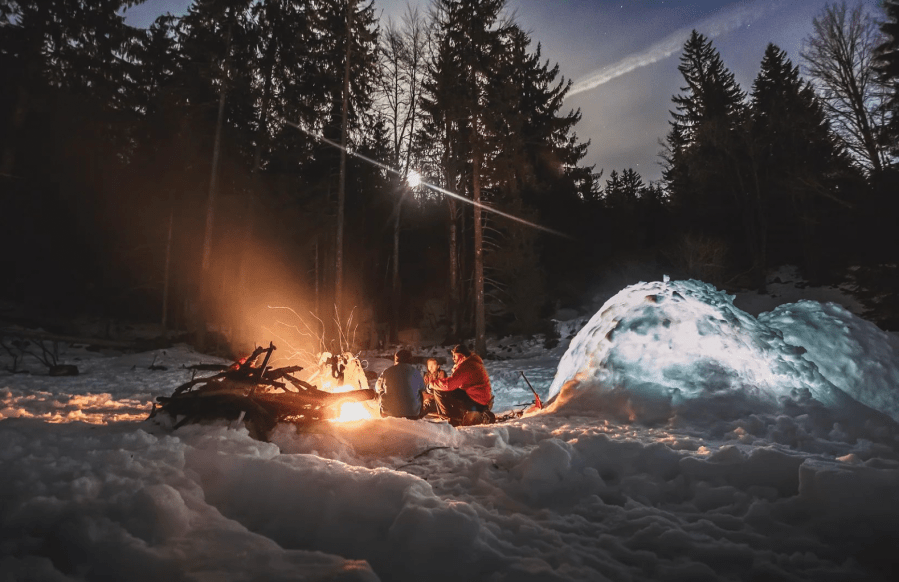
It was almost dark when we finished the igloo. I’d spent over an hour hollowing out the inside of the snow dome we’d built and hadn’t noticed the light fading. Underground, thick piles of snow between me and the sky, I felt like an Arctic ground squirrel. We’d prepared like bears going into hibernation: a mountain of risotto the night before to rival the peaks of Swiss Jura around us, a stack of viennoiseries (pastries) that morning.
For the next two days we were to be survivors, living solely off what we managed to forage or hunt, and our only protection from the elements would be whatever we built ourselves. The frozen tundra around us hardly looked like it was going to be a cornucopia of edible plants and trappable animals, so I was glad of our hibernation preparation.
There were nine of us including the guide. My partner Val, who’d generally prefer a king-sized bed to a night spent in the dirt, had nobly given me an ‘extreme cold survival course’ for Christmas, and signed himself up too. The six other men, all as yet strangers to each other, ranged in age from early 20s to mid 50s. Our guide Xavier could have fallen anywhere in this age range. His skin was weathered from constant exposure to the elements, and his clothes peppered with what looked like cigarette burns, although we’d find out their real origins later.
I’d had a feeling that men would outnumber women — even on hikes I still generally cross more men — but I hadn’t anticipated being the only woman. Interviewing other organisers of survival courses retrospectively, I found that this isn’t unusual. Only 25% of participants at courses run by Survival School in Devon are female. Randall’s Adventure in Alabama tried to launch an all-women survival course… but no-one turned up.
“We usually have one female participant in eight, or as little as one in ten,” said Dan Wowack, organiser of Coalcracker Bushcraft in Pennsylvania. “So we started women’s only courses. Overall, women do better in our courses. I can’t say for sure why – but I assume because they follow our instructions better, whereas the men generally assume they know a better way and do what they think rather than what’s being taught at the course.”
Back to basics
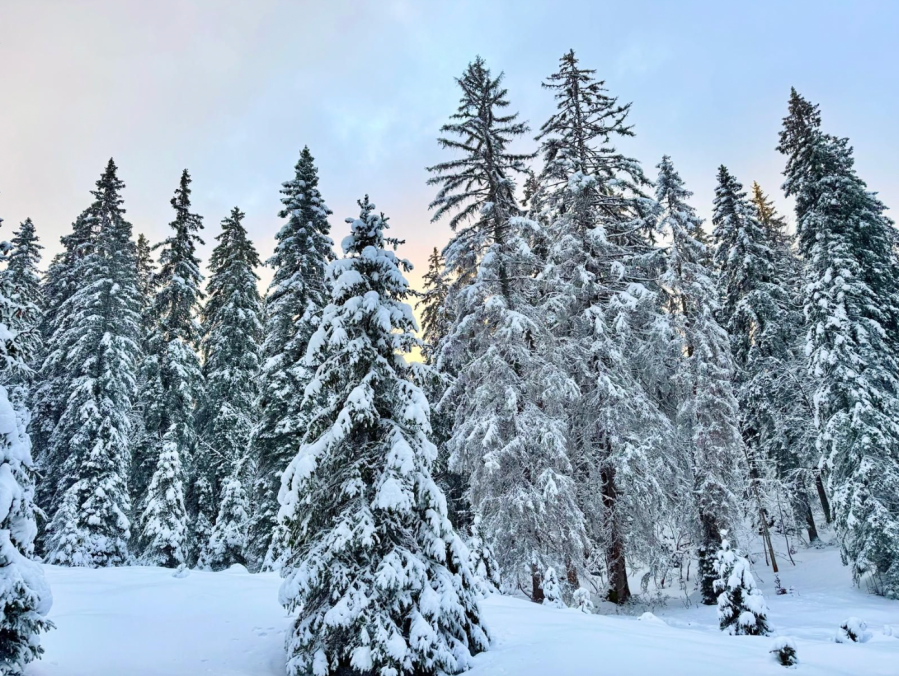
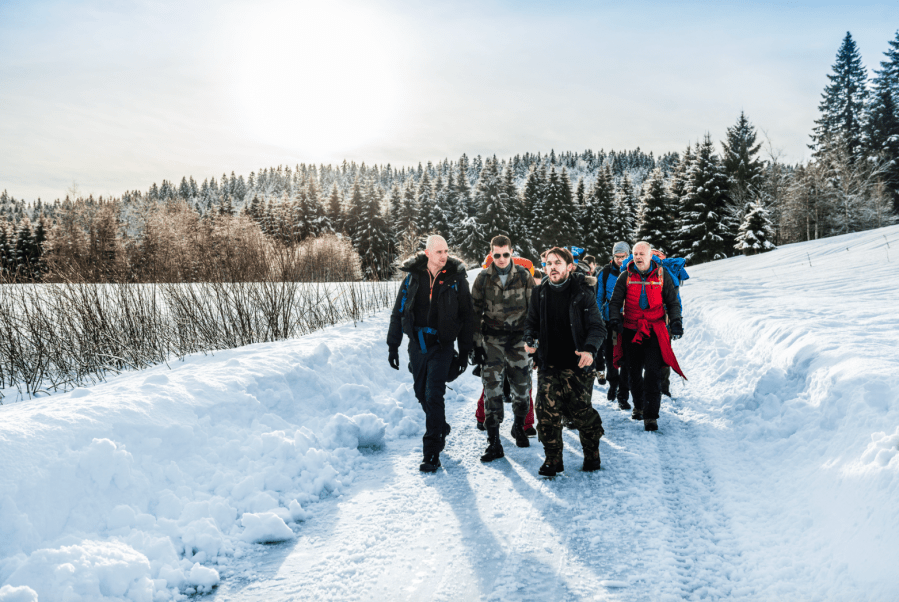
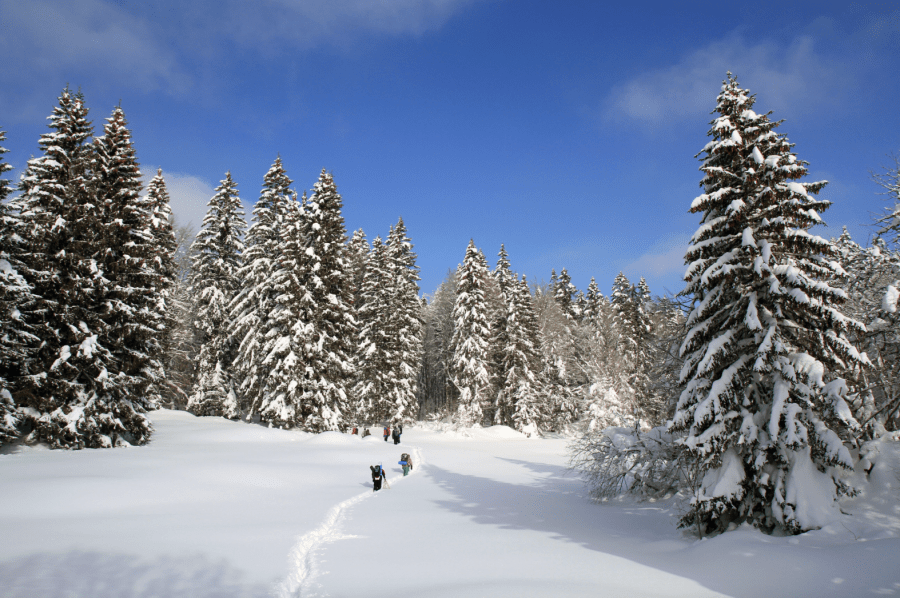
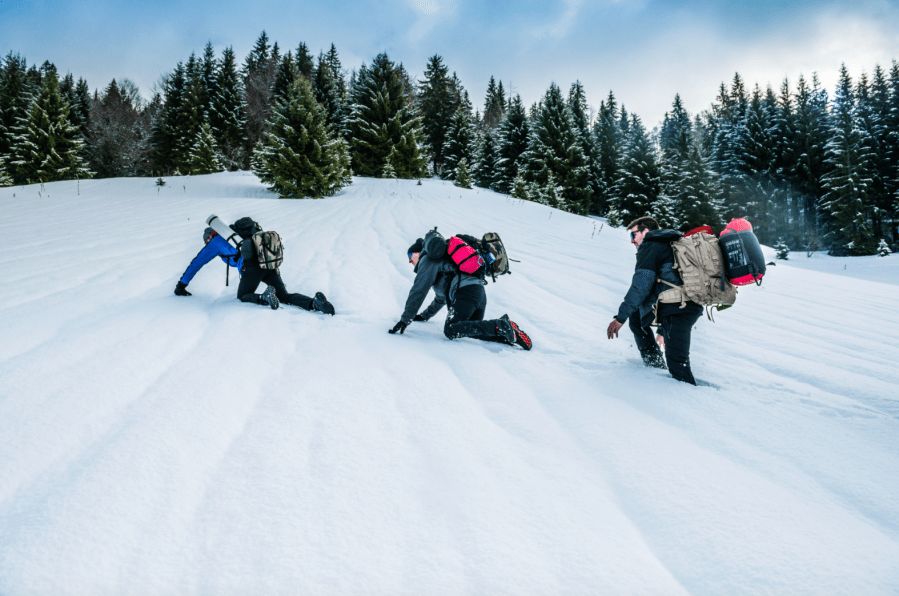
Fortunately, my group didn’t seem to be made up of mansplainers. We traipsed into the woods through thick snow. I usually notch up kilometres on a hike, or at least elevation gain, but this time we were trying to do the opposite. With food scarce, there was no reason to burn unnecessary calories ; and we had igloos to build that afternoon.
In the middle of a snowy forest, landmarks are few and far between. Phones or other GPS devices were strictly banned, and the landscape was so deeply buried in snow that it was difficult to make out stone walls, let alone footpaths. We studied our little print-out maps in plastic wallets, the contour lines the most reliable source of information in the absence of visibility.
I felt slightly pathetic: had I been born 50 years earlier I’d likely have had no trouble with a paper map, something I’d barely used since my school’s Duke of Edinburgh programmes. I always keep a physical map and a compass in my backpack on multi-day adventures in case of emergencies, but it never gets used, and in the snow it was triply difficult. I cursed my generation, spoilt by GPS and trail markers. Although, if I’d been born 50 years earlier, would women have been on survival courses at all?
One thing took precedence above all else: fire. If we were to survive a night in the snow, stay warm, melt snow for drinking water and cook a meal (I thought hopefully, my stomach already rumbling a few hours in), we were going to need a decent campfire. Since we were in the middle of a forest, there was wood all around us ; but we needed to find the dry stuff, dead wood. Naturally, lighters and matches were also banned.
But nature has solutions. We scraped off dry, amber sap from wounded trees, storing it in tissues or whatever other receptacles we had to hand, to make firelighters. We filled pockets (or in my case, poo bags, a dog owner’s staple) with the cardboard-like insides of dead tree trunks, which would catch fire quickly.
We even enthusiastically sniffed patches of fox piss. There was no survival reason for it, just some extra knowledge, and a way of reinforcing why you should never eat yellow snow.
Magic mushrooms
We arrived at camp shortly after lunchtime – or what would have been lunchtime in the outside world. We’d eaten nothing. Our camp spot was a little clearing in the forest, with plenty of snow for building igloos. We chopped wood for the campfire. Then we put little wooden benches around the circular fire pit we’d shovelled free of snow, and Xavier began our firelighting lesson.
He went through two methods, one with a firestick and one with no equipment at all. The fire steel had a considerable advantage. Provided you always have one in your bag, it doesn’t matter how soaked your belongings get: it will still work if used the right way. The other method was the sort of thing you imagine from films – rubbing two sticks together.
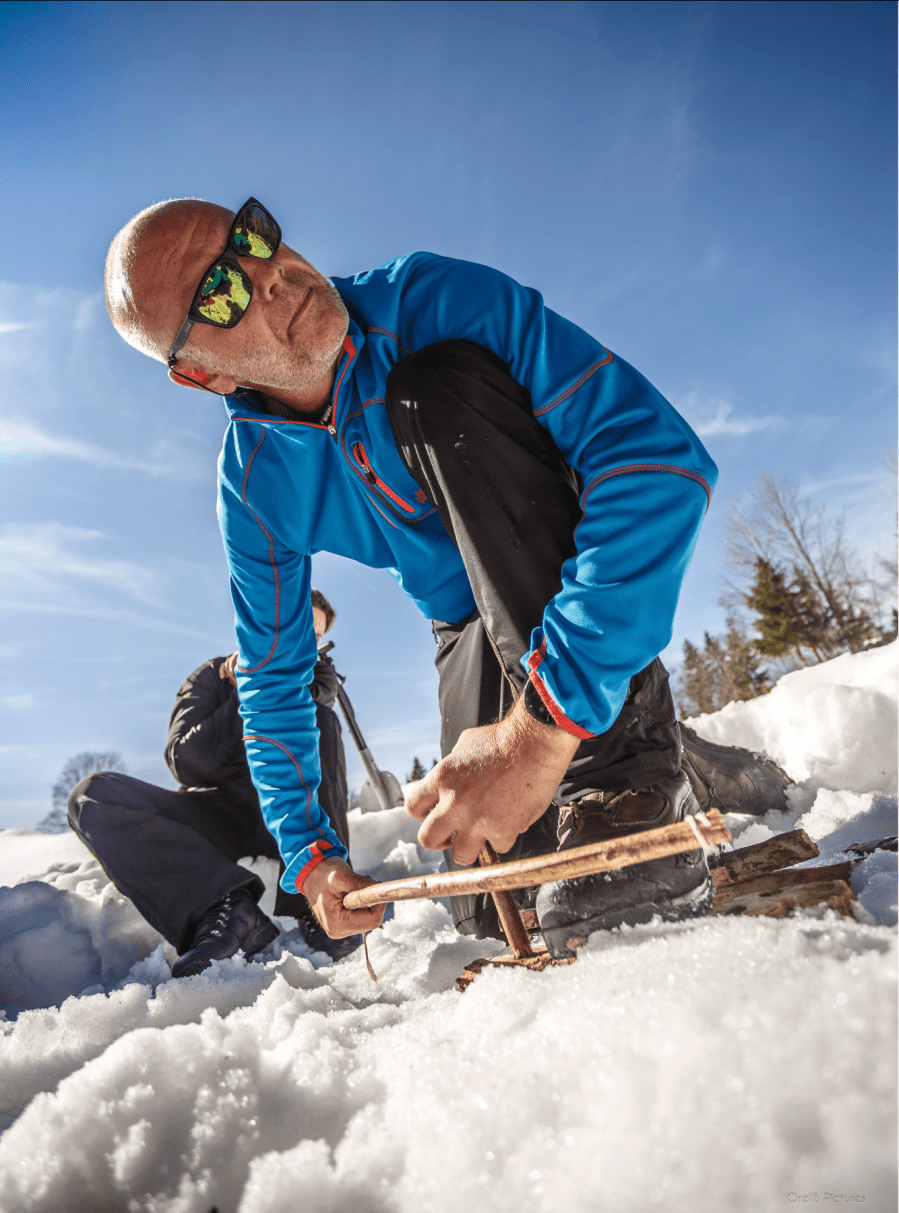
Using a bow fashioned from wood to create friction, Xavier spun a stick sharpened to a point in a different block of wood with a hole in it. It was considerably more laborious, even for the professional.
Xavier also had a magic mushroom, one much more useful to survivors than the hallucinogenic kind. Hoof fungus, otherwise known as tinder fungus, will burn slowly for hours once lit. It means you can easily relight your fire if it goes out, or walk miles to share your fire with the next camp, which is likely what Neanderthals did.
Xavier made a nest from bracken, popping fragments of cardboard wood and our tree sap firelighters in the middle, and shaved some ferrocerium from the fire steel. Next he began to shower sparks from the firestick into the nest. It wasn’t long before it caught and was transferred to the pile of wood we’d prepared. The following day, we’d need to build our own fires using only what we could forage.
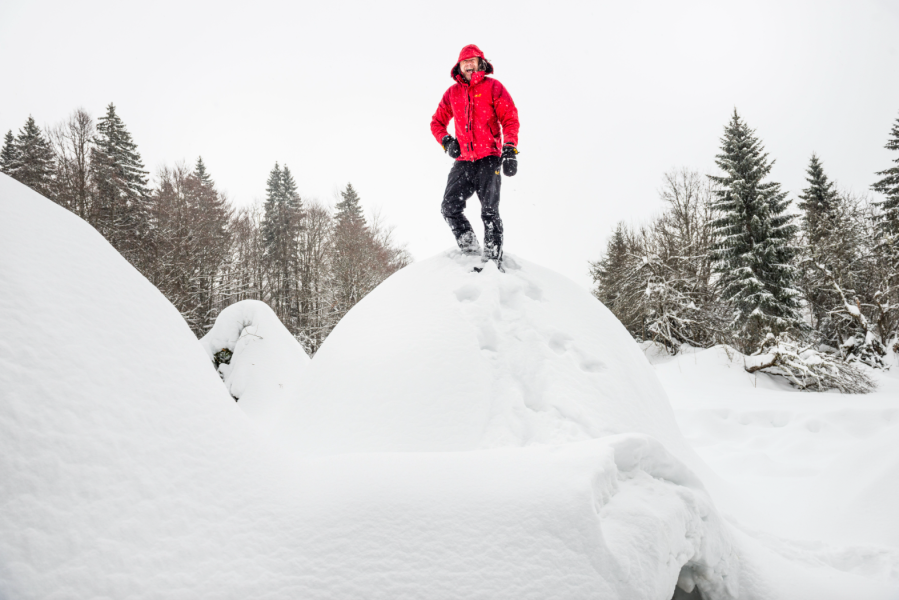
With the fire blazing, the igloo construction could commence. We went with the dome system rather than hewing blocks of ice. It felt far less technical — all we needed to do was build an enormous, compact dome of snow and hollow it out.
It may not have been the wisest survival move, but upon learning that there were several snorers in the group (something that would be amplified by the curved ice walls of an igloo), Val and I opted to build our own igloo cottage for two. The others embarked on a much larger igloo mansion. We shovelled and dug and packed snow for over three hours as the igloo mansion team did likewise next to us.
I could have murdered a hearty meal at the end of it – raclette or fondue or any other alpine classic – but since we’d foraged nothing and laid no traps, we boiled snow with pine needles to satiate our hunger.
‘Bite et couteau’
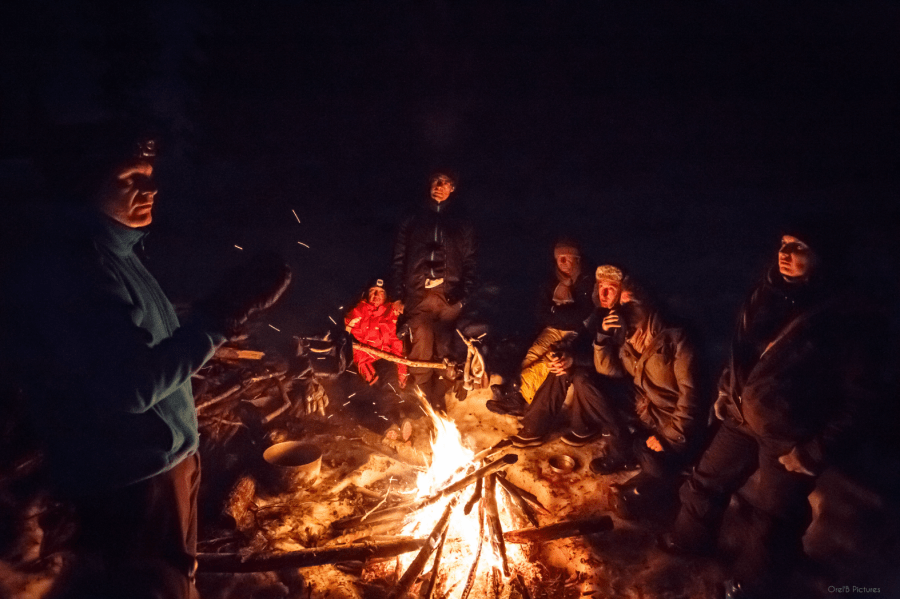
We sat around the campfire with steaming bowls of pine needle water. I was surprised by how effectively it alleviated my hunger pangs. The eldest in the group told us that this was child’s play ; he had once spent four days with virtually no food, save for a rabbit shared between a dozen people. It had been during the ‘bite et couteau’ (dick and knife) challenge.
I wondered if I’d misheard — as well as being the only woman in the group, I was the only person who wasn’t French. But no, ‘Bite et couteau’ is a particularly extreme survival course set up by Denis Tribaudeau, the same person behind the survival course we were currently on. It’s exactly what it says on the tin. Participants head off into the wild for several days at a time to survive, equipped with only a knife and the clothes on your back. Oh, and your dick… or vagina.
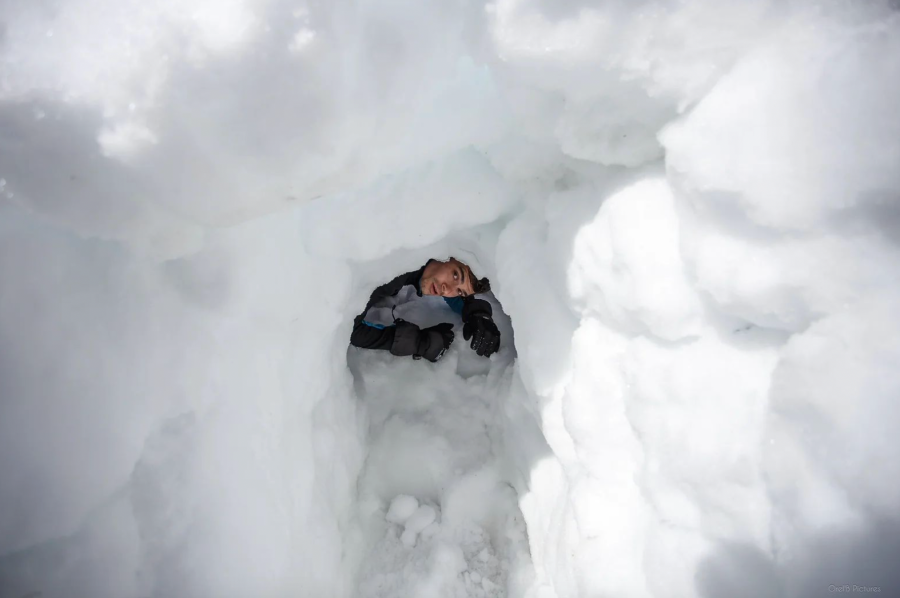
Our night in the igloo was novel, rather than comfortable. Even with a sleeping bag supposed to go down to sub-10° for comfort, I tossed and turned most of the night, glueing myself to Val to stay as warm as possible. Breakfast was more pine needle tea, followed by another orienteering walk to an unmanned mountain chalet.
Here, the unsupervised challenge began. I began to feel we were on a survival programme, half expecting camera crews to pop out from behind the pine trees. In pairs, we had half an hour to forage all we needed to build a fire, followed by half an hour to light it and keep it burning. The reward was all anyone could desire after 30 hours in the cold with no food: a proper Swiss fondue.
Val started chopping the largest logs as I searched for sap. I was lucky: loggers had been through recently, wounding trees as they went, and I quickly had more than we needed. I took over wood chopping, splitting the smaller logs Val had prepared as he made thin wood shavings to catch the flames. We built our fire and nest of hay, sap firelighters and wood shavings inside it. Then Xavier threw in a curveball. No magic mushrooms (AKA tinder fungus) were allowed.
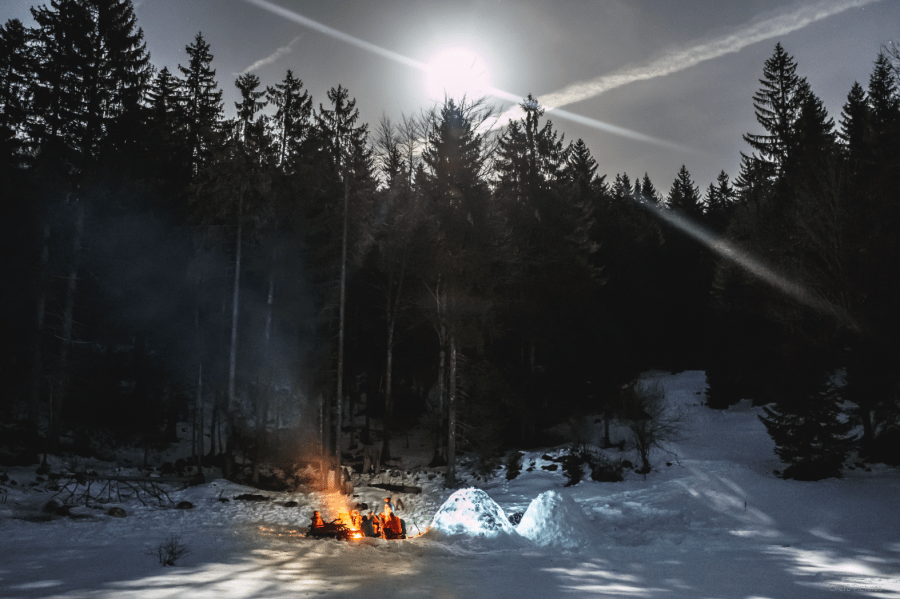
Val made sparks and I was the bellows. The sparks wouldn’t catch. A flame appeared and went out for what seemed like an age, although it can only have been 10 minutes. Keeping the fire lit and growing it enough to transfer it to the larger pile of wood unearthed a patience (or perhaps survival instinct) I didn’t know I had. And when my lungs felt as though they were full of smoke (although again it can’t have been more than 10 minutes), we transferred our fire nest to the woodpile and watched it burn. I couldn’t remember feeling prouder.
The fondue was the best I’d ever eaten, although whether that was a testament to its quality or simply my hunger levels I’ll never know. As we wiped the pot clean, Xavier had more lessons lined up for us. He begun by showing us how to filter water until it’s safe for drinking using just charcoal and a plastic bottle. Then he demonstrated how to make snares – although you’re not likely to catch much for days, as wild animals take time to get used to your smell before approaching. I was secretly rather relieved, as 30 hours of fasting might have made me break six years of a vegetarian diet !
With clothes and hair alike stinking, caked in the delicious smell of a fire we’d made from scratch ourselves, we headed back to civilisation. The final snowy orienteering walk felt much easier on a full stomach. It didn’t stop us heading straight to a cheese shop as soon as we were back in town, though, but isn’t that what all survivors would do?
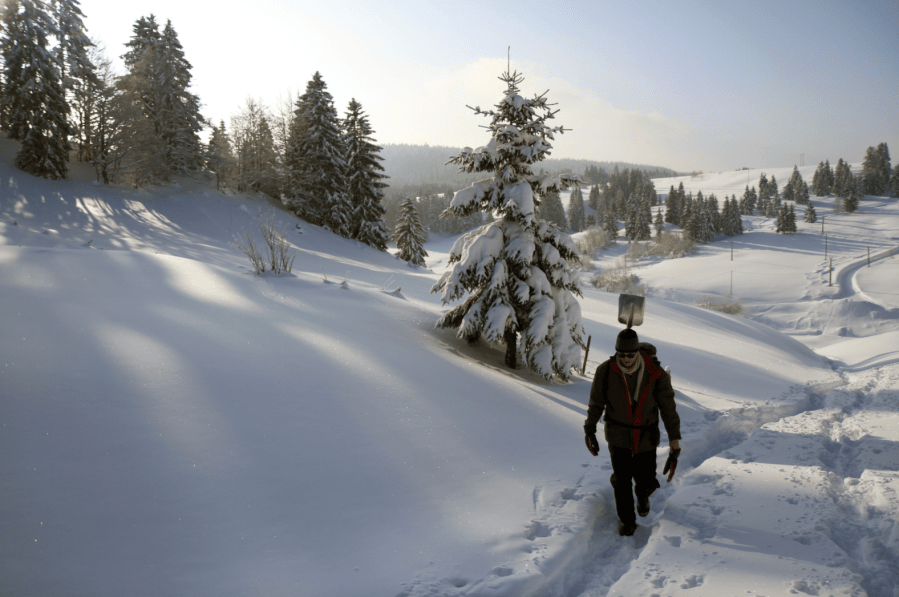
Learning survival skills in Swiss Jura
Stage de Survie Tribaudeau (stage-survie-tribaudeau.com) has survival courses lasting from two days to several weeks. It works with some 20 guides, many of whom speak English. The majority of survival courses take place in France, but the organisation also runs trips all over the world.
Anna took the ‘stage grand froid’ (extreme cold survival course) in Swiss Jura, which costs €276pp. The closest airport is Geneva. Mobile phones are allowed, but SIM cards are banned, as are all GPS devices. The price includes all activities and food during the two days, although food is limited to what you’re able to forage.