
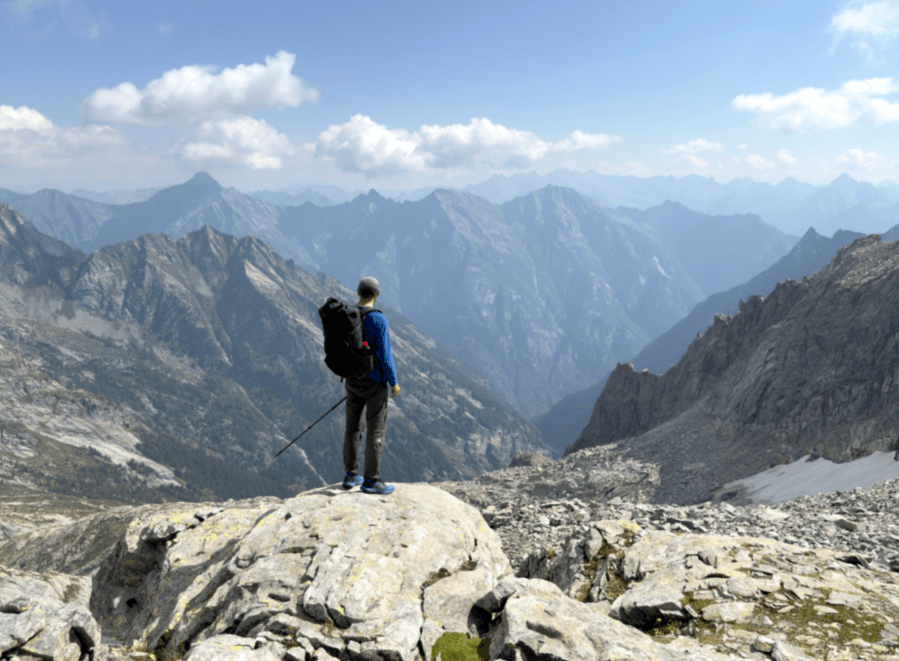
Our wild rivers serve us all differently. Everywhere we turn, H₂O is fluidly guiding us where to go next, how to ride that wave. So, this issue is an elemental ode to water, the element which has shaped the landscapes we love so much. And yet, water is a life-giving resource that we mostly take for granted. We only have access to 3% of our rivers in England and, under this cloak of private ownership, these blue places are being polluted. According to The Rivers Trust, in 2020, no river in England or Wales was classed as being in good overall health. Not one. Whether you dip or dive or paddle or float through it, we hope you enjoy this issue – and it serves as a cooldown for your brain and body.
Main image: Looking down into the Val Bavona | Credit: Rich Hartfield
Highlights of this wild rivers special issue:
- Tim Gent treads a landscape nourished and shaped by freshwater tributaries in Dartmoor
- Julia Clarke is your guide to summit-to-sauna walking routes in the Highlands
- Rich Hartfield solo backpacks from Lake Maggiore into the jagged terrain of the Valle Maggia
- Jim Perrin meanders through yesteryear along the River Wye with a colourful cast of characters
- Our experts map the way to their favourite watering holes on Britain’s finest swim-walks
- Brave readers share their hiking health horrors so we can all learn from their tales of woe
- Siân Anna Lewis invites you to blue spaces in the South West with local wild swimming spots
PLUS: Kenton Cool shares the story of his record-breaking Everest ascent; we escape to the Stour on the Dorset Heaths; Nadia Shaikh goes down to the wire to celebrate swallows; Juls Stodel helps one adventurous soul to find her outdoor family; get the latest news from the mountains; read our review of the new Right to Roam film; and check our calendar of walking events.
Get wild river adventures – and more – inside:
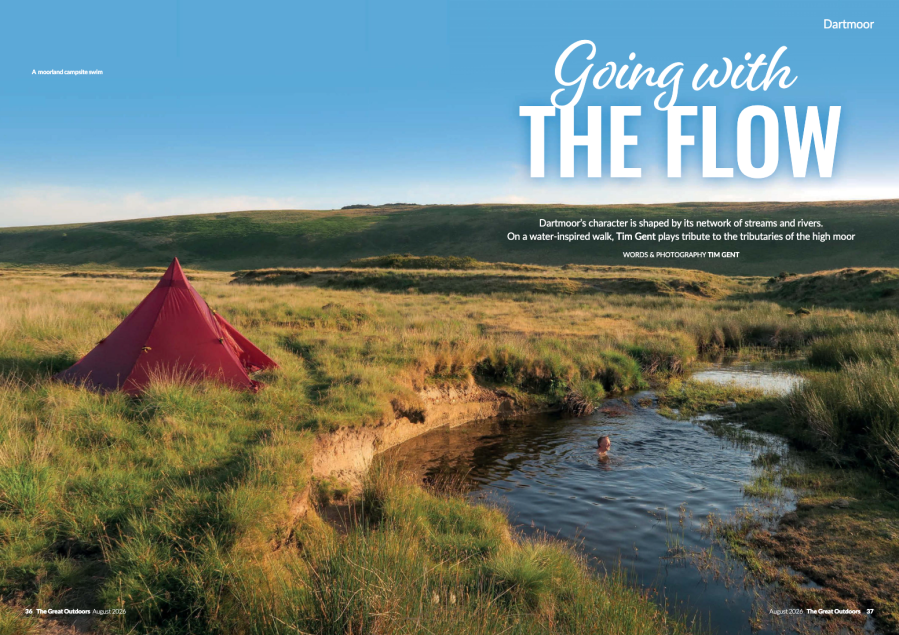
Going with the flow: Dartmoor’s character is shaped by its network of streams and rivers. On a water-inspired walk, Tim Gent plays tribute to the tributaries of the high moor.
Looming somewhat moodily over the centre of Devon, Dartmoor is hardly renowned for its generous disposition. Across this wild upland expanse, bare granite bones punctuate decidedly thin pickings. What trees that survive are windswept and stunted, confined in the main to the lower slopes. The same might be said of the moor’s cattle, sheep and famed upland ponies. There are rabbits, it’s true, some hares, a few ravens… but the emphasis here is on few. Especially in poor weather – and there’s no shortage of that – this can seem a hard and stinting landscape. Yet amidst this seemingly barren solidity, Dartmoor possesses a softer aspect; one that quite literally flows with riches. Of Devon’s twelve major rivers, all but two begin their life high on this central highland. Even the Exe, springing chiefly from its own moor, has a major tributary (the Creedy) that starts out on the edge of Dartmoor. Both the Torridge and Tamar possess sizeable branches, the Okement and Lydd, that begin up here too. Only the Rivers Axe and Otter have nothing to do with the moor. Mean it might seem in many ways; but Dartmoor is no miser when it comes to rivers, and a hillwalker can certainly benefit from all this freely offered watery wealth.
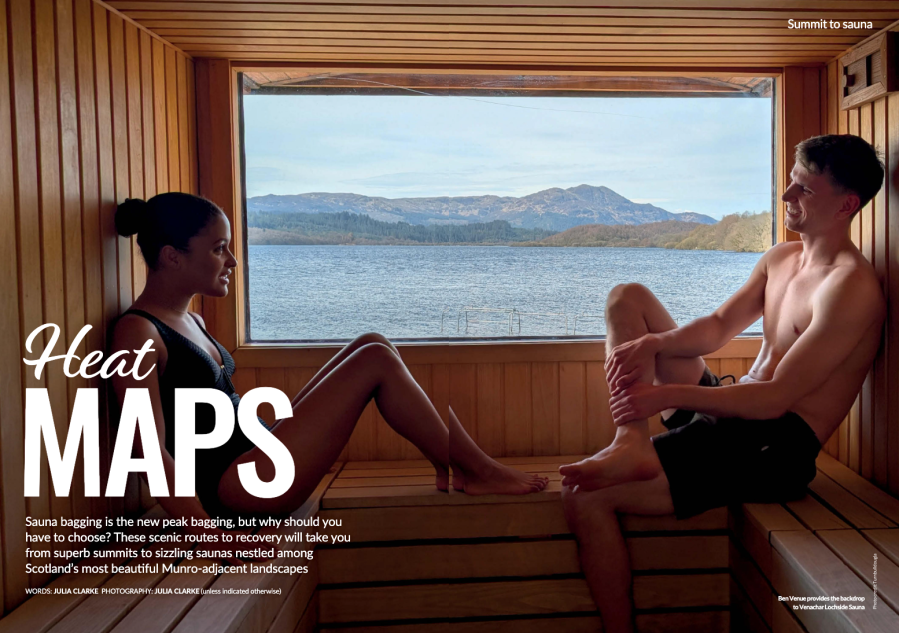
Heat maps: Sauna bagging is the new peak bagging, but why should you have to choose? These scenic routes to recovery will take you from superb summits to sizzling saunas nestled among Scotland’s most beautiful Munro-adjacent landscapes
Alpine life has always been shaped by extreme physical effort in the cold, using heat as a recovery tool. In Scotland, we’ve traditionally embraced the fire found in a hip flask rather than the smouldering coals of a sauna, but all that is starting to change. Picture yourself coming off the side of a Munro after being whipped by wind and pelted by rain for hours. Instead of relying on a change of socks and a mug of hot chocolate to restore you, you peel off your wet layers and enter a hot wooden box heated to 80°C. The scent of pine hits your nostrils as you pour a little water over the coals, sending up a burst of steam. Your achy muscles begin to relax, and before you know it, you’ve forgotten that two hours ago you swore off hiking for life. Think of the shelter of a Scottish bothy but without the drafts, questionable odours and discarded camping kit in the corner. Wild saunas in Scotland are an activity you can enjoy whatever the weather, and for that reason alone, they’re the best idea we’ve had in this country for decades. Our guide to the best Munro and sauna pairings takes you to some of Scotland’s most bucolic peaks, with lots of options to extend or curtail your walk. Afterwards, a “wee heat” – and an icy plunge – at the most scenic saunas we’ve visited will turn a good day out in the hills into a truly unforgettable experience.
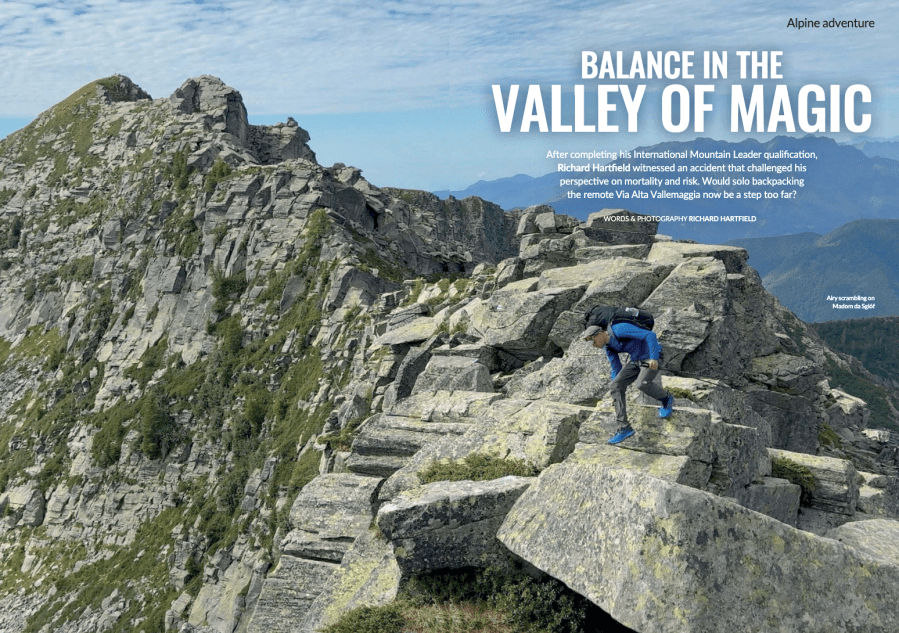
Balance in the Valley of Magic: After completing his International Mountain Leader qualification, Richard Hartfield witnessed an accident which challenged his perspective on mortality and risk. Would solo backpacking the remote Via Alta Vallemaggia now be a step too far?
High above the steep forests of the Valle Maggia, I arrived on Sasso Bello Pass just as the rising sun hit the surrounding cliffs. From the thin cleft in the jagged ridge above, I caught my breath and peered over the other side. A narrow descent gully fell away toward a boulder-strewn cirque perched above dense pine forest. This was the head of the Val Serenello – yet another remote side valley branching off of the Valle Maggia – that I needed to cross. Although meticulously way marked at every turn, the Via Alta Vallemaggia (VAV) often had no distinct trail at all. This high elevation, long-distance route was leading me across a challenging and lightly trodden region of the Alps. These unspoilt corners of the mountains are the places that I enjoy most. Moving through them makes me feel more alive and connected with nature than anywhere else. My curiosity had already led me on long-distance solo traverses of the Greater Caucasus Mountains and the Alps (both of which I’ve written about for this magazine) but this time things felt quite different. I’d recently spent 18 months working through my International Mountain Leader (IML) qualification. The morning after passing the final assessment in Switzerland, I was first on the scene of a serious car accident involving the instructors from my course. For now, I won’t underline the cognitive dissonance held within that experience. Certainly, I struggled with the aftershock. I hoped that this solo walk would be an opportunity to reflect, and to recalibrate my comfort zone in the mountains.
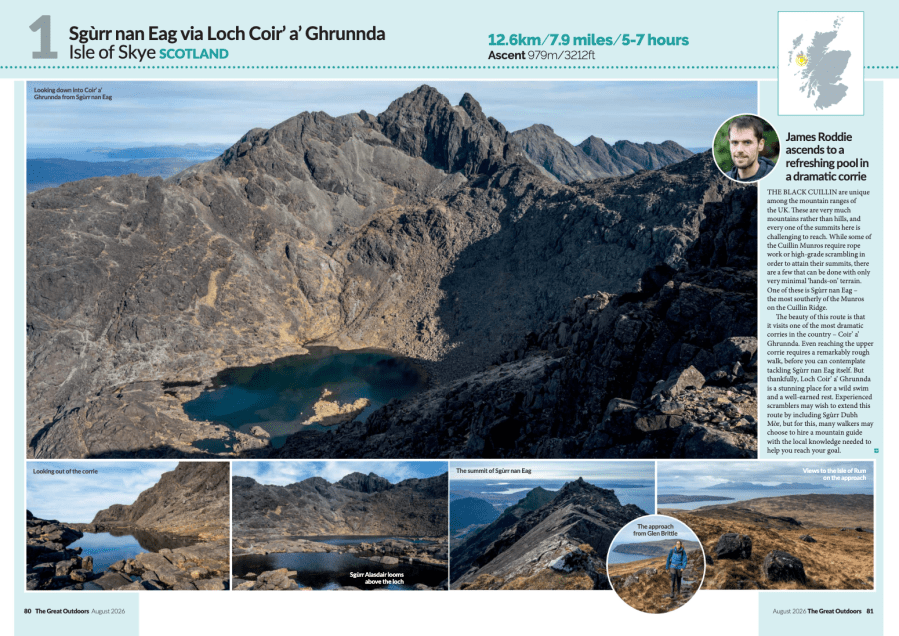
Wild Walks: Our experts guide you on mapped routes to their favourite spots for dunks, dips, and dives!
Hillwalkers have been cooling off in high waters since the dawn of our movement through the mountains – and long before we collectively started calling the practice ‘wild swimming’. Aside from the obvious benefits of soothing sweat-slicked skin, there are few perspectives on our hillscapes that can feel so humbling and refreshing as observing your surroundings from turquoise pools or deep, black bodies of water. Let your breathing slow and allow the land to tower around you on one of these awe-inspiring swim-walks.