
There’s something about ridges – the likes of Crib Goch, Striding Edge, Aonach Eagach, the Cuillin – that speaks to the hillwalking soul. They’re picturesque. They’re eye-catching. They’re a wake-up call for the adrenal glands. And when they aren’t scaring the pants off you, they can actually be quite relaxing. Not too much up and down, very little navigation… you just follow your nose, walking a tightrope line through the sky. It only takes a couple of minutes on Google to develop a general cynicism about ‘best ridge walk’ lists. So in this issue, we’ve put together a finely-curated selection of ridge-based walks that are… well, not best exactly, but big, quiet, gloriously sustained, and hopefully momentous enough to stick in your memory for a very long time.
That’s not to say, of course, that memorable walks always follow the most spectacular line. On a LEJOG meander between the bookshops of Britain, it was quiet nights and small encounters that brought joy to Ursula Martin. And when Carey Davies took on a long-distance Alpine trekking tour across Switzerland, France and Italy, he was wowed as much by the wildflowers as by the grand scenery. Elsewhere in this issue, you’ll find more fresh perspectives on mountain landscapes and culture together with practical ways to prepare for a summer in the hills.
Cover image: Jumping for joy on Ben Donich, Arrochar Alps | Credit: Dougie Cunningham / Leading Lines
Highlights include:
- Our pick of the best ridgewalks in Britain
- Ursula Martin enjoys a land of quiet surprises on a big LEJOG between bookshop
- The Alps in Technicolour: Carey Davies takes two high treks through alpine meadows
- Dive into the life and pictures of photographer of the ‘golden age of climbing’, John Cleare
- The mountains are not a substitute for therapy in all cases, argues Kate Armstrong
- Wild Walks: from the Cairngorms to Peak District, pros map family-friendly walks
- When lightning strikes: how to recognise the signs of summer storms and what to do
PLUS: Jim Perrin paints a portrait of Moel Hebog; our experts review the best trail runners and daypacks on the market; we escape to the Y Gribin ridge in Eryri; Nadia Shaikh sings about sweet Nightingales; Juls Stodel helps one outdoor gear shopaholic; get the latest news from the mountains; and check our calendar of walking events.
Read on:
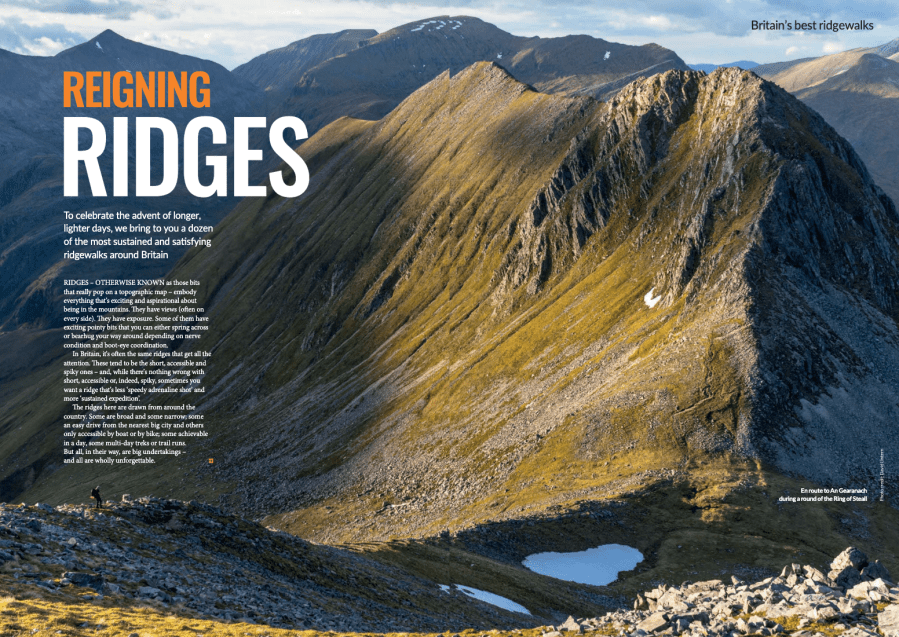
Reigning ridges: To celebrate the advent of longer, lighter days, we bring to you a dozen of the most sustained and satisfying ridge walks around Britain.
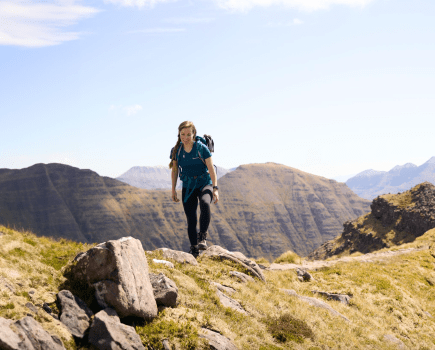
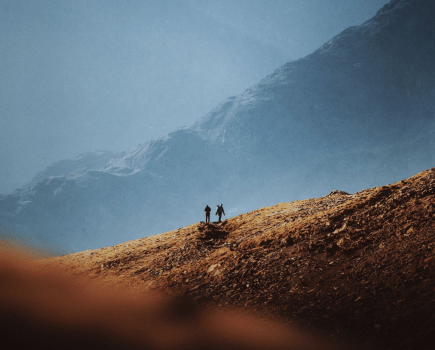
“Ridges – otherwise known as those bits that really pop on a topographic map – embody everything that’s exciting and aspirational about being in the mountains. They have views (often on every side). They have exposure. Some of them have exciting pointy bits that you can either spring across or bearhug your way around depending on nerve condition and boot-eye coordination. In Britain, it’s often the same ridges that get all the attention. These tend to be the short, accessible and spiky ones – and, while there’s nothing wrong with short, accessible or, indeed, spiky, sometimes you want a ridge that’s less ‘speedy adrenaline shot’ and more ‘sustained expedition’. The ridges here are drawn from around the country. Some are broad and some narrow; some an easy drive from the nearest big city and others only accessible by boat or by bike; some achievable in a day, some multi-day treks or trail runs. But all, in their way, big undertakings – and all wholly unforgettable…”
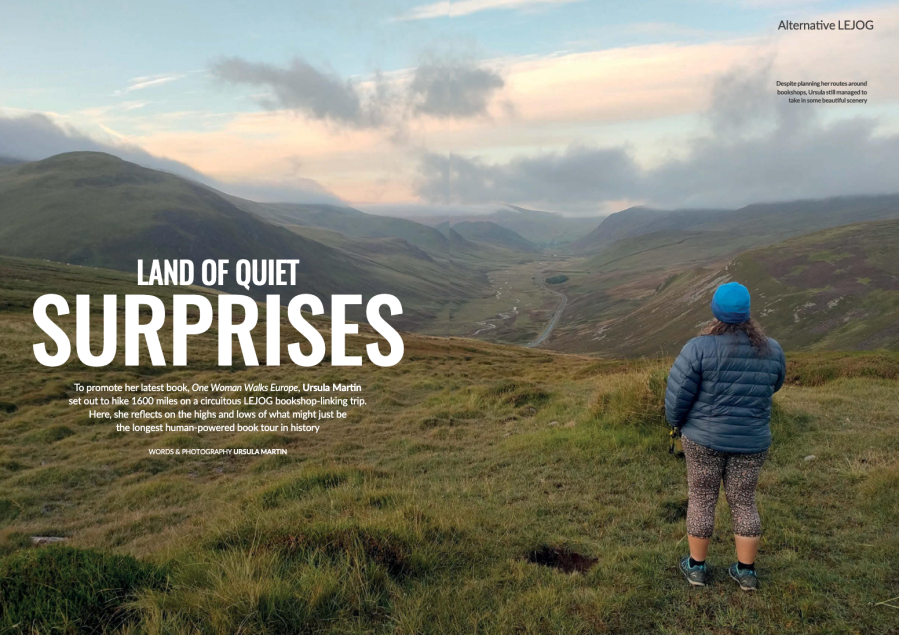
Land of quiet surprises: To promote her latest book, Ursula Martin set out to hike 1,600 miles on a circuitous LEJOG bookshop-linking journey. Here, she reflects on the highs and lows of what might just be the longest human-powered book tour in history.
“One of my favourite nights of wild camping during a six-month walk from Land’s End to John O’Groats came in an ordinary field at the edge of an ordinary beautiful village in Cornwall. It was a hot day, because almost every spring and summer day was hot last year, and I took shade in a church porch for a while, eating an ice cream and chatting to the man who came to lock up. It took long enough that I walked out of the village with some urgency around finding a place to sleep. The community woods at village edge were too popular. I walked on into bare ploughed fields, the dry earth caked solid, and no trees to string my hammock. The farm buildings ahead marked the beginning of the next village; so, in desperation, I turned right and walked down the sloping field towards thorny thickets at the bottom. Then, on my right, a beautiful dell opened up. It was hidden in the curve of an ancient stone wall – part of the mine workings that dotted the area – with a guardian tree reaching a branch down for me to string a hammock and dangle underneath. Finding safety in what had been an inhospitable field was a moment of perfect beauty. I lay back in the dappled green peace of a sunlit evening and watched the leaves flutter above me. The next day I’d walk into Helston to meet Ginny, my first bookshop owner of the walk…”
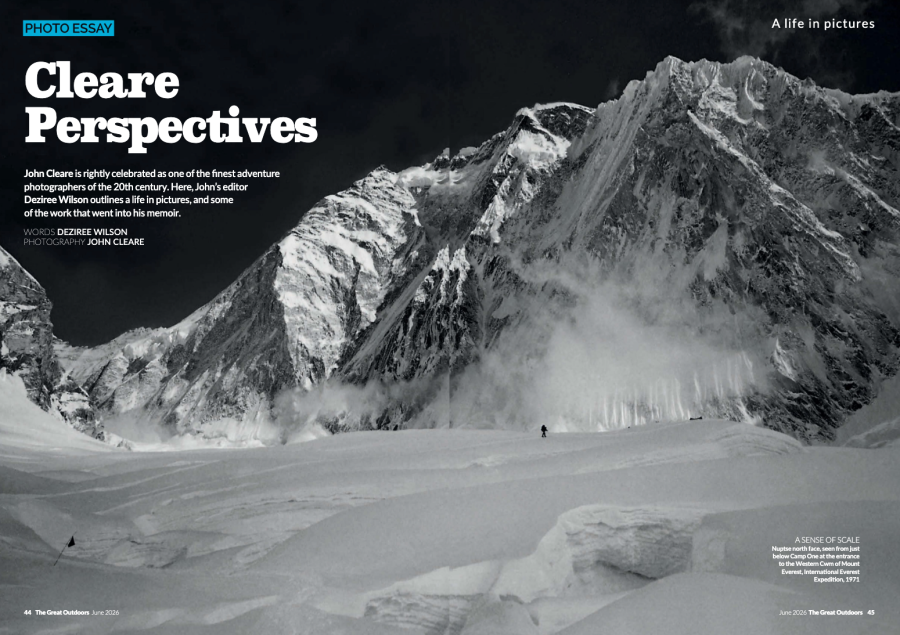
Cleare Perspectives: John Cleare is rightly celebrated as one of the finest adventure photographers of the 20th century. Here, John’s editor Deziree Wilson outlines a life in pictures, and some of the work that went into his memoir.
“Even if you haven’t heard of John Cleare, if you have a love of mountain literature, you’ll likely have seen some of his iconic photographs chronicling what is often dubbed the ‘golden age’ of British climbing history. John was at the forefront of adventure photography and cinematography in the latter half of the 20th century, and his intimate portraits of leading figures such as Hamish MacInnes, Tom Patey, Don Whillans and Chris Bonington helped define a generation. It’s serendipitous that we had someone of John’s calibre to document this era for future generations, and today’s professionals stand on his shoulders…”
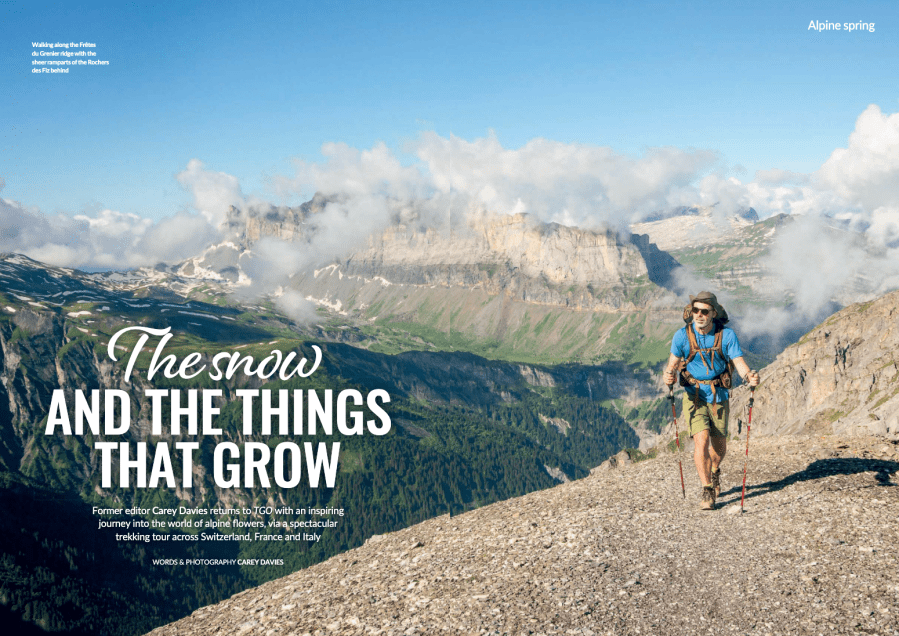
The snow and the things that grow: Former editor Carey Davies returns with an inspiring journey into the world of Alpine flowers, via a spectacular trekking tour across Switzerland, France and Italy.
“I was gloriously unprepared for this. After months under the snow, a vast riot of colour had broken out on the mountainside. At first glance it all blurred together – an overwhelming rampage of blooms and blossoms blended into a vast, multicoloured fizz that saturated the slope, stretching up towards the peaks with no end in sight. Yet taking it in one square metre at a time began to reveal endless individual species – campions, rampions, buttercups, gentians, vetches, saxifrages, geraniums, rhododendrons, aster, avens, anemones, orchids. As I bent to look closer, the complexity only deepened, revealing new layers. Bees and butterflies buzzed through it all, further enhancing the soft static. And above were the summits of the Dents du Midi: snow-laced towers of crumbling limestone, almost lunar-looking in their lifelessness, startling in their contrast. Every few paces I’d notice some new cluster of wonder and had to stop once more. This was in large part what I had come to the Alps at this time of year to experience, but it still stunned me. There are wildflowers in Britain, of course. But not quite like this; not entire mountainsides turned technicolour…”
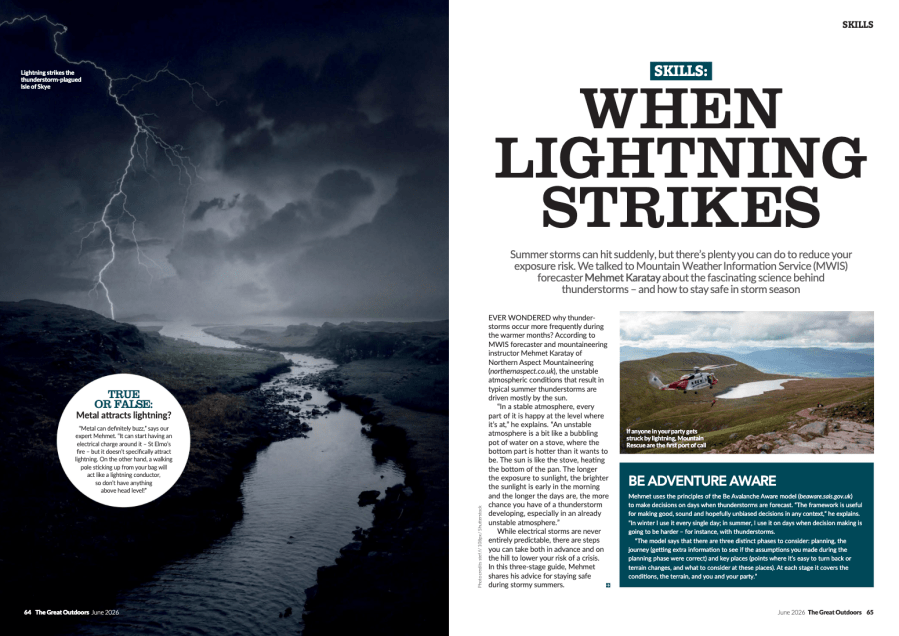
When lightning strikes: Summer storms can hit suddenly, but there’s plenty you can do to reduce your exposure risk. We talked to Mountain Weather Information Service (MWIS) forecaster Mehmet Karatay about the fascinating science behind thunderstorms – and how to stay safe in storm season.
“Ever wondered why thunderstorms occur more frequently during the warmer months? According to MWIS forecaster and mountaineering instructor Mehmet Karatay of Northern Aspect Mountaineering (northernaspect.co.uk), the unstable atmospheric conditions that result in typical summer thunderstorms are driven mostly by the sun. In a stable atmosphere, every part of it is happy at the level where it’s at, he explains. An unstable atmosphere is a bit like a bubbling pot of water on a stove, where the bottom part is hotter than it wants to be. The sun is like the stove, heating the bottom of the pan. The longer the exposure to sunlight, the brighter the sunlight is early in the morning and the longer the days are, the more chance you have of a thunderstorm developing, especially in an already unstable atmosphere. While electrical storms are never entirely predictable, there are steps you can take both in advance and on the hill to lower your risk of a crisis. In this three-stage guide, Mehmet shares his advice for staying safe during stormy summers.”
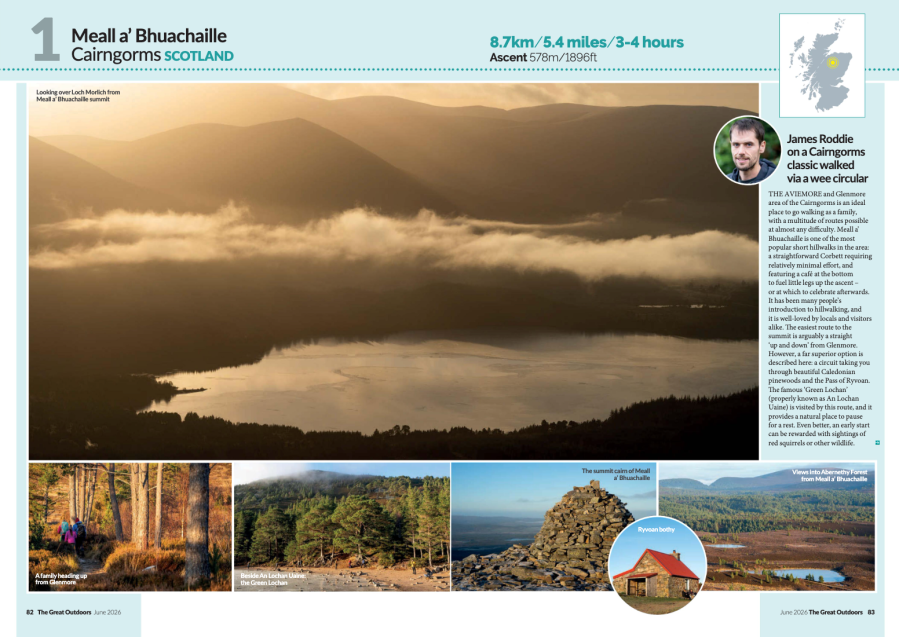
Wild Walks: Family-friendly routes mapped by the experts for you to enjoy with explorers of all generations
“Spending time together outdoors can help build lifelong bonds – and we’re lucky that our small island offers plenty of high places suitable for explorers young and old in spirit and years! From wildflower meadows in the Dales to little peaks in the Cairngorms, these expert-mapped routes have something to hold the attention of any walker. A love of our natural world can be a gift shared across generations – just as long as you pick your route wisely and within your group’s capabilities!”