
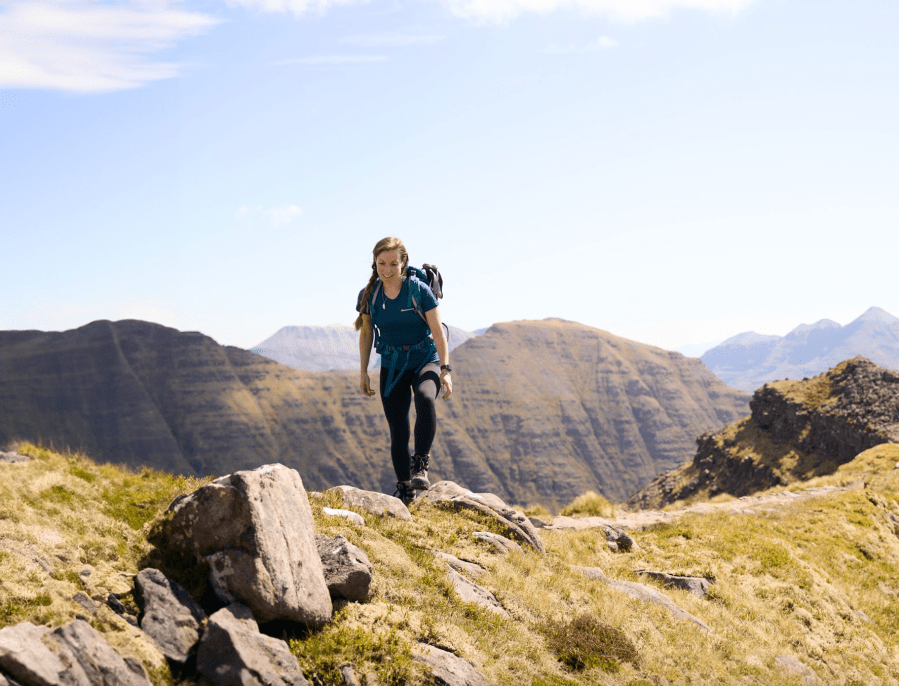
This month’s magazine is all about going the extra mile, celebrating the sometimes weird, wonderful or crazy supersized adventures we can have outdoors when we’re given enough rope to do them. It’s about putting ourselves into what teachers and guides sometimes call ‘the stretch zone’ – trying things that might not always be comfortable but will always be interesting. In our outdoors niche and in the wider western world, this is often framed as ‘further, faster’ or ‘pushing our limits’, but that’s more a reflection of liberal capitalism and less an accurate description of what really happens when we find ourselves out on a limb.
Doing something new or different or trying extra hard is as much about curiosity, humility and perspective as about toughness or challenge. We bump into our limits – how to cross that river, get up those crags, over that bog, how to work through fatigue, weather, hunger, thirst, our own emotions or each other’s company! There may be awkward questions to which we don’t at first have answers, but we grow though these experiences. Therein lies the paradox; to do hard things, we must be ‘soft’ enough and open enough to doubt and to question. Our contributors to this issue speak these truths clearly and with hope and with fun – because if we are not having fun, what exactly are we having? This is why The Great Outdoors exists, surely – to advocate for joy and learning through joy, as often as possible.
Cover image: On the Horns of Alligin in Torridon, Beinn Eighe and Liathach behind | Credit: Meirion Watkin
Highlights include:
- Use long summer days to supersize adventures on backpacks, bikepacks, swimruns & big rounds
- Your best quests yet: Glenmore Lodge guides share insider tips on summer hill skills
- David Myers makes (very) short work of the 630-mile South West Coast Path
- Road to Energia: Hannah Mitchell & Sam Jagger head for life-altering summits in the Fanns
- Cold at camp? Our expert debunks sleep system ratings so you can sleep soundly
- Big packs & hiking apps: tested by the pros so you can invest wisely
- Wild Walks: reach new no-hassle heights on these beautiful car-free walks
- Fighting fire: we speak to the first ever Peak District wildfire engagement officer
PLUS: Jim Perrin paints a portrait of Cat Bells; we escape to Langdale in Lakeland; Nadia Shaikh counts all the ways in which she loves the variety in the humble Shieldbug; Juls Stodel helps one disorientated hiker; get the latest news from the mountains; and check our calendar of walking events.
Get supersized adventures inside:
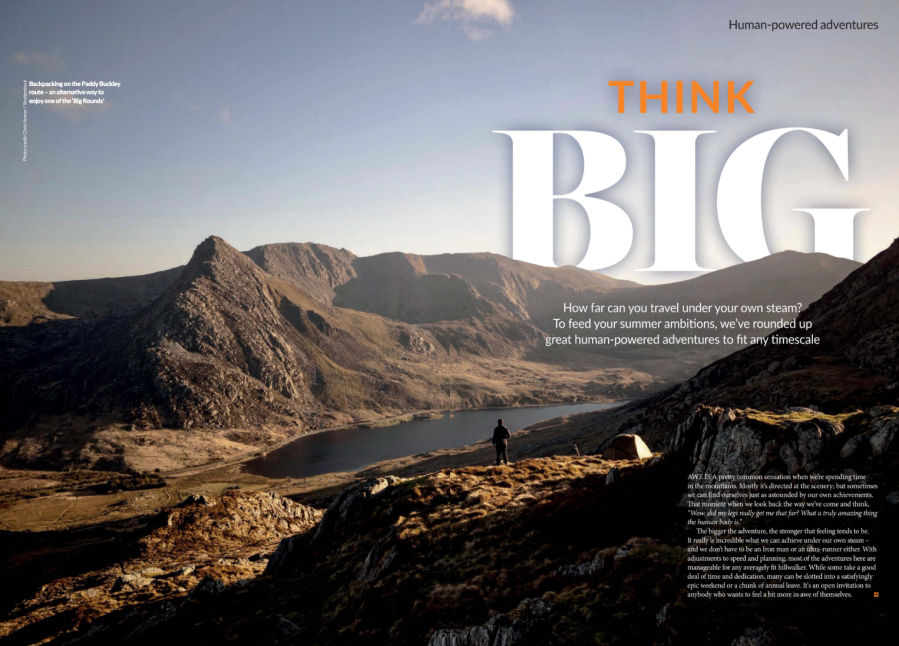
Think big: How far can you travel under your own steam? To feed your summer ambitions, we’ve rounded up great human-powered adventures to fit any timescale – from a weekend to annual leave to an extended sabbatical
“Awe is a pretty common sensation when we’re spending time in the mountains. Mostly it’s directed at the scenery; but sometimes we can find ourselves just as astounded by our own achievements. That moment when we look back the way we’ve come and think, “Wow, did my legs really get me that far? What a truly amazing thing the human body is.” The bigger the adventure, the stronger that feeling tends to be. It really is incredible what we can achieve under our own steam – and we don’t have to be an Iron man or an ultra-runner either. With adjustments to speed and planning, most of the adventures here are manageable for any averagely fit hillwalker. While some take a good deal of time and dedication, many can be slotted into a satisfyingly epic weekend or a chunk of annual leave. It’s an open invitation to anybody who wants to feel a bit more in awe of themselves…”
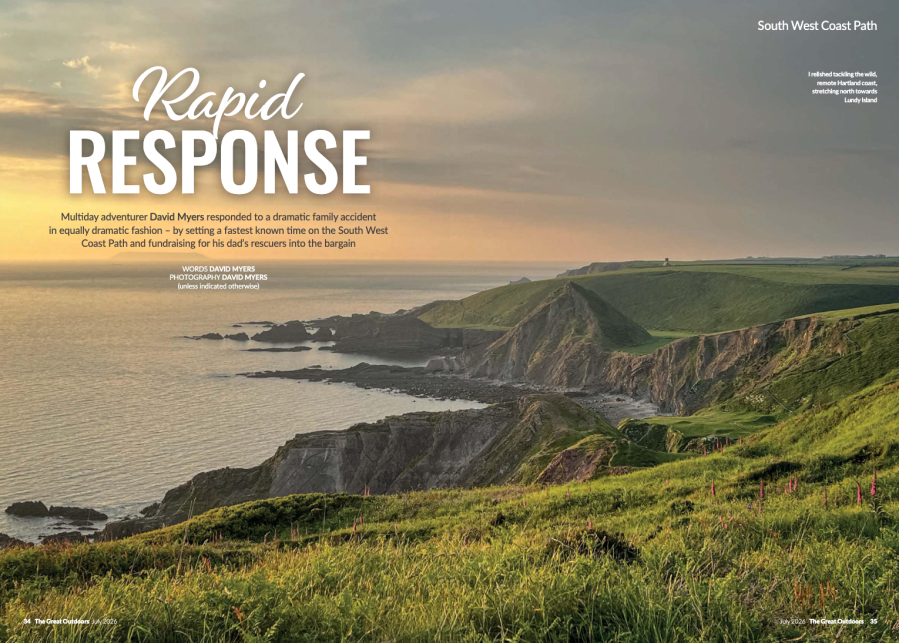
Rapid response: Multiday adventurer David Myers responded to a dramatic family accident in equally dramatic fashion – setting a fastest known time on the South West Coastal Path and fundraising for his dad’s rescuers into the bargain.
“The Cornish pilot gig and her crew of seven quietly made their way back into harbour, where the historic North Devon village of Clovelly tumbles down the steep, wooded cliffs into the sea. Once ashore, they started the arduous process of hauling the wooden vessel up the pebbled beach, away from the grasp of high tide. Weary from their latest battle with the Bristol Channel, the crews’ minds were already drifting towards the pints of ale in the Red Lion, when suddenly one of them fell face first into the water. His motionless body was plucked from the sea, and within seconds club captain Paul was administering CPR on the lifeboat slipway as help was called. The remote bottom-of-a-cliff location meant any ambulance would take an age, even if it could depart immediately from the nearest hospital, over 20 miles away. Without the heroic actions of the crew and the rapid response of the air ambulance, my father would not have survived his cardiac arrest that summer evening. He went on to make a full recovery, and ever since I had wanted to fundraise for the Devon Air Ambulance – a non-profit, non-government funded charity, relying primarily on donations from the public. I turned to the only thing I know how to do well: run a really long way…”
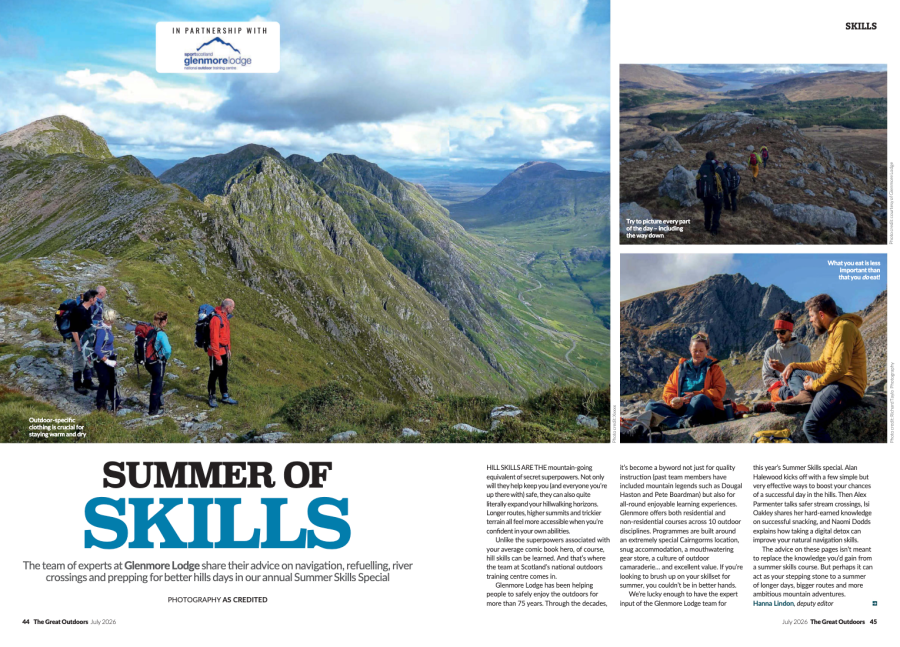
Summer of skills: The team of experts at Glenmore Lodge share their advice on navigation, refuelling, river crossings and prepping for better hills days in our annual Summer Skills Special.
“Hill skills are the mountain-going equivalent of secret superpowers. Not only will they help keep you (and everyone you’re up there with) safe, they can also quite literally expand your hillwalking horizons. Longer routes, higher summits, trickier terrain – all feel more accessible when you’re confident in your own abilities. Unlike the superpowers associated with your average comic book hero, of course, hill skills can be learned. And that’s where the team at Scotland’s national outdoors training centre comes in. Glenmore Lodge has been helping people to safely enjoy the outdoors for more than 75 years. Through the decades, it’s become a byword not just for quality instruction (past team members have included mountain legends such as Dougal Haston and Pete Boardman) but also for all-round enjoyable learning experiences. Glenmore offers both residential and non-residential courses across 10 outdoor disciplines. Programmes are built around an extremely special Cairngorms location, snug accommodation, a mouthwatering gear store, a culture of outdoor camaraderie… and excellent value. If you’re looking to brush up on your skillset for summer, you couldn’t be in better hands…”
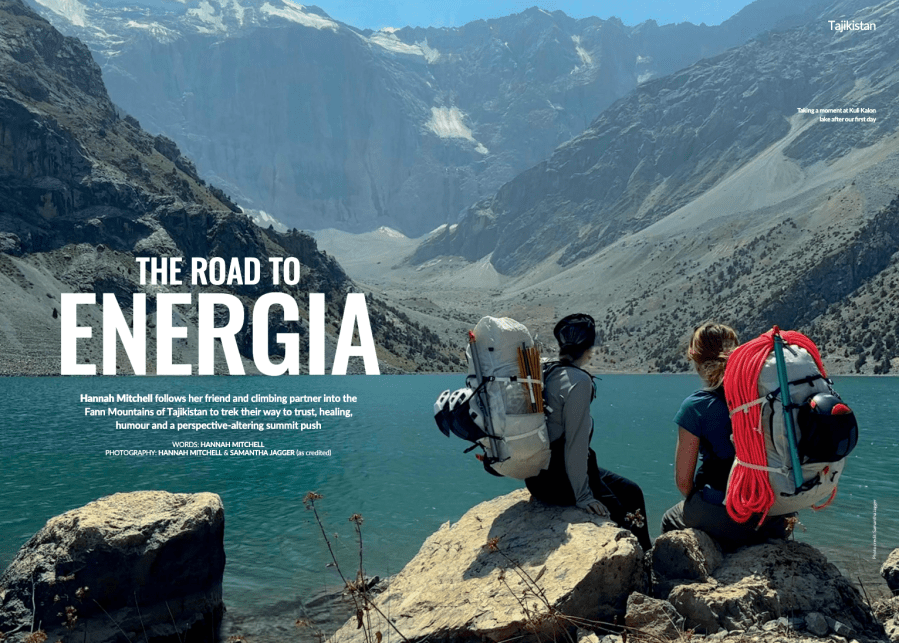
The Road to Energia: Hannah Mitchell follows her friend and climbing partner into the Fann Mountains of Tajikistan to trek their way to trust, healing, humour and a perspective-altering summit push.
“As the early morning sunlight permeated the red dome of the tent, I drifted into consciousness. Unfamiliar sounds from outside infiltrated my sleeping bag hood and my skin prickled. My climbing partner Sam shifted on her mat next to me. I sat up, immediately on guard. Sam was already kneeling, tentatively unzipping the tent door. Despite our preparedness for all manner of threats, I could feel my brain begin to initiate its fight-or-flight response. We were alone in the mountains of Central Asia. My trepidation, luckily, was short-lived. Camera now in hand, Sam stifled giggles as she peered through the vestibule. Far from existential threat, our tent was engulfed by a flock of noisy Hissar sheep whose bleats and snorts sounded almost human. A staple of Central Asian livestock, Hissar are famed among westerners for their comedic wobbly bottoms. Sam’s laughter was contagious…”
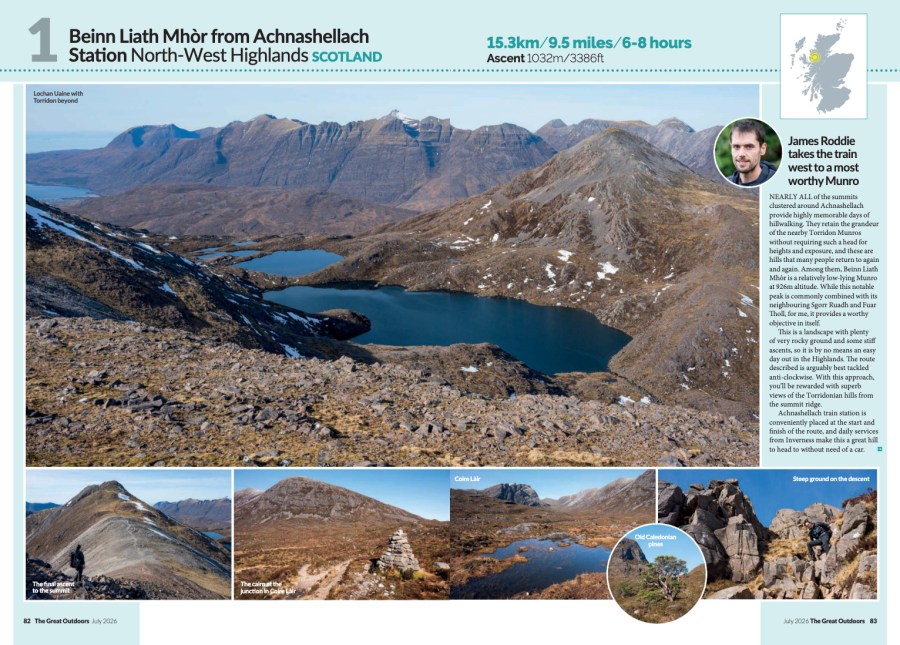
Wild Walks: Fancy a beautiful but guilt-free walk knowing you’ve made choices that alleviate negative impacts upon the environments of our high places? These car-free mapped routes boast some of the finest walking up and down Britain. With a selection of circular and linear routes, opportunities to roam abound. Forgo the hassle of finding parking in remote places with delicate infrastructures, enjoy your big day out on foot, and settle into a relaxing return journey. Yes, you may have to wait for the bus – but what freedom might it afford you in exchange?
“Nearly all of the summits clustered around Achneshellach provide highly memorable days of hill walking. They retain the grandeur of the nearby Torridon Munros without requiring such a head for heights and exposure, and these are hills that many people return to again and again. Beinn Liath Mhor is a relatively low-lying Munro at 926m altitude. While it is commonly combined with neighbouring Sgorr Ruadh and Fuar Tholl, it provides a worthy objective in itself. This is a route with plenty of very rocky ground and some stiff ascents, so it is by no means an easy day. The route described is arguably best tackled anti-clockwise, with the reward being superb views into Torridon from the summit ridge. Achneshellach train station is conveniently placed right at the start and finish of the route, and daily services from Inverness make this a great hill to head to without needing a car…”