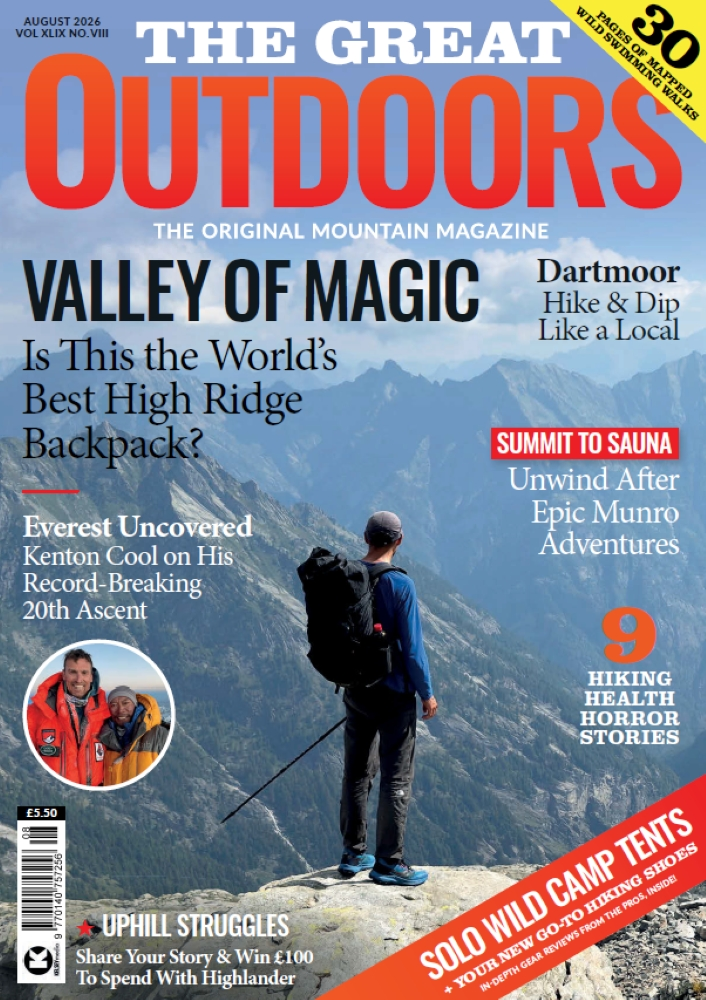

“Go for a walk, it doesn’t cost anything!” If we had a penny for every time someone said this to us, we probably would’ve been too busy counting our pennies to dedicate this issue of The Great Outdoors to budget adventures. It’s often said that walking is free. True – but only if you do it from your back door, on an empty stomach, devoid of mountain skills and naked. If you’re hoping to travel to your nearest hilly place, stay for a night or two and be at least semi-protected from the elements, then walking does cost money. Often quite a lot of it.
In the belief that the hills should be open to everyone, no matter what their budget, we’ve put together a manifesto for saving a bit of money while still getting to enjoy that all-important fresh mountain air.
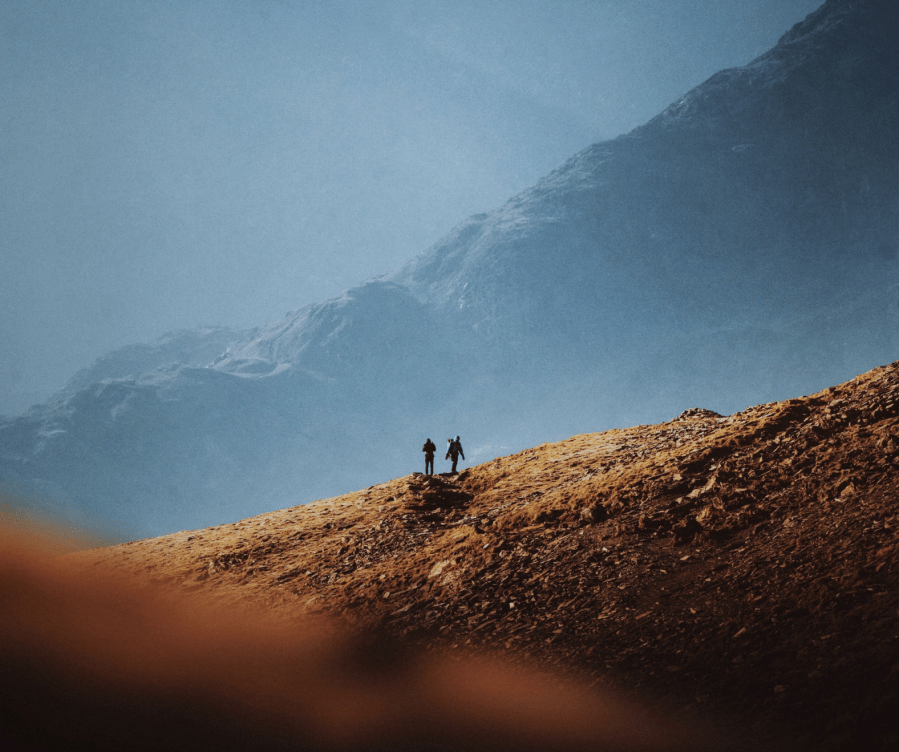
Main image: Hikers of the ridge to Glyder Fawr, Eryri | Credit: Chris Sharp / Black Sail
Highlights of this budget adventure special issue include:
- Low-cost ventures: Our 50-point manifesto for saving cash on your favourite outdoor hobby
- We round up the best budget backpacking kit tested by Britain’s most experienced gear testing team
- Fix up your old kit with new skills – and recognise when that waterproof is actually a goner
- We also show you how to get geared up from head-to-toe for under £100 – yes, we’ve got the receipts!
- Plan your next overnight to Eryri/Snowdonia’s peaceful camp spots with sweeping sea views
- Take an Irish multi-day trek devised by an artist and two former-nuns with Ailsa Sheldon
- David Myers tests his calves and sanity on Switzerland’s wildest trail – the elevation profile must be seen to be believed!
- Rachel Hewitt unpacks the ‘dangerous’ new rule for Britain’s most brutal ultra, the Spine Race
- Mountain Rescue callout: Juls Stodel helps one reader overcome her shame one year on
PLUS: Jim Perrin paints a portrait of Y Berwyn; we escape to a prettily-perched Peak District castle; Nadia Shaikh welcomes the first signs of spring with the orange-tipped butterfly; get the latest news from the mountains; check the calendar of walking events we rate; and get inspired for a night in with the latest outdoor blockbuster film.
Read on to discover your next budget adventure:
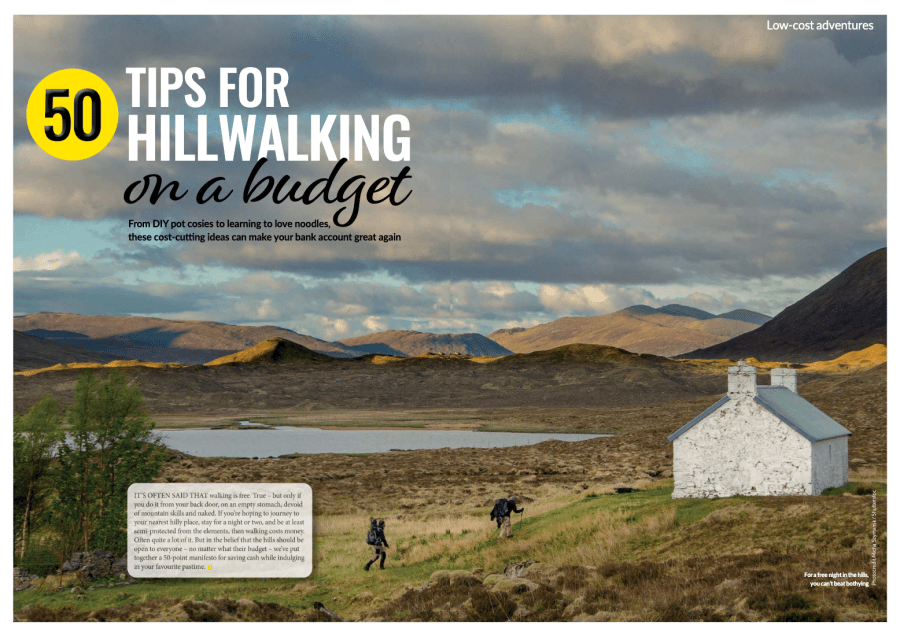
50 tips for hillwalking on a budget: From DIY pot cosies to learning to love noodles, these cost-cutting ideas will help make your bank account great again
“It’s often said that walking is free. True – but only if you do it from your back door, on an empty stomach, devoid of mountain skills and naked. If you’re hoping to travel to your nearest hilly place, stay for a night or two and be at least semi-protected from the elements, then walking costs money. Often quite a lot of it. In the belief that the hills should be open to everyone, no matter what their budget, we’ve put together a 50-point manifesto for saving cash while indulging in your favourite pastime.”
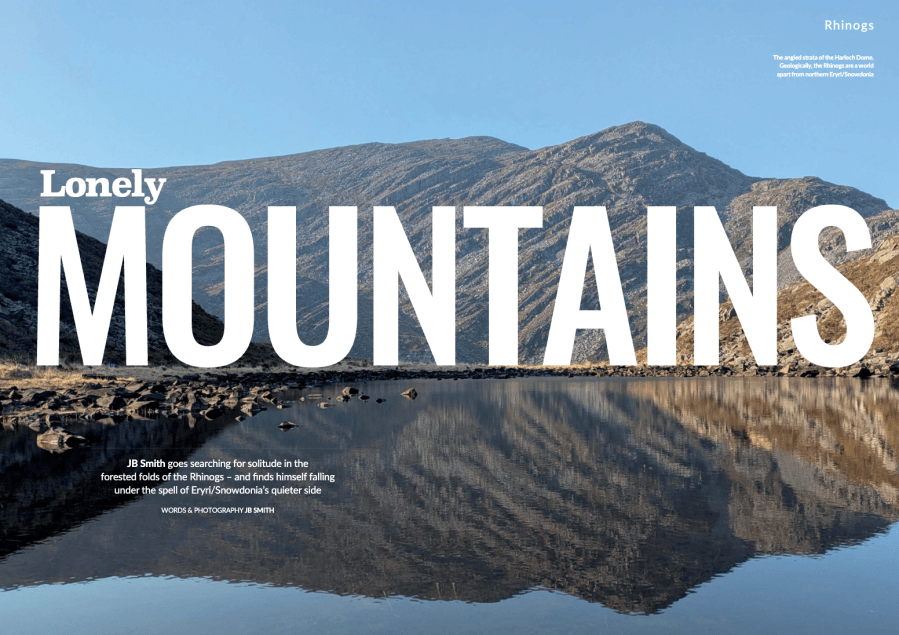
Lonely Mountains: JB Smith goes searching for solitude in the forested folds of Eryri – and finds himself falling under the spell of Snowdonia’s quieter side
“By my calculations, I had three days to spare. I’d answered my emails, turned on my out of office and deposited my son with his long-suffering grandparents – but I still had to pick a destination. I spread out my maps on the kitchen table, scanning the famous contours of Eryri and those well-known summits. Then my gaze alighted on a blank space that I’d pored over many times but never actually visited. The map shows a region covered by so many streams, lakes, and craggy terrain it looks like my 4-year-old son has scribbled all over it with blue and black pens. I had always fancied the traverse of the range, but the notion of walking from A to B while ticking off summits left me cold. My heart was yearning for something less ordered. Something wilder. So I decided to park at Cwm Bychan, halfway down the range, and simply explore, taking in the upland heaths, rocky peaks and vestigial scraps of Atlantic rainforest hidden in the folds of the land…”
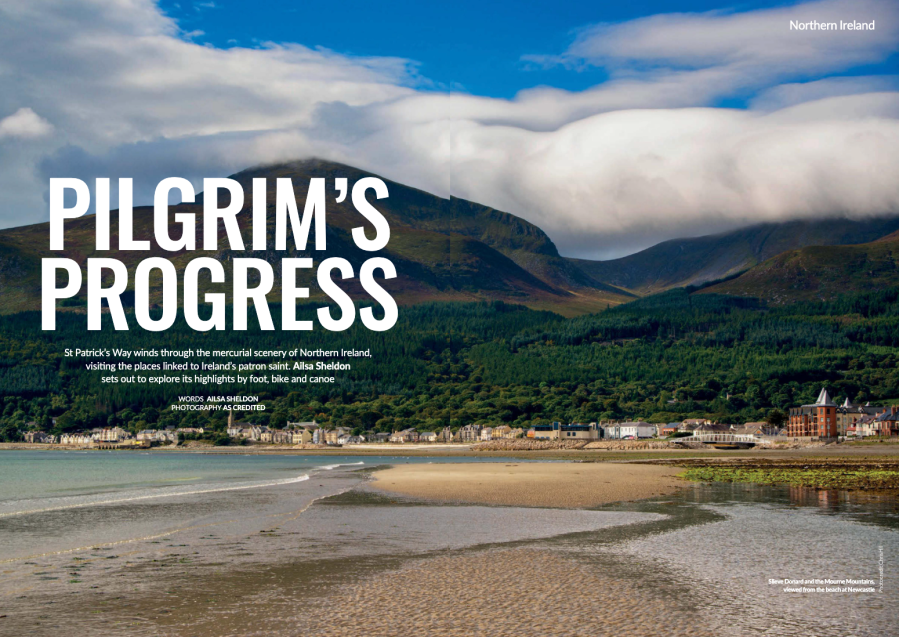
Pilgrim’s Progress: St Patrick’s Way winds through the mercurial scenery of Northern Ireland, visiting the places linked to Ireland’s patron saint. Ailsa Sheldon sets out to explore its highlights by foot, bike and paddle
“The Pilgrim’s Walk ends in Downpatrick – but thanks to former nuns Martina and Elaine, who I have the pleasure of walking with for a day each, it’s not the end of the trails. During the pandemic, the pair began exploring the area in earnest. They created a series of additional walks and experiences around Downpatrick, with guides available at the St Patrick Centre. To this atheist, walking with Martina and Elaine is enlightening and adds a living dimension to the historic sites. I learn that the importance of the saint to many Irish people goes far deeper than a yearly parade…”
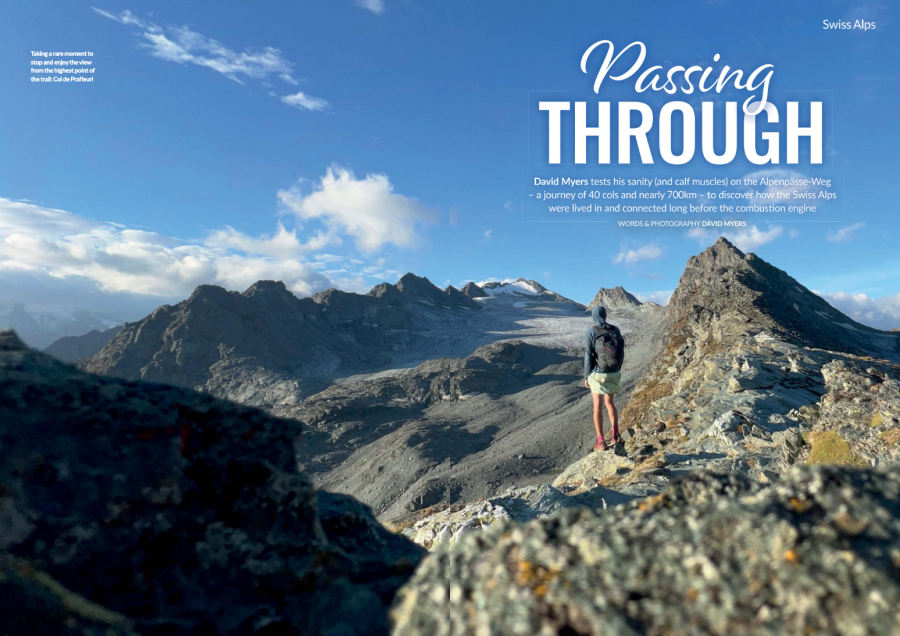
Passing Through: David Myers tests his sanity and calf muscles on the Alpenpässe-Weg, a journey of 40 cols and nearly 700kms to discover how the Swiss Alps were lived in and connected together long before the combustion engine
“I gasped for air at the top of the pass, as the serene Lake Geneva shimmered far below. A couple of cows turned their heads lazily to see what all the fuss was about, then quickly returned to their grazing. I was just two kilometres into my walk, but already 700 metres higher. One pass down, I thought, and started my descent before I had too much time to dwell on the prospect of another 40-odd to go. I’d just embarked on the Alpenpässe-Weg (Alpine Passes Trail) which begins on the Franco-Swiss border on the shores of Lac Léman. This relatively unknown trail meanders its way across the south of Switzerland for 695 precipitous kilometres towards Italy, its sole and arguably bloody-minded purpose to convey the walker over as many high mountain passes as possible. The route appealed to me because it was offered a challenging way to cross the Alps through the lesser known, more remote reaches of the mountain range, mostly eschewing more the popular trails…”
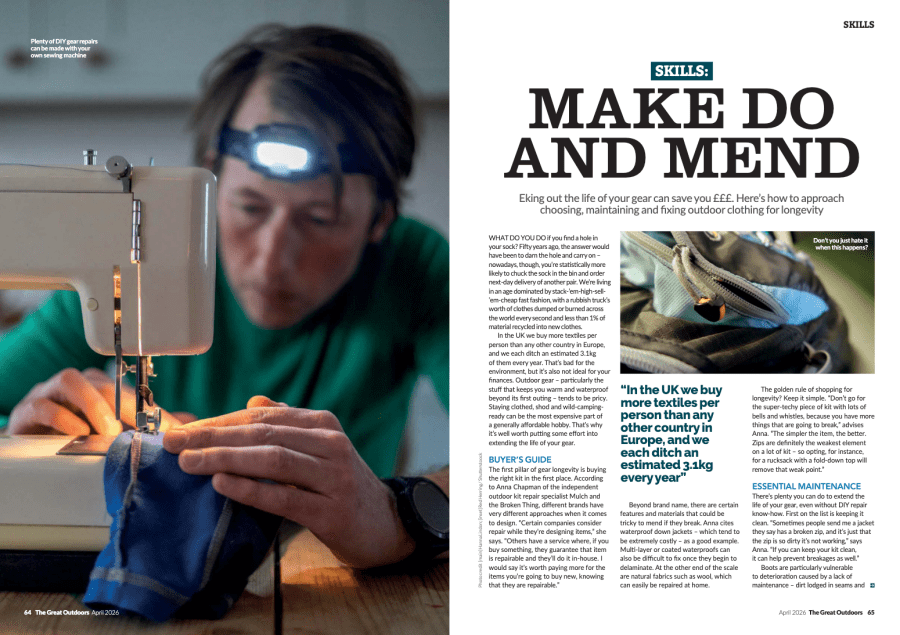
Make and mend: Eking out the life of your gear can save you £££. Here’s how to approach choosing, maintaining and fixing outdoor clothing for longevity
“What do you do if you find a hole in your sock? Fifty years ago, the answer would have been to darn the hole and carry on – nowadays, though, you’re statistically more likely to chuck the sock in the bin and order next-day delivery of another pair. We’re living in an age dominated by stack-‘em-high-sell-‘em-cheap fast fashion, with a rubbish truck’s worth of clothes dumped or burned across the world every second and less than 1% of material recycled into new clothes. In the UK, we buy more textiles per person than any other country in Europe and we each ditch an estimated 3.1kg of them every year. That’s bad for the environment, but it’s also not ideal for your finances. Outdoor gear – particularly the stuff that keeps you warm and waterproof beyond its first outing – tends to be pricy. Staying clothed, shod and wild camping-ready can be the most expensive part of a generally affordable hobby. That’s why it’s well worth putting some effort into extending the life of your gear…”
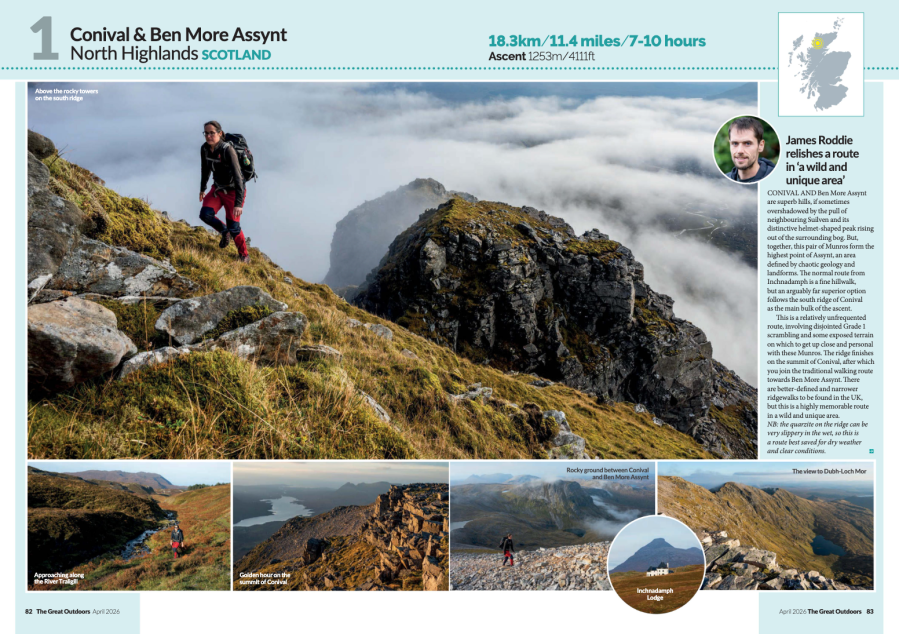
Wild Walks: Britain’s mountainous regions might not soar to the heights of the Alps, the Atlas or the Appalachians but there are swathes of world-class terrain up and down the western reaches of these isles that make for some epic, dynamic days and those seeking lofty greatness will find plenty to enjoy in our experts’ round-up of the finest ridge walks, from the Highlands to Lakeland by way of Eryri
“Conival and Ben More Assynt are superb hills, if sometimes overshadowed by the pull of neighbouring Suilven. Together they form the highest point of Assynt – a fascinating area defined by chaotic geology and landforms. The normal route from Inchnadamph is a fine hill walk, but an arguably far superior route follows the South ridge of Conival as the main bulk of the ascent. This is a relatively unfrequented route, involving disjointed Grade I scrambling and some exposed terrain. The ridge finishes on the summit of Conival, after which you join the normal walking route towards Ben More Assynt. Although there are better defined and narrower ridge walks to be found in the UK, this is a highly memorable route in a wild and unique area…”