
Chris Townsend awards the Big Agnes Pitchpine VST 1.5 tent his Greener Choice award. Find out why.
There’s a great deal to like about this ultralight tent but sadly also a few drawbacks to the Big Agnes Pitchpine VST 1.5 tent for UK use.
Chris Townsend’s Greener Choice
It has an innovative ultralight design that Big Agnes call hybrid. This means a single-skin tent with a sewn-in groundsheet and a mesh inner door.- ultralight
- compact packed size
- innovative design
- recycled fabric
- spaccious
- condensation
- thin groundsheet
- expensive
| Quick specs |
|---|
| Price: $649.95 | £600 (available from Big Agnes) Weight: 875g Pitching: unit Flysheet: 20D recycled solution-dyed polyester, 4000mm hydrostatic head, taped seams Inner: polyester mesh Groundsheet: recycled 15D nylon ripstop, 1500mm hydrostatic head Poles: DAC Featherlite NFL Pegs: 8 x 15cm T Porches: 1 Inner Dimensions: 224cm L x 71cm W x 102cm H www.bigagnes.com |
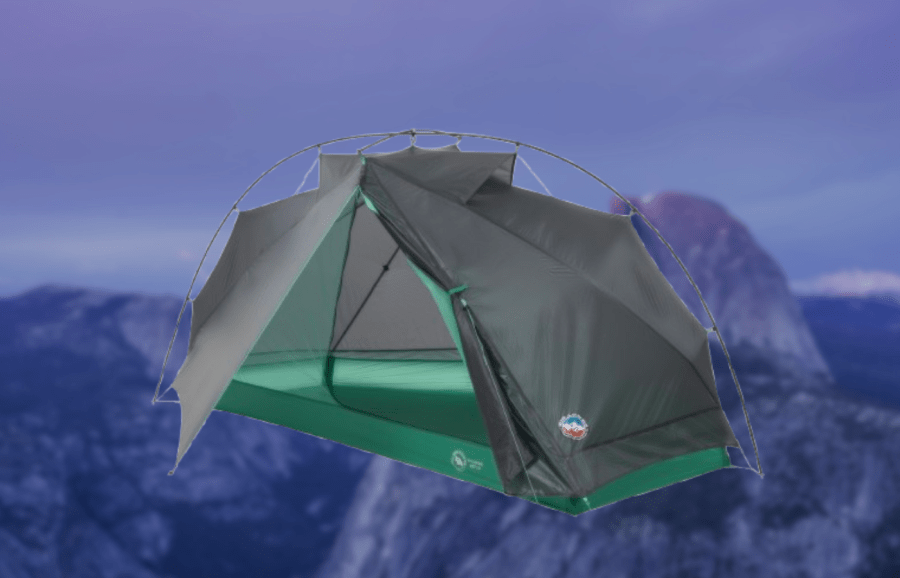
It has an innovative design that Big Agnes call hybrid. This means a single-skin tent with a sewn-in groundsheet and a mesh inner door. The groundsheet is attached to the outer with mesh walls to aid ventilation. There are also two large vents at the top of the tent. The structure is unusual with a single pole running diagonally over the tent and a short ridge pole. This creates a very roomy inner with excellent headroom and a large porch. The fabric is Big Agnes’s proprietary HyperBead which is made from stretch-resistant recycled polyester whose water repellency it claims never wears off. The flysheet has a high hydrostatic head but the groundsheet doesn’t. Big Agnes recommends using the Pitchpine footprint with it. This adds 74g to the weight and £50 to an already high cost.
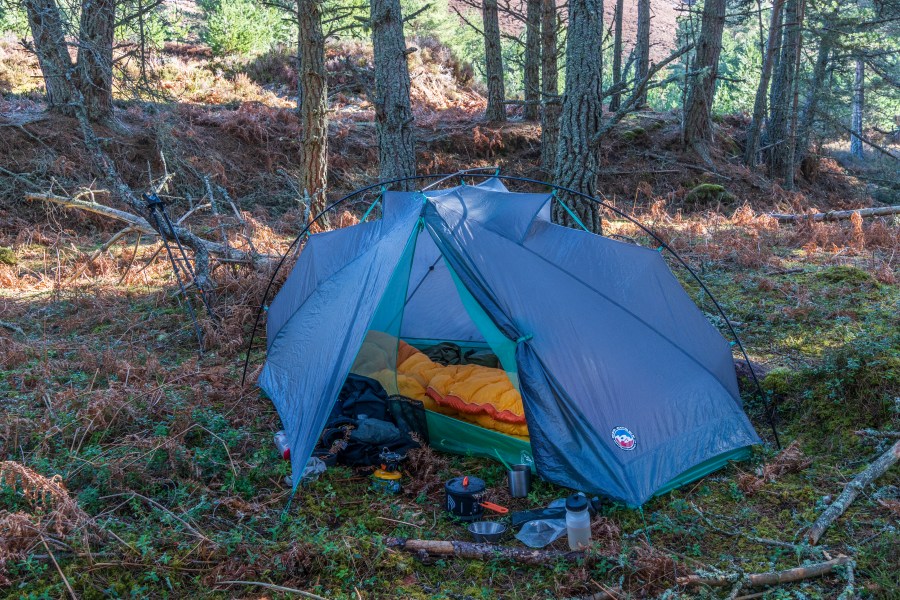
The big top vents and the mesh walls round the groundsheet do allow airflow, as long as there’s a breeze. However on calm humid nights condensation is unavoidable and, as with any single-skin shelter, it’s harder to avoid than in a double -skin tent. The Pitchpine is quite easy to pitch but a little practice is needed to get the tension right. It’s stood up to gusty winds better than I expected but not as well as other tents. It has kept rain out too but the big vents can’t be closed. I haven’t had rain coming in as yet but I still think this is a tent better suited to low level, sheltered sites. A big plus of the innovative design is the low weight, especially given how spacious it is. However, there are use limitations given our often-stormy British weather.
How Chris tested
TGO is exceptionally thorough when testing tents in particular and these were used in the Scottish Highlands in all weather conditions – heavy rain, strong winds, frosty nights, snow, humid nights, sunshine – on sites ranging from exposed high mountain to deep forest. All tents were weighed on Chris’ digital scales and the weights are for all components including stuffsacks. This review was first published in the August 2026 issue of The Great Outdoors. You can compare it with other in our guide to the best solo backpacking tents.