
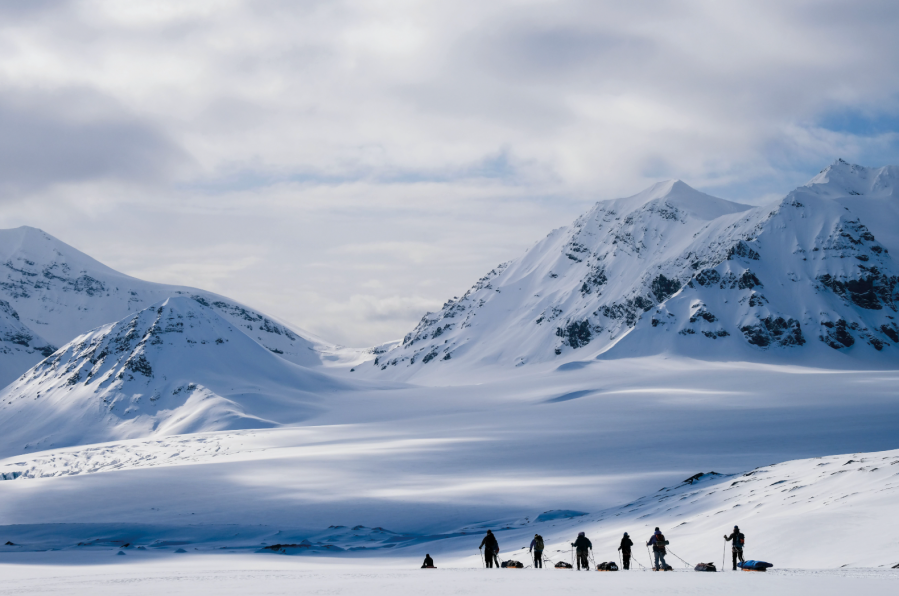
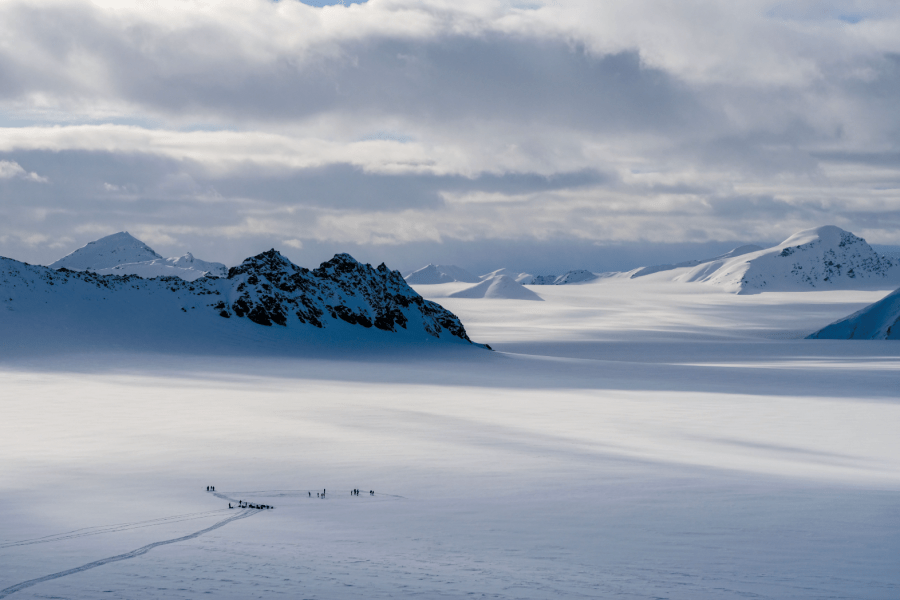
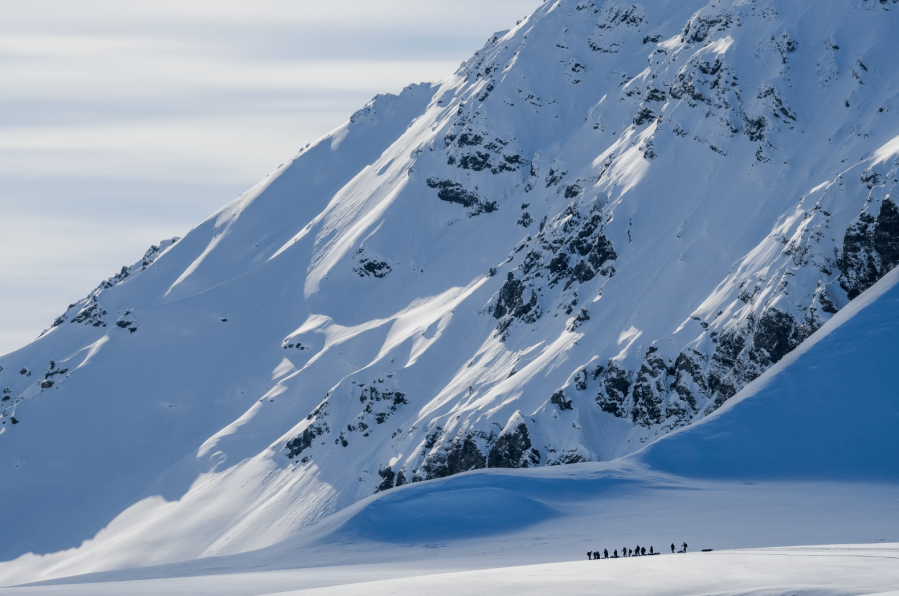
Main image: From Svalbard, arctic guides approach Harriet Glacier, watching out for crevasses near the glacier’s edge | Credit: Maria Philippa Rossi
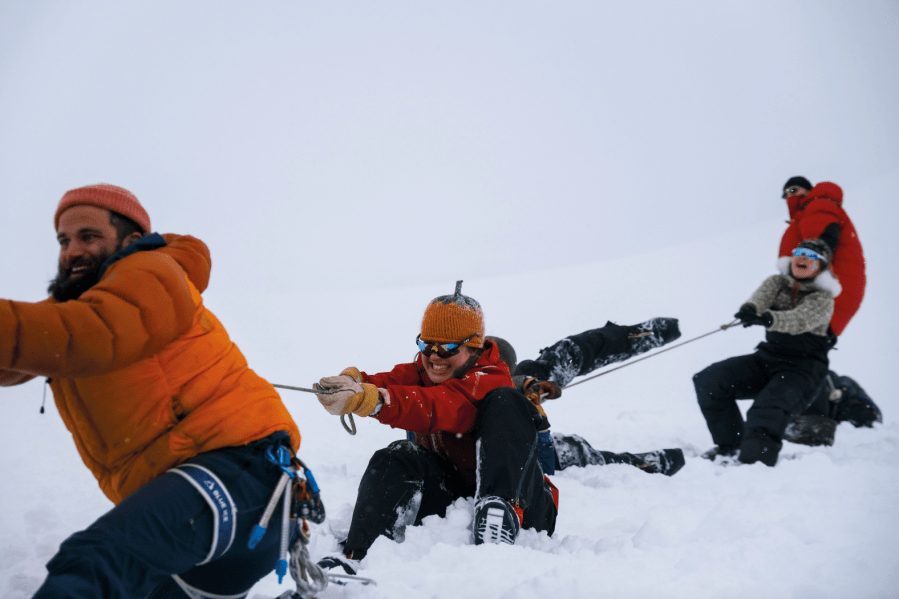
“Pull harder!” “PULL HARDER!” The rope burns in my hands as my grip tightens. I look into my friend’s eyes. They are wide with determination, and she too refuses to let go. Snow is falling in big, chunky flakes, making it hard to navigate more than a few hundred yards. The ground beneath my ski boots is slippery and threatens to throw me off balance.
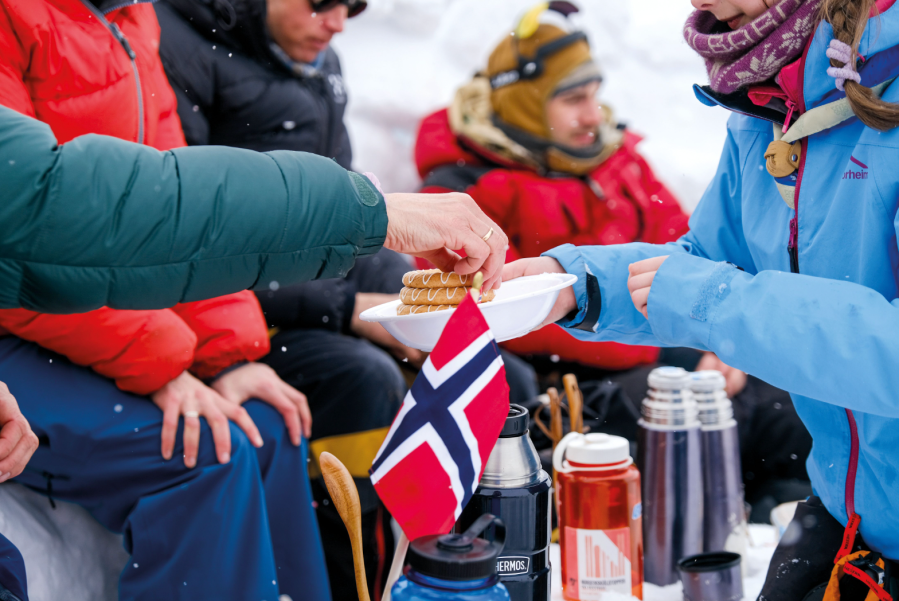
“Don’t give up!” A voice cuts through the snowy haze. It is close yet muffled by the swirling wind. Someone cheers, but it is a lost cause. My team has no chance against Jen McKeown and her Vikings, and we tumble over the line like snowballs down a hill. We have lost, but it is just a game of tug-of-war.
It’s May 17th, Norway’s national holiday. Typically, this day is celebrated in comfortable spring temperatures, with parades passing by the Royal Castle in Oslo. Some tipsy from champagne breakfasts, others running after their children with ice creams, all surrounded by the sweet fragrance of blooming lilacs, mingling with the smells of hot dogs and candy floss – two staples of Constitution Day.
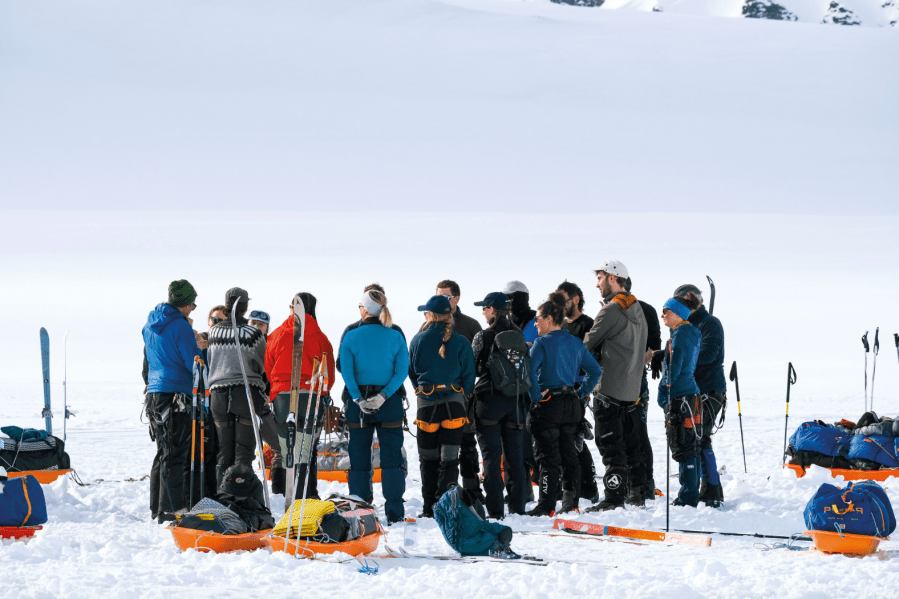
But this year is different. 104 adventurers have convened in one of the remotest parts of the Arctic Archipelago of Svalbard. It’s more than 30 miles to the nearest settlement, although that too is an isolated town. For the next six days, we’ll be guided through this secluded corner of Spitsbergen by Arctic Nature Guide students.
The challenges are real: crevasses, avalanches, and the possibility of encountering a curious polar bear.
Frontier fun
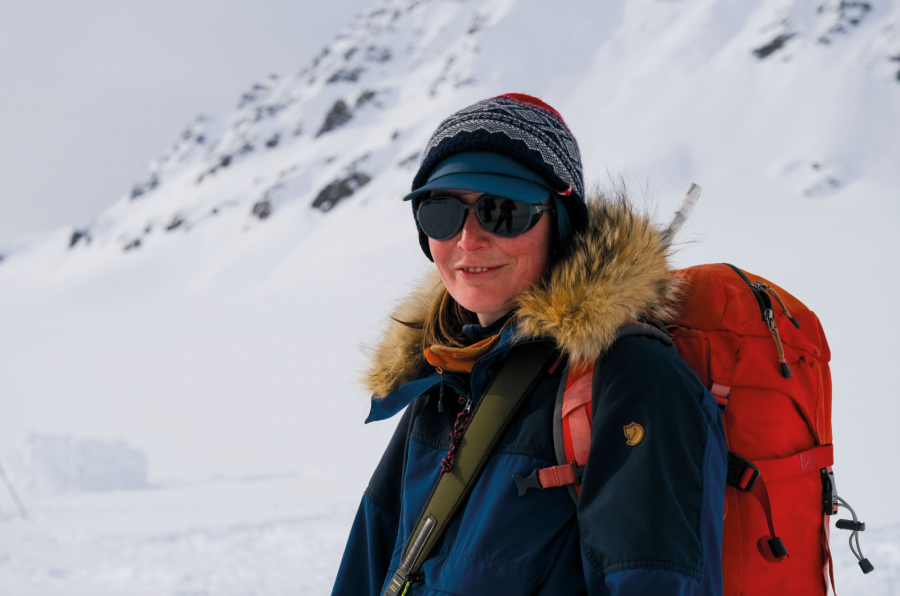
Jen McKeown, 35, from Peterhead, Scotland, had always dreamed of visiting Antarctica. In 2019, that dream became reality when she landed a job at Union Glacier, where she spent her days cleaning toilets, shoveling snow, and doing various odd jobs. It was a tough, frontier-style place, frequented by polar explorers of all kinds and an intriguing group of guides. “This one group of guides seemed to be having even more fun than I was,” McKeown recalls, “and it turned out they had all done this course called Arctic Nature Guide, in a place called Svalbard.”
A few years after her stint in Antarctica, McKeown found herself in Longyearbyen, the main settlement of the Norwegian archipelago in the Arctic. “I remember arriving and thinking, this place is nuts.” Often referred to as the northernmost settlement in the world, Longyearbyen is unique. Though it is possible to live further north for parts of the year, Longyearbyen is a full-fledged community. Toddlers meet weekly with their parents at the local library, the gym boasts an impressive climbing wall and there are more registered snowmobiles than residents. There are no roundabouts or traffic lights, but plenty of award-winning restaurants. And, yes, occasionally a polar bear really does wander through town.
Bluebird to whiteout
With yesterday’s tug-of-war defeat fresh in our minds, we break camp in pristine conditions. The sun is shining, distant clouds add to the dramatic landscape, and the temperature hovers just below freezing. We wait in t-shirts as the guides decide today’s route.
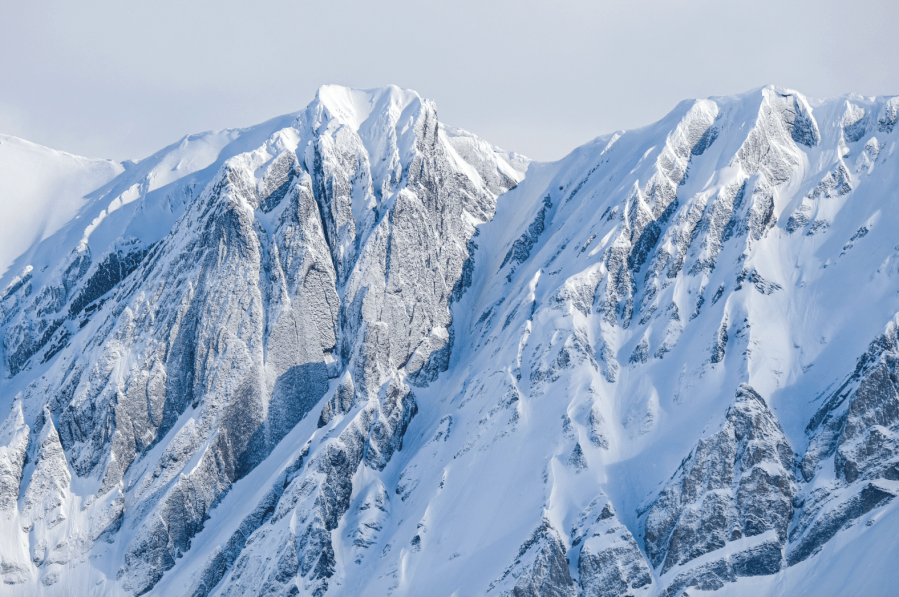
We are in Trollheimen, its name derived from the beasts of Nordic folklore. The mountain ranging before us is “Stortrollet,” or “The Ogre.” With its jagged peaks and steep slopes, it is as large, dangerous, and unattainable as the name suggests.
This camp marks the most remote point of our trip. For the past three days we have skied northbound across the glacier. Over the next three we will head south, closer to civilization – or at least closer to where a boat pick-up is possible. Until lunchtime, visibility is good, but as we sit down in our carefully crafted lunch pit, clouds move in and visibility diminishes.
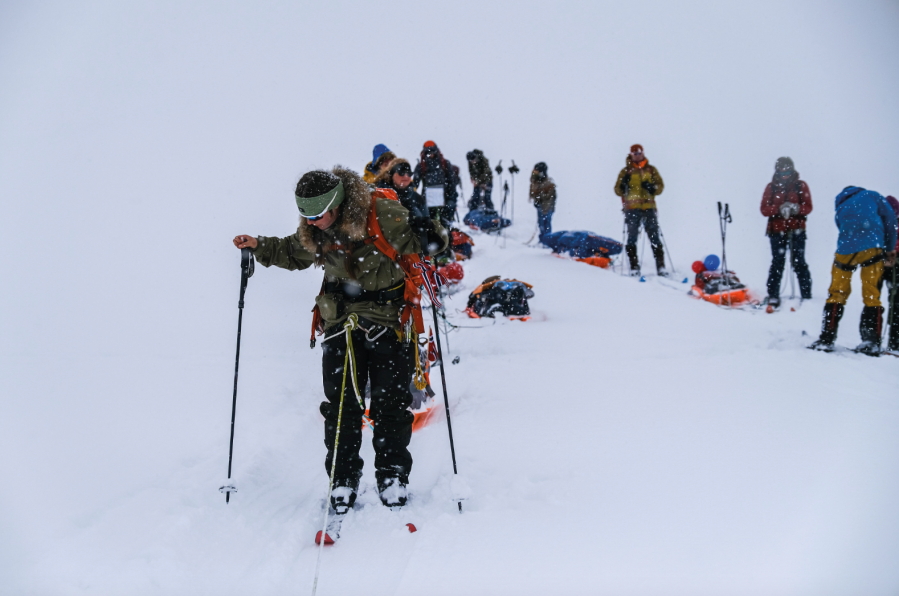
“Stop!” Jen McKeown tries to navigate in the whiteout. She discusses with her co-guide whether the hollow in the snow a few hundred meters ahead is just that, or a hidden crevasse. With the group stretched out and visibility poor, she calls for everyone to rope up. “A lot of pre-work goes into making days like this successful,” she later reflected. “Where is the sky? Where is the slope? Nobody knows!”
In a complete whiteout, we can’t distinguish ground from sky. Navigation depends on a mix of traditional map-and-compass work, GPS, and pre-trip research, including aerial and satellite photos from the summer to identify potential crevasses. The last stretch to camp is a gentle two and a half-mile downhill slope. In good conditions, it would take about fifteen minutes, but roped together and forced to walk in step, it becomes a two-hour ordeal. As camp finally comes into view, a blizzard hits, throwing us off our feet again.
The art of guiding
During the year-long Arctic Nature Guide studies, students embark on several trips, alternating between being guides and guests. For McKeown, working with real guests in Trollheimen is the highlight of her year. “When you’re a student pretending to be a guest, it feels a lot more constructed and fake, so it is nice to have actual guests,” she explains.
The entire trip is a logistical exercise. Due to budget constraints, the boat taking the group from Longyearbyen across the fjord to the starting point ended up “docking” at the sea ice at 11 PM, and the adventurers were not in their tents until 2 AM. “We spent half the trip dealing with the repercussions of a decision made months earlier,” she reflects afterwards. Despite the challenges, McKeown is surprisingly pleased with how smoothly everything went. “We collectively said ‘touch wood’ because having that many people with no major incidents, injuries or any disasters was… well!” she laughs, clearly happy to have enabled so many people to have the adventure of a lifetime.
Before coming to Svalbard, McKeown had expected the focus to be on hard skills and technical work. However, she was surprised to learn that the teachers emphasized people skills, storytelling, and conflict management. “We try to tell stories that can shape people’s experiences, so they get value from nature,” she reflects. McKeown has found that giving people a little context or information helps them connect with the experience much more deeply.
Being bothered
Svalbard is a land of extreme temperatures, extreme weather conditions, and extreme contrasts. From mid-April to late August, the sun doesn’t set. After a brief period of what most people would identify as ‘normal’ day and night, darkness blankets the archipelago for three full months. The only light comes from the moon and the northern lights.
For McKeown, the dark winter months are a challenge. Due to the polar bear threat anyone venturing beyond the town limits must carry a rifle. And since Norway is not Texas, getting a gun license is a time-consuming process. It took months before she could legally carry protection against polar bears. In the meantime, she walked laps around the small town.
“I was bored to tears, but it was also a good chance to practice being bothered,” she says. “Practice being bored?”, I ask. “No, bothered,” she emphasizes. Spending time in these remote places is as much a mental challenge as a physical one. You are responsible for your own health and safety. Only you can get out of your sleeping bag, boil snow to get water, pack down the tent, and head out into the freezing cold to walk or ski to your next camp. McKeown explains that practicing being “bothered” in daily life prepares her for those moments in the wilds when all she wants to do is hunker down in her warm sleeping bag – well aware that such a mindset will not get her nor the group anywhere. “Pushing myself to do things helped me put reserves in the bank for later,” she adds.
Svalbard is also experiencing the fastest climate changes on earth. The Arctic is warming three times faster than the global average, creating a feedback loop that leads to more sea ice and glaciers melting. For McKeown, it is important to be honest about climate change and to stick to the facts when talking to guests. She avoids adding emotions to the conversation, as she is unsure if feelings of guilt are helpful. “I find it difficult to tell people, ‘Do X, Y, and Z,’ because we live here and clearly aren’t doing enough to reduce our own footprint. I try to present the facts and reality, and then it’s up to the visitors to decide how they can contribute.”
Wildlife watch
After six days, we have come together as a group. We help each other break camp in the morning, assist with boiling water in the afternoon, and take turns dragging a few extra kilos in the pulka if someone has a blister or is feeling low on energy that day.
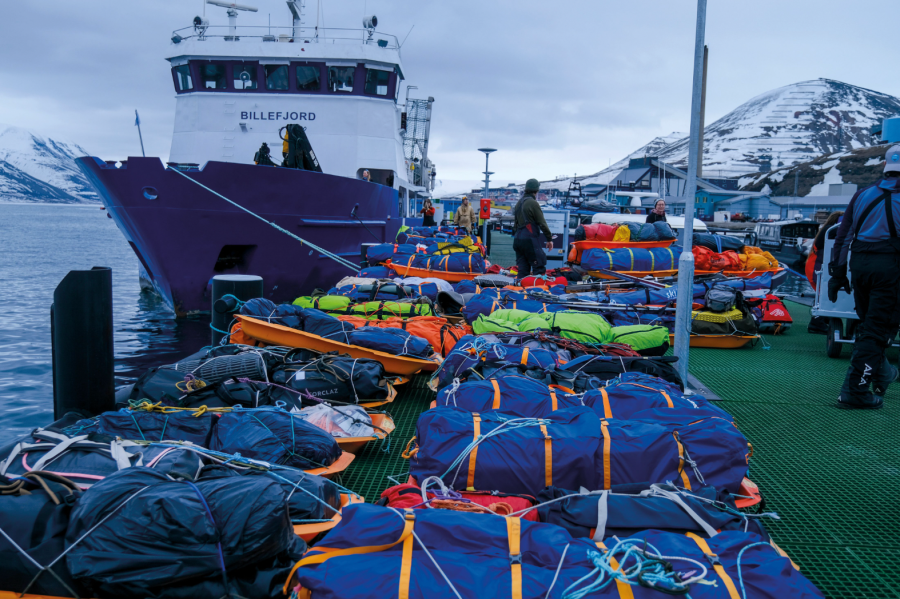
Due to the polar bear threat, we operate night-long polar bear watches. It might seem like a hassle to get up in the middle of the night for a 90-minute look-out. But after being surrounded by people all day and sharing a tent with a snoring buddy, that hour and a half becomes a cherished break, adding to the experience. And for the record, we don’t see any polar bears. They might have seen us, but the misconception that they are constantly lurking, waiting for us at every turn, is best dispelled. Nevertheless, the threat (if not the likelihood) is always there.
McKeown’s favorite wildlife moment from the past year doesn’t involve the off-white, fluffy killing machine either. Just two weeks into her stay, she went camping at a secluded spot 35 miles from Longyearbyen. As she and her fellow students were shuffling gear back and forth between the boat and the shore, a pod of belugas surfaced right next to them. “It blew my mind. And to think the whole area used to be filled with whales was amazing.”
She refers to the abundant whaling in the area during the 16th and 17th centuries. By the late 1700s, however, intensive hunting had driven several whale populations to near extinction, and the Arctic whaling industry collapsed. Although scientists don’t yet see signs of today’s polar bear population declining, their fate is tied to the existence of sea ice. If global warming continues at its current pace, polar bears could face the same fate as whales before the Industrial Revolution.
Polargirl
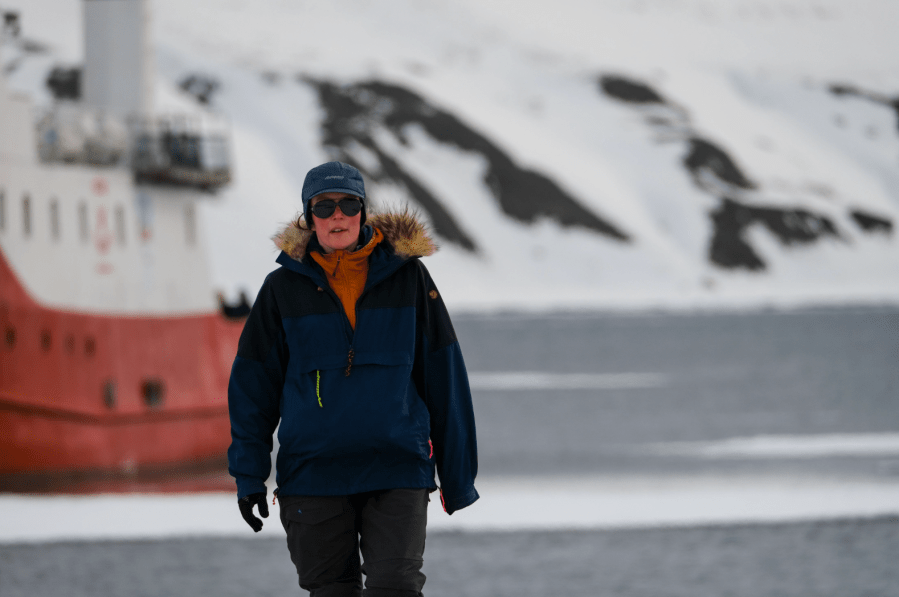
“Is that our boat?” It is the last morning, and through the fog, a vessel emerges. The red and white “Polargirl” steams toward us. Our feelings are mixed. On one hand, we’ve dreamed of the warm cafeteria and waffles waiting onboard all week. On the other hand, our adventure is nearing an end. Every close encounter with Svalbard’s nature leaves a mark. It might be something physical, like a blister or a giant bruise from tumbling down a hill with a 40-kilo pulka and a limp rope. But more often, it’s a mental mark, hard to describe except as otherworldly.
“If I were to describe Svalbard, I’d say it’s like another planet. It’s incredible bringing guests here for the first time,” McKeown chimes in. It’s not only the trip that’s ending, but also her year as an Arctic Nature Guide student. McKeown is heading back to Finse, a village in a national park in the middle of Norway. Here she will continue guiding on skis and teaching hard and soft skills for the winter. “The course has given me a strong sense of confidence in myself. I feel like I’ve had a sneak preview of my potential.” She admits that this preview has also revealed how much more there is to learn.
As guides and guests find a spot for themselves and their luggage on the Polargirl, McKeown’s advice from earlier in the trip resonates. “Take the opportunity to just sit, be, and listen to the wind. Reflect on where you are in the world and how extraordinary this place is. Listen to the silence and marvel at it.”
Head north
Svalbard is a Norwegian archipelago in the Arctic Ocean, almost 1000 kilometers north of the Norwegian mainland. Fly to Oslo, then on to Longyearbyen. You may need to overnight in Oslo.
Several expeditions can be made on Svalbard. Maria began in Ymer Bay, approximately 28 miles from Longyearbyen, covering 40 miles in 6 days. Another popular route is an east – west crossing from Agardh Bay to Isfjord Radio. Boat or snowmobile transfers add significantly to the cost of the trip.
It is forbidden to venture outside the settlement without polar bear protection, and as such, most visitors join guided tours. Several tour companies offer ski trips for a duration of 4 – 12 days. See www.hurtigrutensvalbard.com, www.basecampexplorer.com or www.backyardsvalbard.com.
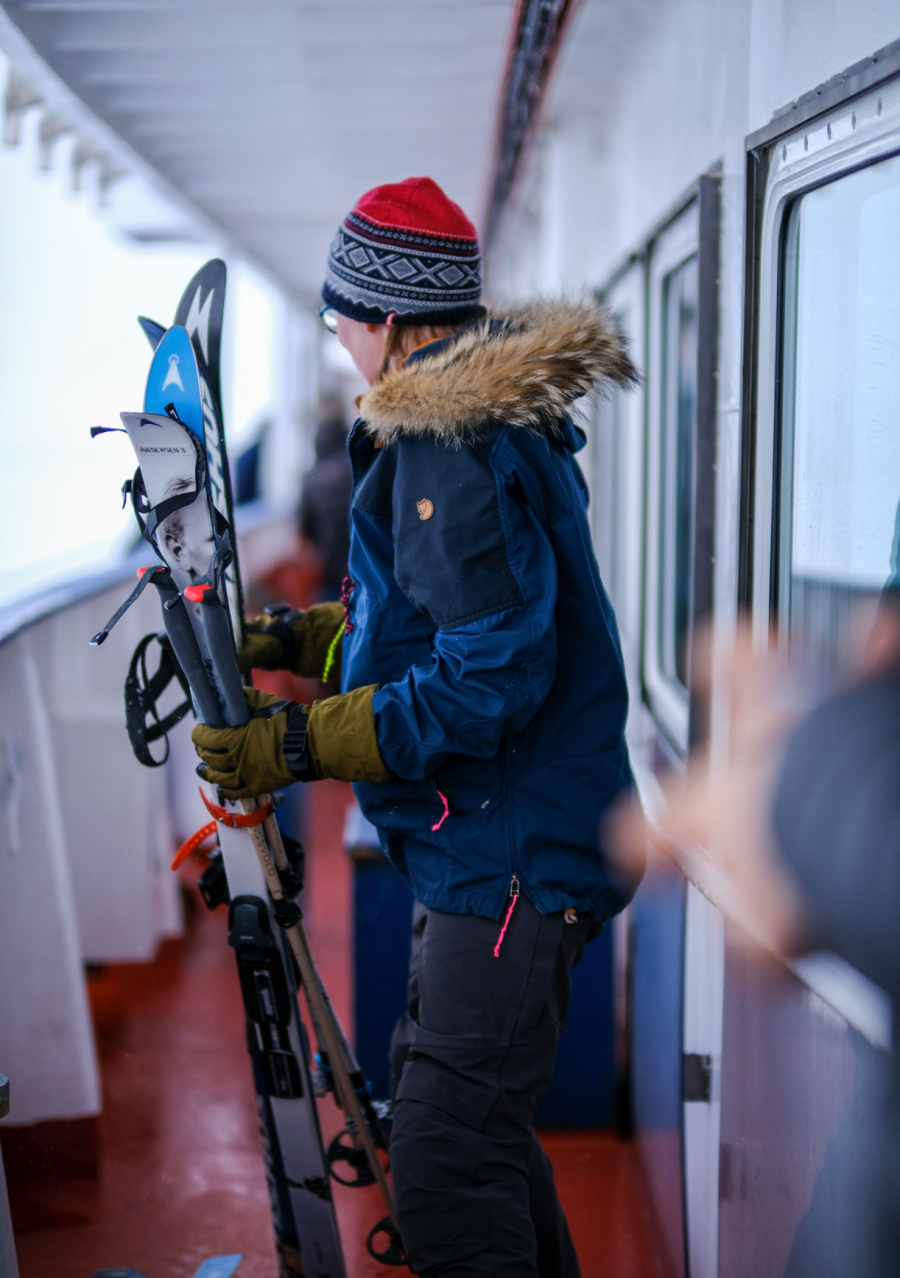
It is possible to go by yourself, but the logistics are demanding. Bear safety (perimeter fence and rifle), full winter and glacier kit are needed, as well as communication equipment (inReach, satellite phone and/or emergency beacon) and a special permission from the Governor of Svalbard if going outside Area 10 – the main area around Longyearbyen.
Need to build up some experience before heading to Svalbard? Jen McKeown has returned to Finse, where she offers guided tours in Hardangervidda national park. See www.snowstormadventures.com.