
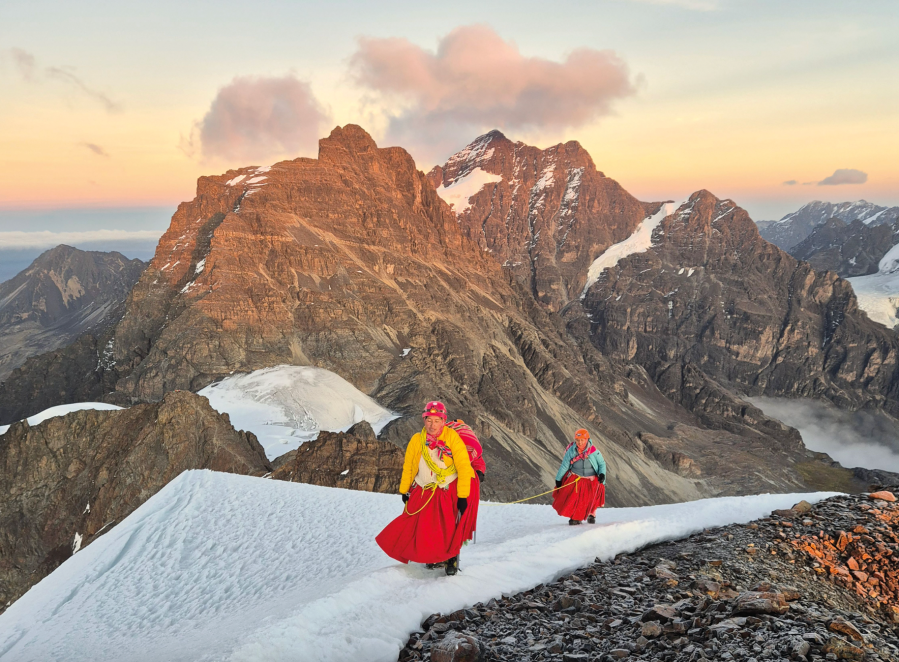
Main image: The final steps to the summit with the Bolivian cholita climbers; Julia and Elena ascending into the sunrise | Credit: Anna Fleming
What do you wear to climb a 6000 metre mountain? For the Cholitas Escaladoras, big-red skirts, three layers of petticoats, cardigans, gloves and a jacket will suffice. Instead of backpacks, they use the aguayo – a colourful Bolivian square blanket – tied in a knot around the chest. Startling images of these women in their huge skirts wielding ice axes and crampons have beamed out around the world.
The Bolivian cholitas have climbed numerous mountains over 6000 metres in the Andes. But who are they? And what is the story behind the image? In June 2024 I travelled to Bolivia, to meet the Cholitas Escaldoras and find out.
Star Struck
I meet Julia, Elena, Alicia and Pacesa in La Paz. They have caught the cable-car down from the neighbouring city of El Alto and we go for lunch in a trendy Bolivian fusion restaurant. I’m a little star struck. I’d seen their pictures online and followed them for some time, impressed and curious about their work in the mountains. Now I’m half-way across the world and they’re sat across the table from me.
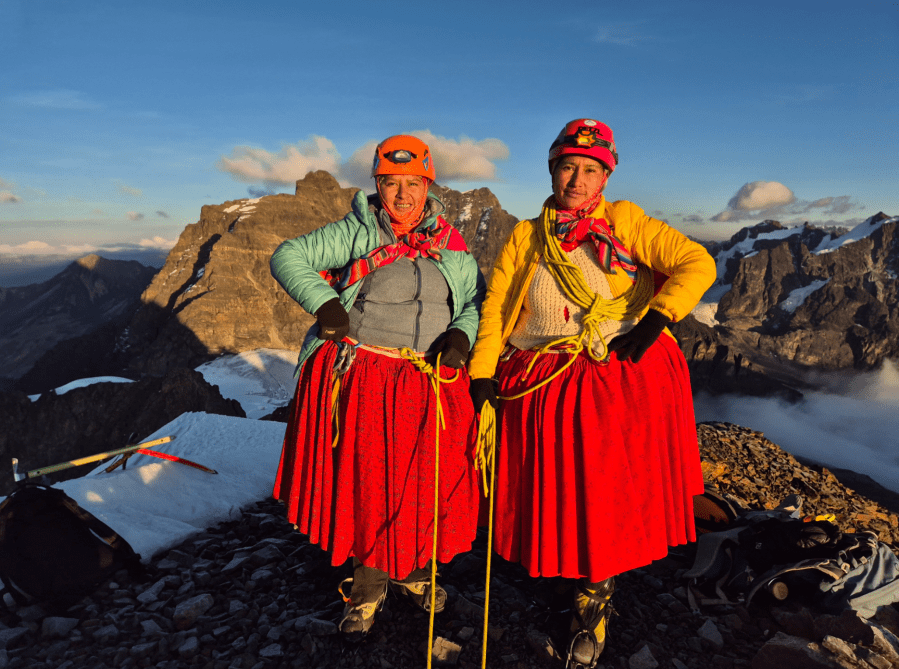
The women are smiley and giggly. A little shy. They talk to each other in Aymara and to Benjamin, our translator, in Spanish. They look amazing, impeccably turned out in big skirts, shawls, earrings and delicate little cholita shoes. I’m miles from home and yet it feels familiar. They remind me of older Welsh ladies in their best shawls, shoes, skirts and cardigans. The cholita style resembles the traditional dress we used to wear to school on Dydd Gŵyl Dewi (Saint David’s Day). But the cholitas wear colours a Welsh woman could only dream of.
The skirt is called the pollera, Julia explains, and it denotes identity. She is wearing a pale pink pollera with pink shoes and two layers of crocheted cardigans on top. Her younger sister Elena wears a flamboyant pollera in hot pink with large black flowers. Her crocheted cardigan is hot-pink to match and she offsets her black cholita shoes with pink socks.
“A woman of pollera is a woman who wears a pollera since she was born,” Julia explains. “From my grandmother to my mother, to me, so I also have my pollera of the Aymara Indigenous people.”
Oppressed but undefeated
As Aymara Indigenous women, the sisters belong to an ethnic group that has lived in the Andes for thousands of years. Aymara civilization predates the Inca. They had sophisticated agricultural systems and kingdoms: Lake Titicaca and the city of Tiawanaku were at the centre of this world. But the Aymara are a colonized people. First by the Inca, then by the Spanish, they became a subordinate peasantry, impoverished in their own lands.
“There was a lot of discrimination,” Elena explains, reflecting on how things have changed in her lifetime. “You couldn’t go into schools to study in pollera, or to offices and public places were very difficult. People would call us cholas! Cholitas! why don’t you go back to the countryside to your sheep, to your llamas to your potatoes to your chuños” (freeze-dried potatoes from an ingenious ancient Aymara method of food preservation).
‘Cholita’ comes from the Spanish word ‘cholo’ or ‘chola’ for women meaning mixed-race or, pejoratively, ‘halfbreed’ or ‘civilised Indian’. The cholitas, with their colourful distinctive feminine style, make easy targets for discrimination.
The Aymara resistance was strong – despite the efforts of the colonisers to exterminate their culture, the Aymara survived. Oprimindo pero nunca vencido! Oppressed but never defeated! These experts in marginal living continued cultivating the potato and celebrating the sacred llama. Their beliefs persist into this day in a hybridised form. Pachamama, the earth-mother, is ever present and the energy from El Alto, the booming Aymara capital city, suggests growing power and status.
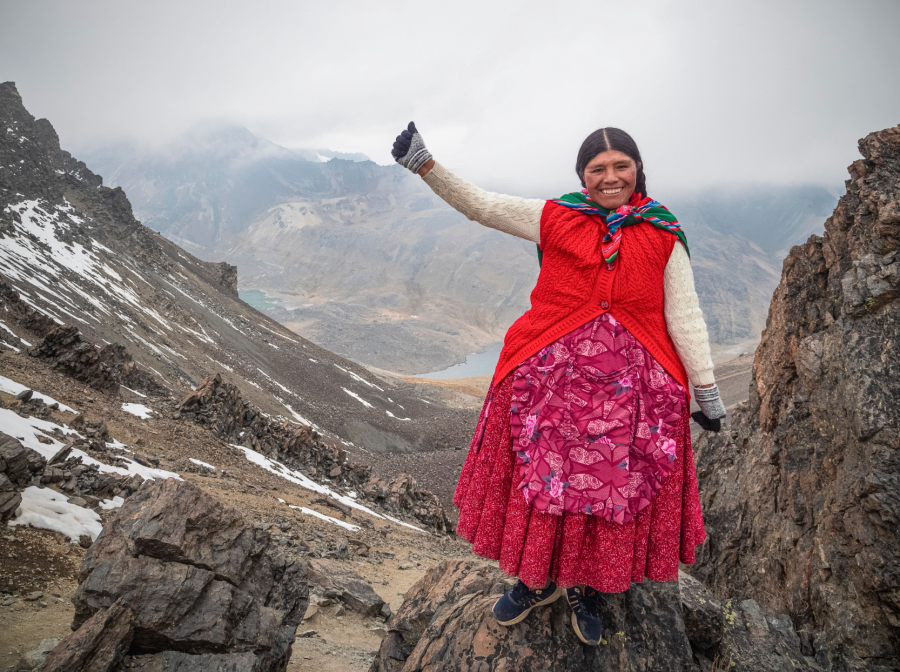
“We’re proud because there was a lot of discrimination that we have overcome,” Elena says. 2005 was the turning point, I am told, when Evo Morales became Bolivia’s first Indigenous president. “When Evo came in we were allowed to enter public spaces and express ourselves.”
Now the Wiphala – the rainbow flag of the Indigenous Andean people – flies on government buildings in downtown La Paz and the pollera itself has become stylish. Cholita wrestling is popular entertainment. But where do the mountains figure in this story of feminine Indigenous empowerment?
Royal Range
The following day we leave the cities behind to explore the mountains together. Away from the noise and petrol fumes, things feel more relaxed. The sky is blue, the Andean sun strong. We take rough rutted tracks into the Cordillera Real, the Royal Range, a line of beautiful jagged black and white peaks rising from the Altiplano, the most extensive high plateau outside of Tibet.
Nearby is the stunning glaciated peak of Huayana Potosí. This mountain is very popular with tourists and guides – the Beinn Nibheis (Ben Nevis) or Yr Wyddfa (Snowdon) of the region – except Huayana is 6088 metres high. Guides stage the climb over several days to allow for acclimatisation.
Huayana Potosí was the first peak that the cholitas climbed in 2015. Alicia, the oldest sister, was the first to go to the summit. The media went crazy: ‘A Cholita has climbed Huayana Potosí!’ They couldn’t believe it. Alicia wanted to climb more mountains, so she went back to her village and got her sister Julia. Julia was 22 and had three young children, but her husband, a mountain guide, encouraged her. Together the sisters climbed Illimani, a mountain that is higher and more complex than Huayana. ‘My boots were very uncomfortable,’ Julia remembers. ‘They were many sizes too big.’
Another media frenzy ensued after Illimani but Alicia and Julia felt uncomfortable with all the attention focused on just them alone. Alicia suggested they share it around, and a group of Cholitas climbed Huayana Potosí. “Why can’t we do the same as men,’ they wondered. ‘Why not demonstrate how women in skirts are strong?”
Basecamp procession
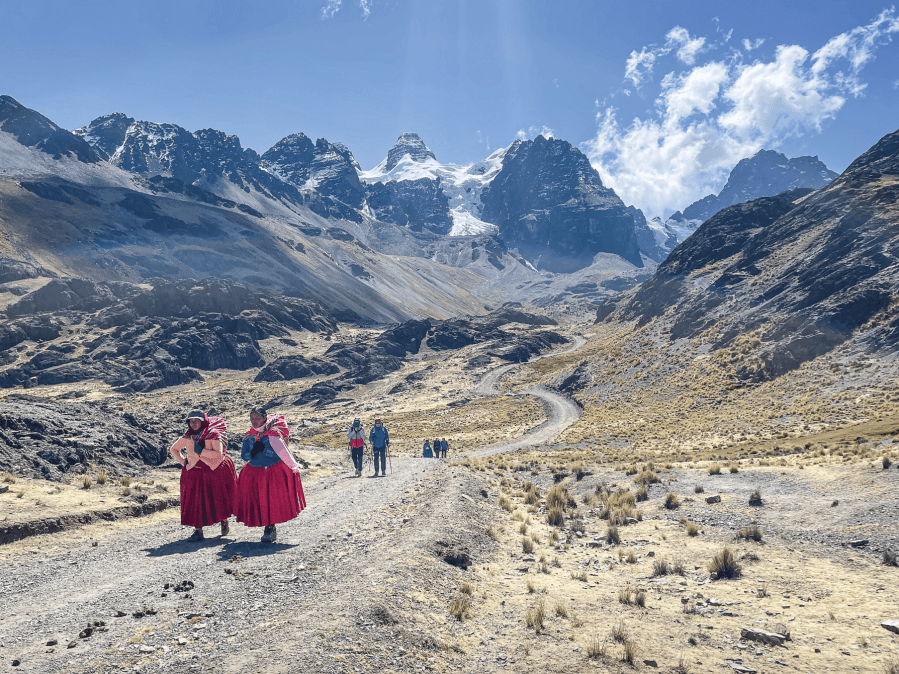
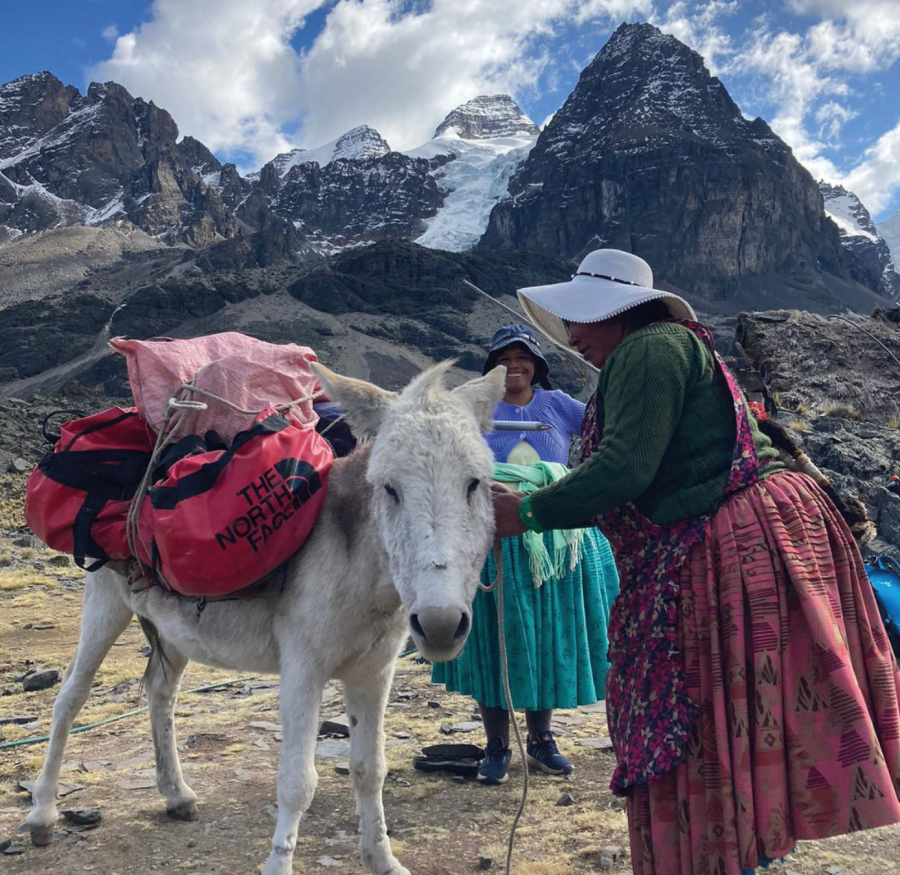
At the end of the road into the mountains we park up. Our bags are loaded onto mules for the last stage of the journey to basecamp. Julia oversees the logistics, walking back and forth in the dust in her delicate pink heeled cholita shoes. Her style and pride in dress is unerring. My approach shoes seem drab in comparison.
We have a lunch of chicken and rice, a pot-luck of llama, sweet fingerling potatoes and coca-cola – then Julia changes into walking boots. “Sarjañani”, she says in Aymara. Let’s go!
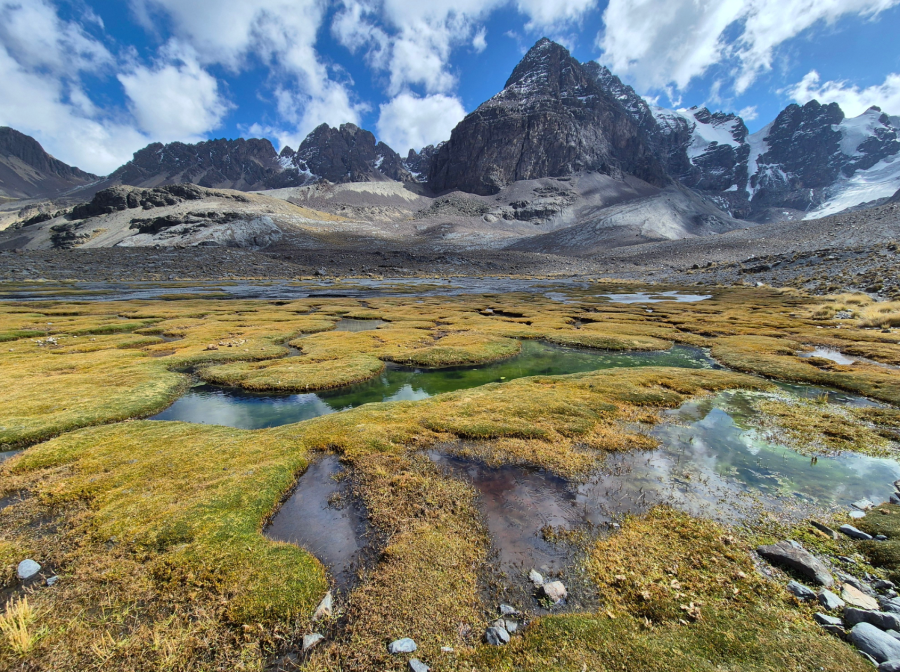
We walk in through beautiful mountain scenery with Julia and Elena leading. A river flows beside us and rocky peaks tower overhead, lined with tropical glaciers. My friend Shauna walks beside me and behind us is Pacesa with our translator, Benjamin. Our group feels processional: powerful, fun and ultra-feminine. My eyes keep returning to the cholitas’ skirts and aguayos. I’m mesmerised by the vibrant pinks, reds, greens and yellows. It is astonishing to be out with so much colour in the mountains. Their style is utterly distinct from the utilitarian trousers of the European hiker.
We meet a group of men on route to basecamp – tourists from Argentina, Mexico and the Netherlands. They want photos with us. This is repeated whenever we meet foreign visitors. Going into the mountains with the Cholita Climbers is to go with celebrities.
When the Cholitas started climbing in 2015, they were already familiar with tourism and the mountain environment. Many had worked as porters and high-altitude cooks, but they had never climbed to the summits themselves. That was for male guides and western tourists. “I started out as a porter”, Pacesa explains. “In my town there was no work, so we dedicated ourselves to working with tourists. I worked as a porter in Huayna Potosí, Illimani and Sajama, then an agency told me that if you’re carrying, you can cook, and so I cooked everything for the clients.”
People noticed that she was strong and good at hiking so she began guiding people up smaller peaks. Then in 2015, she joined the Cholita climb of Huayana Potosí. Her first climb was exciting and emotional, Pacesa recalls. After walking on ice for many hours, “When I reached the peak I felt that I was flying in the sky. I was very excited, and I wanted to cry.”
In their early climbing days, the cholitas encountered a macho mountain culture. Men told them they shouldn’t climb and definitely not in their pollera. “They told us we would make accidents happen up there and that the glaciers would melt because of us,” Elena says, “and then there would be no water anymore.”
“Why?” I ask. This seems crazy. “No one had seen a woman in pollera climb before,” Elena explains. “They were jealous, they were worried maybe that the cholitas climbing would take away their work.” Now it’s funny, they say, because the same men seek them out to work with them. Their clients want to meet the cholitas, to learn their stories and have more confidence if they go with the cholitas. In Bolivia, a country of revolutions, the cholitas have staged their own in the mountains.
High altitude magic
We hike up Pico Austria and the cholitas share more of their story. They have done courses and worked hard to get the expensive equipment required for the mountains. As role models, they use their platform to inspire other women. ‘It’s really important as Aymara Indigenous women to not put limits, to confront obstacles,’ Elena says. “Each one has her own challenges, limits and obstacles within herself and she has to confront these things and summit her own peak within herself.” While Elena is talking about Aymara women, the message feels universal.
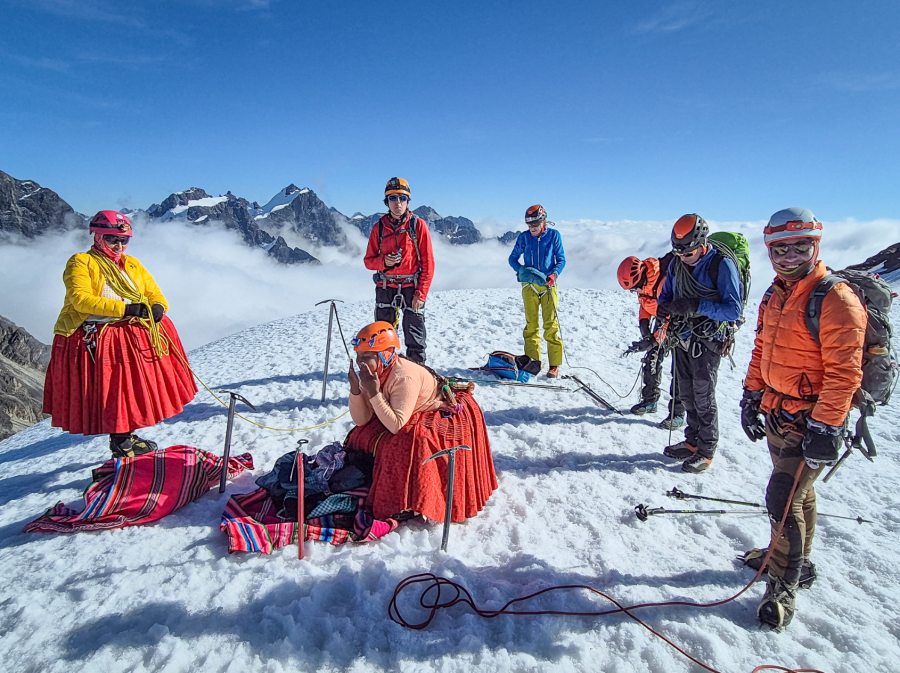
The next day, we take on a bigger challenge. At midnight my alarm sounds. I clamber out of my sleeping bag, tired and excited. After breakfast and coca tea, we begin walking under the moon and stars. At the foot of the glacier, we put on harnesses and crampons, tie into the rope and get our ice axes ready to climb Pequeño Alpamayo, a glaciated peak.
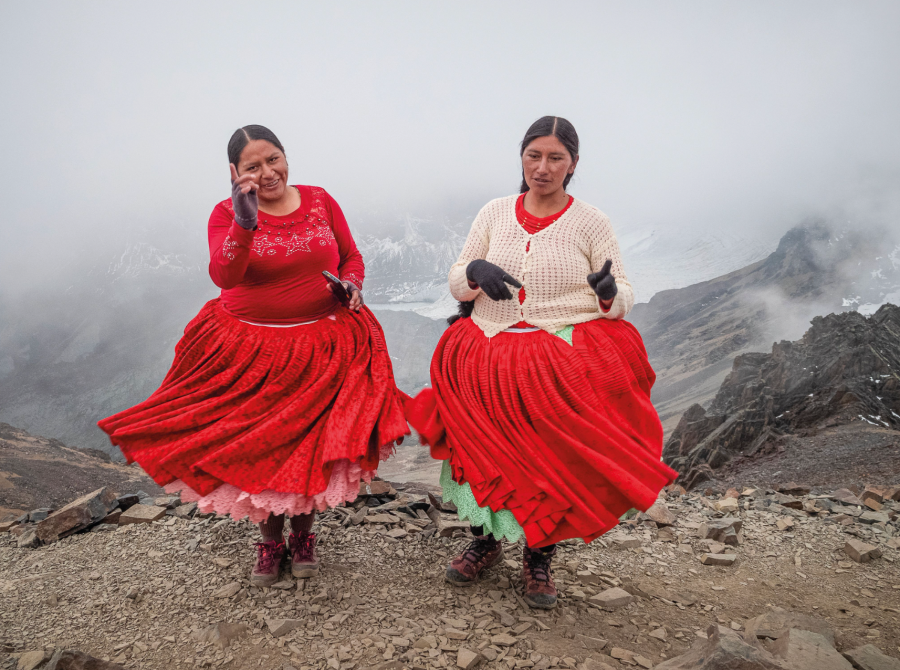
One step after another, the crampon teeth bite into the ice as we climb the glacier. In their pollera and petticoats, Julia and Elena use careful footwork to avoid tearing their skirts. At the first summit, we pause. We’re ahead of schedule and there’s phone signal. Sheltering in the rocks, Bolivian Tik-Tok and giggling resumes. Julia and Elena are relaxed and comfortable up here.
I feel tired and a little queasy as we continue to the final summit. My legs, lungs and heart are working hard in the thin air. Julia and Elena keep a steady pace. Dawn is approaching; it’s cold and their skirts billow in the wind. The darkness passes and beyond the mountains, we look down on an ocean of cloud covering the Amazon basin.
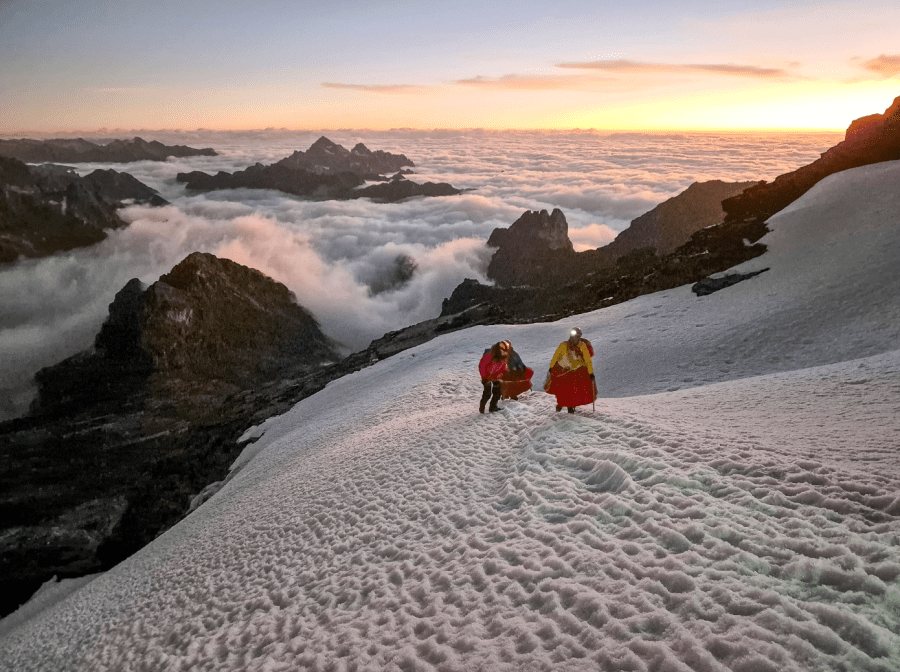
“¡Felicidades! ¡La Cumbre!” We reach the top of Pequeño Alpamayo, at 5370 metres. There is a surreal sense of high-altitude magic. Someone has brought a beer up, and at 7am, we share the cerveza, toasting Pachamama. I feel so inspired and happy climbing this mountain with these women.
From Bolivia to Peru and Argentina, over the last decade the Cholita Climbers have summitted the highest mountains in the Andes. Now they have their sights set on another goal. They want to be the first women to stand on top of the world wearing skirts. The Cholitas Escaladoras are training to climb Everest. “We are going to carry a white flag to the highest mountain in the world,” Elena reveals, “We want to carry a white flag to the violence, to the femicides, to stop discrimination and so there will be peace and freedom.”
Their vision is sky-high. And why not? When we part ways, we swap details and vow to stay in touch. They would love to visit Scotland one day.
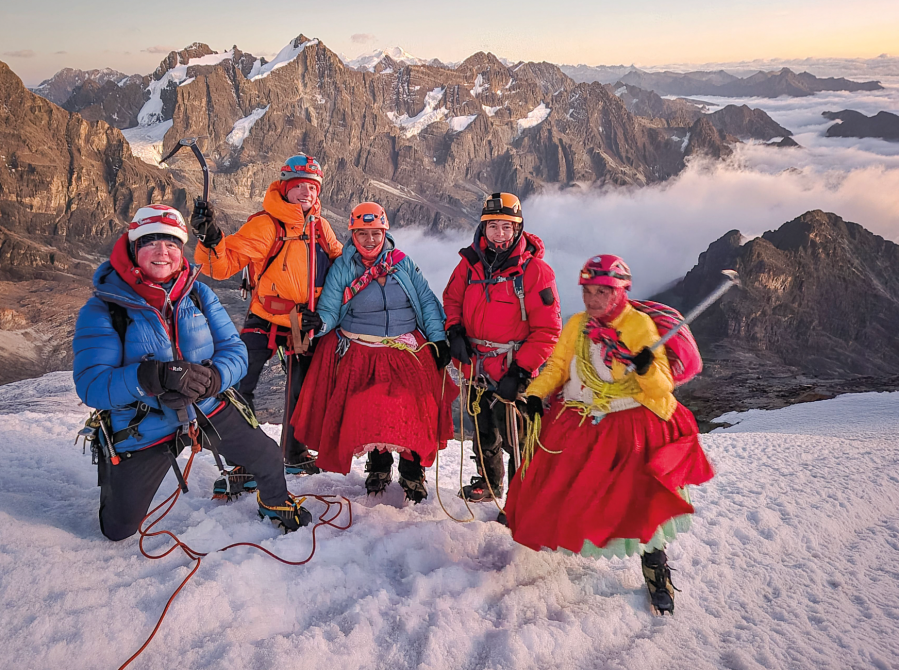
“Soñar no cuestra nada,” adds Elena. It costs nothing to dream.
Trek and climb with the Bolivian Cholita Climbers
The Cholita Climbers are based in La Paz, Bolivia and are available as climbing and trekking guides in the mountains of the Cordillera Real. They offer multi-day mountain climbing expeditions of popular peaks like Huayana Potosí (6088m) and Illimani (6432m). They also offer multi-day trekking routes through stunning mountain scenery.
Anna’s package expedition to Condorriri Basecamp included transport, food, accommodation and guiding. Equipment is also available for hire.
Packages can be booked through Mountain Illimani. This company is owned by an amazing woman, cholita Flora Chura. Her company is the only female and cholita-run tour operator in La Paz. Flora’s company offers climbing and trekking packages, which can include transport, food, guiding, equipment and accommodation. Mountain Illimani has an office on Calle Sagarnaga, La Paz.
The Cholita Climbers – Julia, Elena, Pacesa and Alicia Quispe – can be reached through their Instagram @cholitasescaladoras and via via Whatsapp +59175805858. You can contact them directly to arrange tours, treks or climbing expeditions. Their packages can include transport, food, guiding, equipment and accommodation.