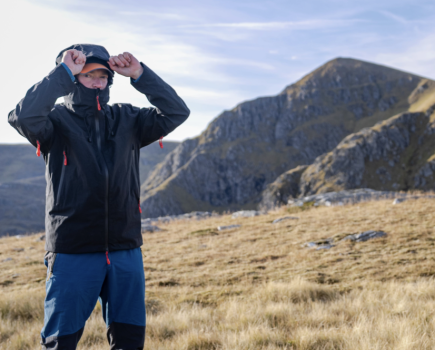

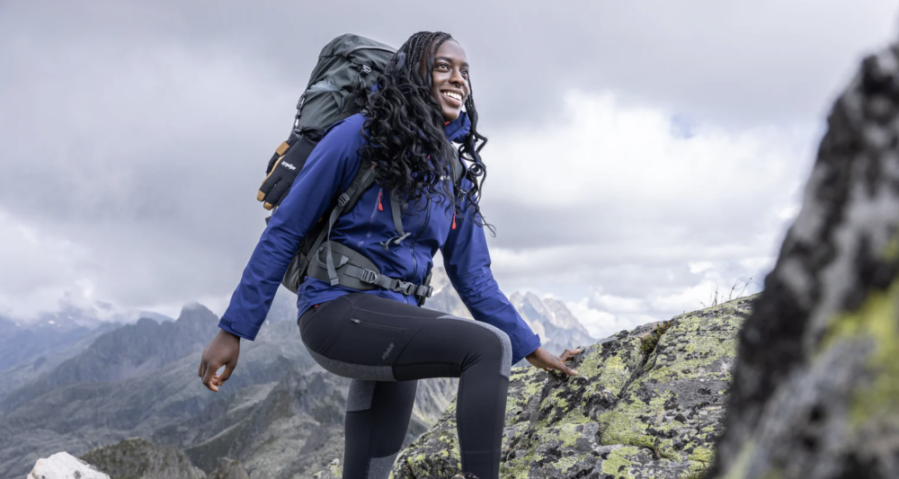
In a very maritime climate, waterproof jackets are one of the most important bits of kit we carry, and making sure they’re right for us requires fit, fabric and features to work together. Obviously, their main job is to keep us dry, but that’s not just from the weather on the outside. We do need them to shed rain, snow and drizzle, and we also need them to breathe and let our sweat out so we’re not wet on the inside. It’s a compromise, because a more breathable membrane is generally less waterproof and vice versa. And at the end of the day, the biggest flaw in hardshell jackets is all the holes for our heads and hands, so water will inevitably get in if it’s really wet!
Main image: The Alpkit Balance | Credit: Alpkit
Waterproof hardshell jackets are often designed for a specific activity and suit that well, but can still be used for others. Think about what you want to do and when, and then find one will do most, acknowledging that a winter mountaineering jacket and trail running jacket will look and behave quite differently.
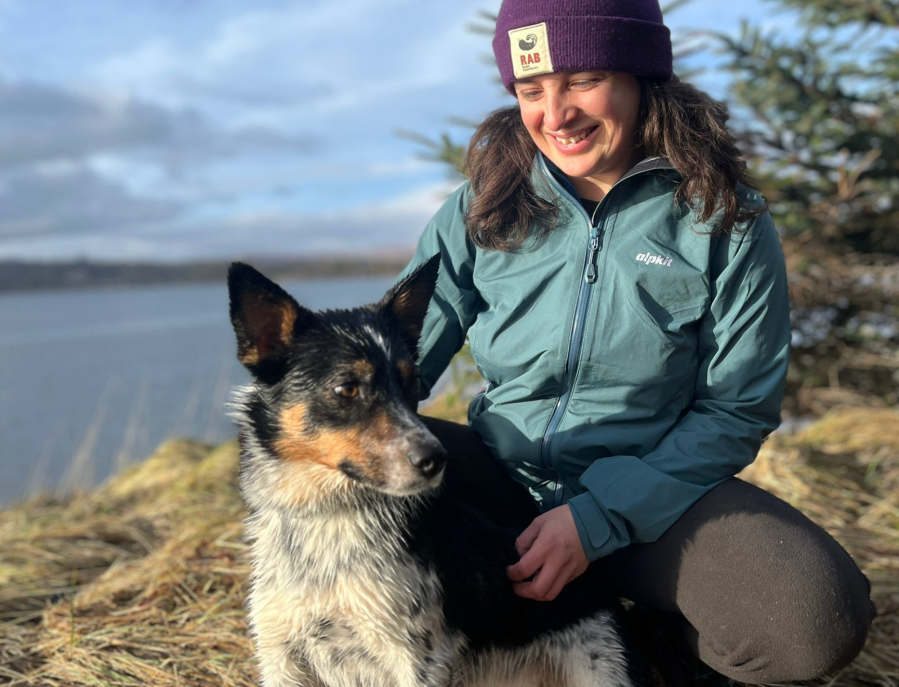
A few features that are important to get right are pockets, fit, hood style, and cuffs. It’s possible to compromise in other ways, but making sure hoods and cuffs fit over layers and gloves, as well as having a good number of pockets in the right place makes life much easier.
Waterproof jackets are often one of the pricier things we buy, so making sure it has everything we want as well as may want if we take up new activities is a big ask! Given how life saving they can be though, it’s not usually a place to scrimp, as you’ll find yourself replacing cheap jackets again and again while one with a higher price tag will last. Winter jackets are often pricier, so if you know you’re not out in full on winter conditions, it may be possible to opt for a lighter, less expensive option.
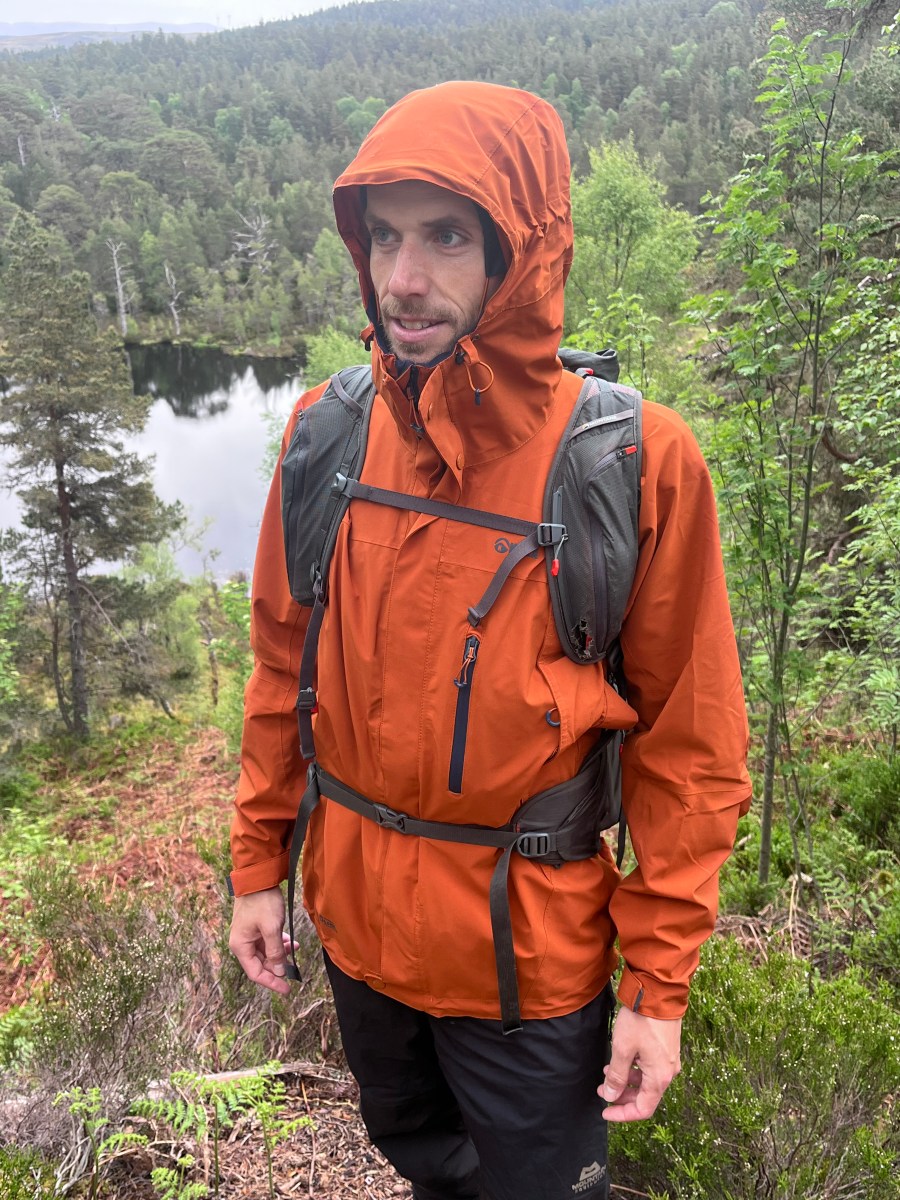
Why you can trust The Great Outdoors
The Great Outdoors is here to help you make the most of your time outside. We have been helping people to explore from sea to summit, valley to mountain top for over 40 years. Our gear tests remain completely impartial. If you are wary of websites that only review brands that advertise with them, or sceptical of social media accounts always singing the praises of their latest freebie, you’ve come to the right place! Our reviews rank #1 for rigour, trustworthiness, and independence, and our gear testing team is the most experienced in Britain. With over 200 years’ experience between us, we are professional mountain leaders and instructors, wildlife photographers and rangers, outdoor authors, guidebook writers and trail addicts.
The best waterproof jackets we’ve tested
This guide contains of the best hardshell jackets according to our experts. Most of these are three-season hardshells but there are also options that will suit tough winter trips in snow too. The jackets have been chosen on the basis of their protection, breathability and durability, with weight, packability, features, fit sustainability and value influencing our decisions, too.
If you’re looking for something more lightweight, here’s our roundup of the best rain jackets. If you’re on a budget, check out our round up of the best value waterproof jackets.
| Quick List |
|---|
| Best for mountain extremes: Helly Hansen Odin Ultimate Infinity (available from Helly Hansen) |
| Best waterproofing system: Keela Prosport (available from OutdoorAction) |
| Best three-season versatility: Alpkit Sigma (buy now from Alpkit) |
| Best breathability: Montane Cetus Lite (buy now from Montane) |
| Greener Choices: Tierra Vastra / Fjallraven Keb GTX |
| Best Value: Highlander Munro V2 – buy now from Highlander |
| Lightest in Test: Rab Phantom Mountain (available from Rab) |
Best for extremes
Helly Hansen Odin Ultimate Infinity
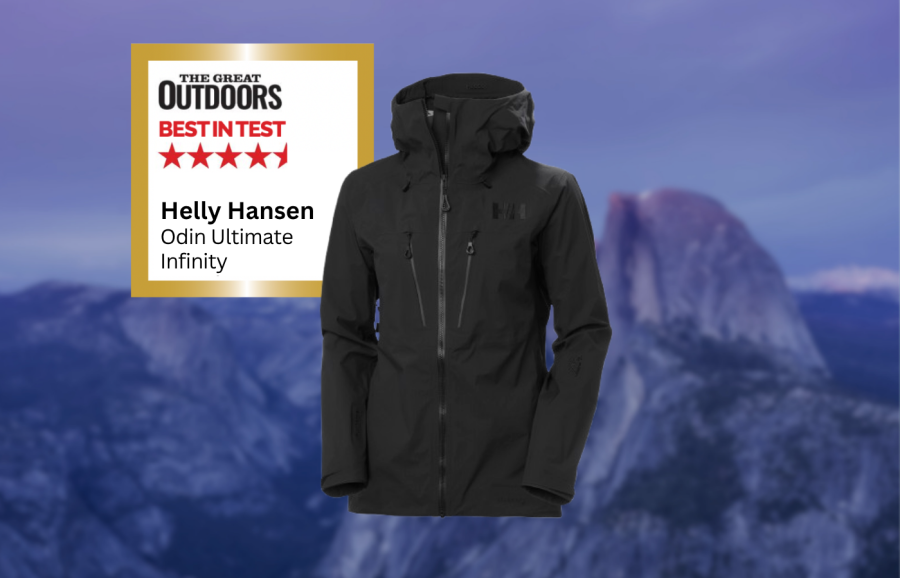
Lara Dunn’s Best in Test
With all the bells and whistles, this is definitely the “Ultimate Allfather” of mountain jackets.- light
- packable and protective
- RECCO reflector
- versatile
- slightly flimsy hood drawcord
| Quick specs |
|---|
| Price: $475 / £460 (available from Helly Hansen) |
| Weight: 381g (size L) |
| Materials: HELLY TECHÒ professional fabric with LIFA INFINITYä membrane. 100% Polyamide |
| Hood: Volume adjuster and stiffened peak |
| Front Closure: Water resistant zip with storm flap |
| Underarm/Side Zips: Yes |
| Pockets: 2 large front chest pockets |
| Hem: Drawcord adjustment |
| Cuffs: Velcro |
| Sizes: XS – XL |
| Women’s version: Yes |
| www.hellyhansen.com |
With the Helly Hansen Odin Ultimate Infinity jacket, the clue is in the slightly hyperbolic name. Helly Hansen has used its long-standing expertise in extreme conditions protection to create a garment designed to be the one jacket you’d need for even the toughest and most demanding environment, no matter whether you’re a hiker, mountain guide, ski tourer or mountaineer. The jacket has all the bells and whistles. The jacket is very light and packs down small enough to be easily packable in a daypack for “just in case” useage, but it’s eminently capable of so much more than that! Out on the hill, it’s superbly protective, yet comfortably breathable with no overheating or moisture build-up issues thanks to its breathable fabric and the inclusion of pit zips.
The peaked hood wraps nicely around the head, with room for a helmet if needed. The roomy pockets are above the harness line and the sleeves are a good length, with easy-to-use Velcro adjustment at the cuffs. The inclusion of a RECCO reflector in the hood is a nice added extra for anyone likely to be in the mountains in winter and adds to the jacket’s versatility for snow as well as mountain sports. Definitely the “Ultimate Allfather” of jackets.
Read more: Lara’s full Helly Hansen Odin Ultimate Infinity jacket review
Best waterproofing system
Keela Prosport
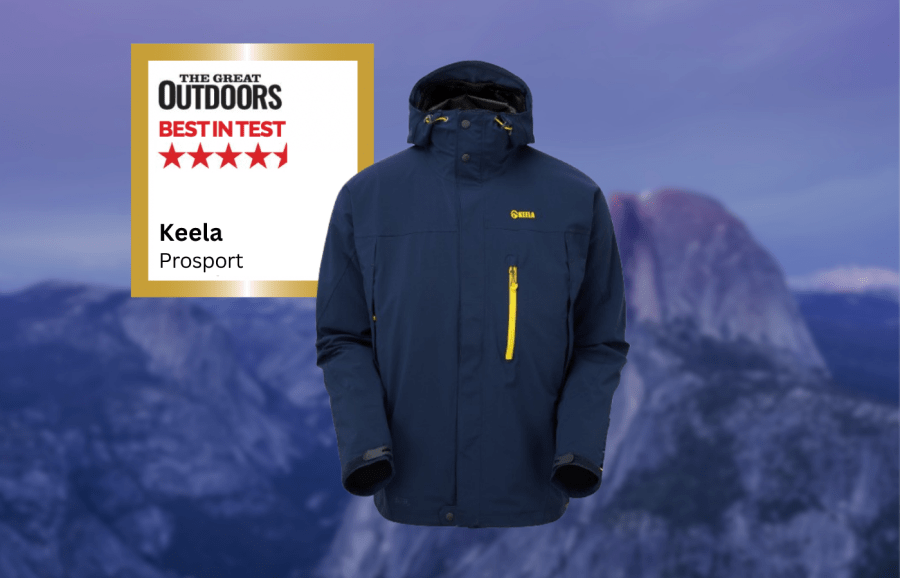
James Roddie’s Best in Test / Best Value
It is far more affordable than many other jackets on the market and its waterproofing system really is excellent, particularly when compared directly to far more expensive alternatives.- low cost
- versatile
- excellent waterproofing
- plenty of features
- heavy materials
| Quick specs |
|---|
| Price: £164.95 (available from OutdoorAction) |
| Weight: 820g (Size S) |
| Materials: Keela Prostretch |
| Hood: Wired peak with three-way volume adjustment |
| Front Closure: Zip, external storm flap and stud |
| Underarm/Side Zips: yes |
| Pockets: 5 |
| Hem: Drawcord adjustment |
| Cuffs: Velcro |
| Sizes: XS – XL |
| Women’s version: Yes |
| keelaoutdoors.com |
The Keela Prosport lies in the middle of Keela’s jacket price range, with an RRP of £164.95, and is designed for a wide range of use. It uses the Brand’s own Dual Protection waterproofing/condensation control system, involving a waterproof outer layer, with an ‘air gap’ between this and a moisture-wicking inner layer laminated with a hydrophilic membrane. This is intended to reduce international condensation – a common problem during cold and wet conditions. I’ve been really impressed with it. The outer layer seems to keep out even prolonged torrential rain, and it’s impressively breathable.
This is a jacket which can be comfortably used in winter conditions. The fabric cheek patches around the collar give a cosy, warm feel around your face when the main zip is fully closed, and I felt this made quite a difference on particularly damp and chilly days. Yet the combination of breathability and the underarm vents allows this jacket to be used comfortably in milder conditions as well. This versatility is a major selling point of this jacket for me. There are 5 pockets in total, with one large enough to take a paper map. Other useful features include a roll-away hood and a snap fastener for keys.
Read more: James’ full Keela Prosport review
Best three-season versatility
Alpkit Sigma
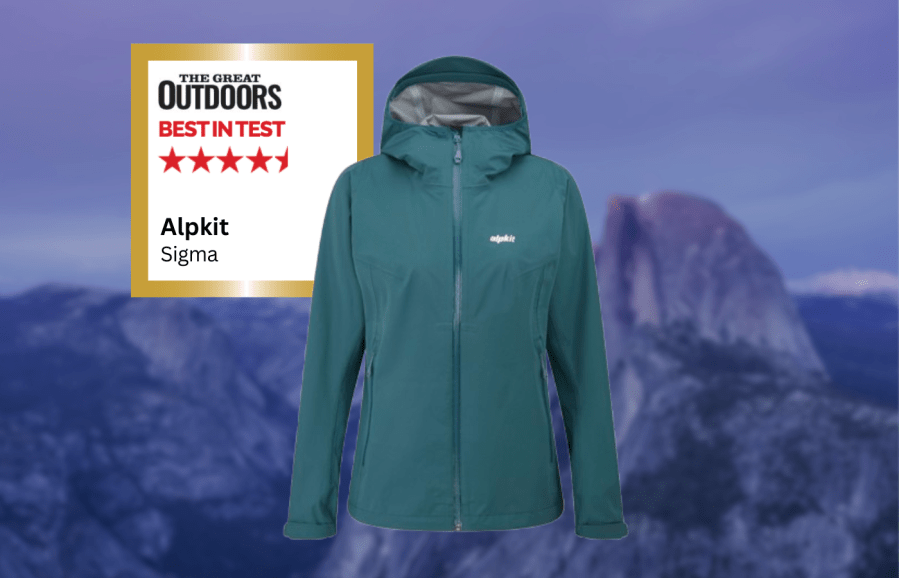
Kirsty Pallas’ Best in Test and Greener Choice
The Sigma should work for many people and activities due to its light weight and its price. The eco credentials are an added bonus.- low profile fit
- neat cuffs and hood
- Pockets sit under rucksack or harness waist strap
| Quick specs |
|---|
| Price: $220 / £169.99 (available from Alpkit) |
| Weight: 340g (size 10) |
| Materials: 100% recycled polyester with PFC free DWR coating |
| Hood: Wired peak, volume adjuster, elasticated sides |
| Front Closure: YKK Aquaguard zip with inner storm flap |
| Underarm/Side Zips: No |
| Pockets: 2 large hand pockets |
| Hem: Drawcord adjustment |
| Cuffs: Elasticated with velcro |
| Sizes: 6 – 20 |
| Men’s version: Yes |
| alpkit.com |
The Sigma is a nice three season jacket from Alpkit, and highlights their commitment to sustainability by not only using 100% recycled materials, but making sure they can all be recycled again at the end of the jacket’s life. I really like the fit and feel of the jacket. It’s neat without being overly tight, and it has a flexible feel, in part due to not using a Gore-Tex membrane. It dealt with all rain I experienced without issue and, as with most modern fabrics, keeping it clean will help it to continue to do so.
The price point and lighter weight mean it should work for a wide range of people and for a range of activities. I plan to use it climbing, walking, mountaineering and biking, all of which it will manage with ease.
Read more: Kirsty’s full Alpkit Sigma review
Best breathability
Montane Cetus Lite
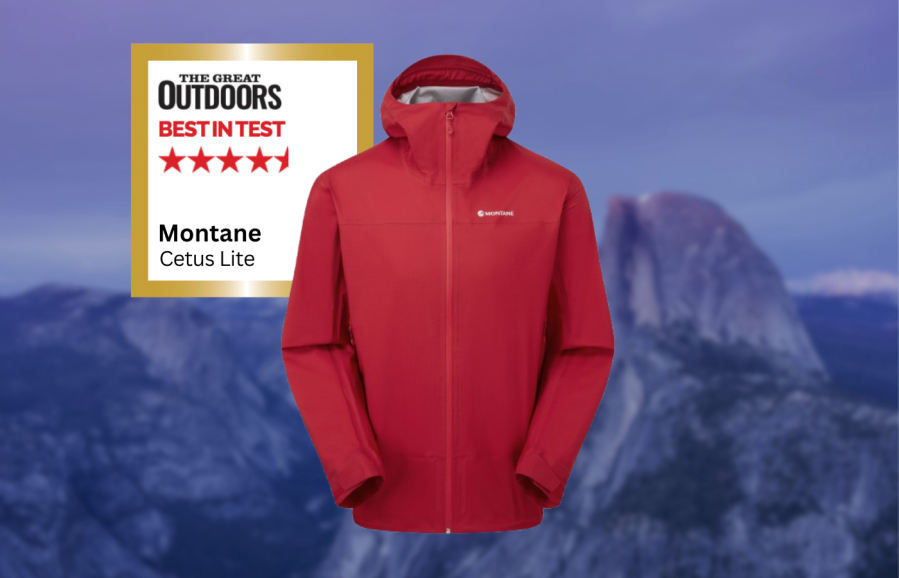
Chris Townsend’s Best in Test and Greener Choice
I think this is a superb three-season hillwalking and backpacking jacket. It’s also my Greener Choice.- breathability
- lightweight
- soft fabric
- recycled fabric
- front drawcords inside jacket
- no chest pocket
| Quick specs |
|---|
| Price: $349 / £270 (available from Montane) |
| Weight: 335g (XL) |
| Materials: PFC – free recycled nylon, hydrophilic polyurethane membrane |
| Hood: front and rear adjustment, wired stiffened peak |
| Front Closure: YKK AquaGuard Zip, inner flap |
| Underarm/Side Zips: No |
| Pockets: 2 hand pockets |
| Hem: Drawcord adjustment |
| Cuffs: Velcro |
| Sizes: S – XXL |
| Women’s version: Yes |
| montane.com |
The Montane Cetus Lite is made from the brand’s new Petrichor Technology, which has a hydrophilic membrane that not only claims to be ‘extremely breathable’ but also to breathe better the harder you work. Big Claims! How do they stack up? Pretty well, in fact.
I’ve worn the jacket in many hours of heavy rain in a wide range of temperatures and wind speeds and have stayed fairly dry inside. Not totally – there has been some condensation at times – but certainly drier than in many other waterproofs. In tests, Petrichor Technology has a Ret value of <5, which puts it in the ‘very good or extremely breathable’ category. I’d agree with ‘very good’. I don’t think any waterproof fabric suitable for the hills is ‘ extremely’ breathable.
Read more: Chris’ full Montane Cetus Lite review
Greener Choice
Fjallraven Keb GTX
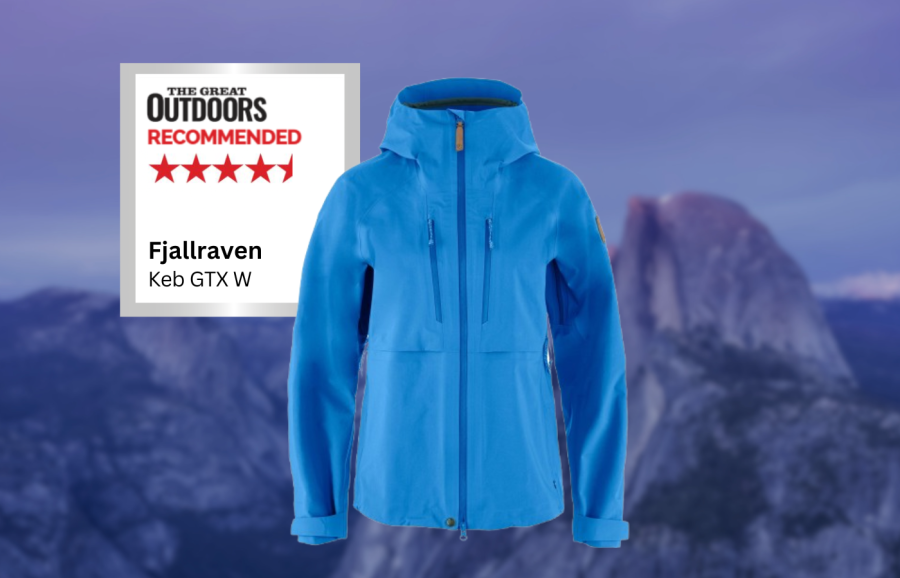
Lara Dunn’s Greener Choice
This is an all but perfect jacket for someone needing high performance matched by low weight and bulk.- very tough
- light
- packable
- breathable
- versatile fit
- expensive
- high, stiff collar
| Quick specs |
|---|
| Price: $640 / £550 (available from Fjallraven) |
| Weight: 443g (size L) |
| Materials: GORE-TEX Performance – 3-layer Plain Weave Laminate: 59% polyamide 70D (recycled), 21% ePE/polyurethane, 20% polyamide 15D. PFAS-free |
| Hood: Volume adjuster and stiffened peak |
| Front Closure: Water resistant zip with storm flap |
| Underarm/Side Zips: Yes |
| Pockets: 2 large chest pockets, 1 small interior zipped pocket |
| Hem: Drawcord adjustment |
| Cuffs: Velcro tab |
| Sizes: XXS – XXL |
| Women’s version: Yes |
| www.fjallraven.com |
At this price a jacket has got to be quite special, but the Fjallraven Keb GTX Jacket W actually is, I’m happy to report. It’s a do-it-all highly protective waterproof jacket that is light and non-bulky enough to ride along in a rucksack for long multi-day treks or shorter day hikes, but that offers enough protection and a versatile fit to allow for layering underneath for colder conditions or higher mountain use. The lightweight but tough 3-layer Gore-Tex fabric is made from recycled materials and the waterproofing treatment is PFAS-free, making it a good choice for those looking for a more environmentally conscious option.
It breathes very well, and on high intensity days or when it’s especially warm and wet, the generous pit zips do a great job and the sleeves can be pulled up if required. The zip pulls and toggles are glove friendly, adding to its ease of use in cold conditions, and the hood is large enough to accommodate a helmet underneath. With the hood cinched in and the jacket fully zipped up, there’s no way any rain or snow is getting inside. The twin generous zipped pockets outside are joined by a small, zipped security pocket inside that is big enough to keep a smartphone cosy, warm and functioning, adding to the year-round practicality of the jacket.
Read more: Lara’s full Fjallraven Keb GTX Jacket W review
Patagonia M10 Storm
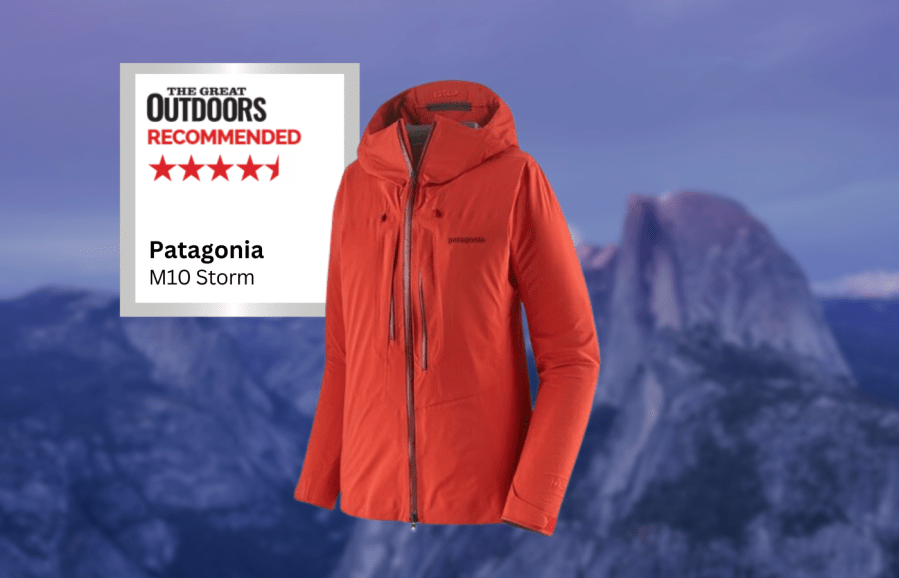
Kirsty Pallas recommends
The barely there feel, with a bit of stretch, makes this a great option for mountaineering as the jacket moves with you.- weight
- neat fit
- price
- durability
| Quick specs |
|---|
| Price: $465 / £360 (available from Cotswold Outdoor) |
| Weight: 279g (size small) |
| Materials: 100% recycled nylon H2No shell with DWR finish made without added PFAS |
| Hood: Stiffened peak with Recco strip, volume adjusters at back and sides |
| Front Closure: 2 way waterproof zip with internal storm flap |
| Underarm/Side Zips: No |
| Pockets: 2 napoleon pockets of different sizes |
| Hem: Drawcord adjustment |
| Cuffs: Velcro |
| Sizes: XS – XL |
| Men’s version: Yes |
| eu.patagonia.com |
Patagonia’s new M10 range really is incredibly light – I didn’t believe there was anything in the box when the Patagonia M10 Storm jacket arrived! The range has been designed for use in Alpine climates, and you can feel that in the jacket as soon as you put it on. It has a barely there feel, with a bit of stretch in the fabric, making it a great option for climbing and mountaineering as it just moves with you. The waterproof membrane is Patagonia’s own H2NO and the jacket is a three-layer design.
My main concern with this jacket is the durability in the waterproofing in UK winter conditions, as generally a lighter weight garment will let water through quicker than a thicker one. Given that on around half my winter days out my jacket will wet out, I’ll be reaching for this one when there’s more Alpine like conditions with drier weather or lower freezing levels.
Read more: Kirsty’s full Patagonia M10 Storm review
Greener Choice
Tierra Vastra
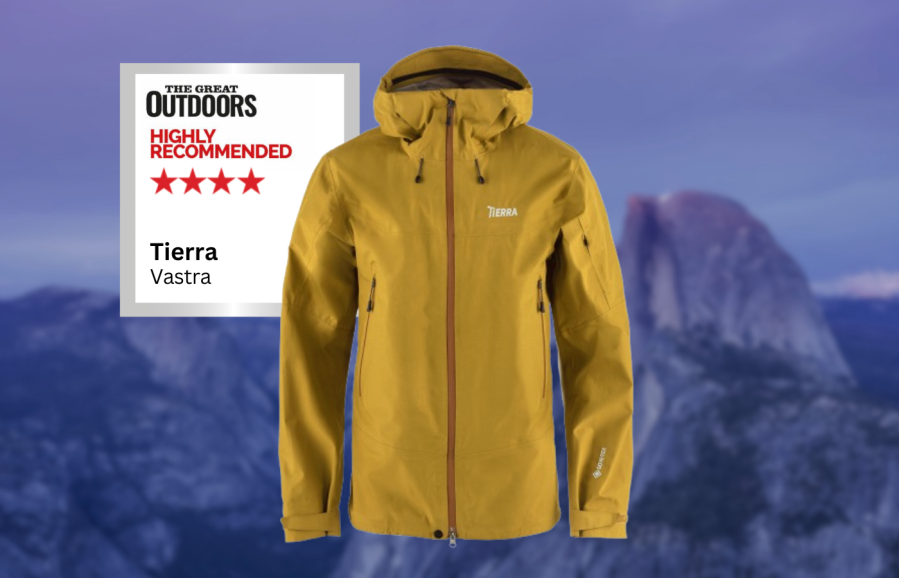
Chris Townsend highly recommends
It is an excellent jacket and suitable for year-round use, though perhaps a little heavy for summer. It’s also my Greener Choice.- ePe Gore-Tex
- hood
- pockets
- side zips
- not that light
- cost
| Quick specs |
|---|
| Price: $465 / £360 (available from Trekitt) |
| Weight: 530g (L) |
| Materials: PFC – free 3 – layer ePE Gore – Tex polyester/polyethylene |
| Hood: front and rear adjustment, wired stiffened peak |
| Front Closure: YKK front zip, inner flap |
| Underarm/Side Zips: side |
| Pockets: 2 mid, 1 sleeve, 2 stretch inner |
| Hem: Drawcord adjustment |
| Cuffs: Velcro |
| Sizes: S – XXL |
| Women’s version: yes |
| tierra.com or trekitt.co.uk |
The Tierra Vastra is made from the new ePe (expanded polyethylene) membrane from Gore-Tex which is fluorocarbon free – unlike the classic Gore-Tex membrane. This is a welcome development. It’s just as waterproof with a hydrostatic head of 28,000 and adequately breathable with a RET of <13. I find it just about impossible to distinguish between the two different Gore-Tex fabrics in use.
The Vastra does rustle a little but has a fairly soft feel. It is comfortable to wear. It is an excellent jacket and suitable for year-round use, though perhaps a little heavy for summer. The cost is quite high but it does have that Gore-Tex name.
Read more: Chris’ full Tierra Vastra review
Outdoor Research Foray
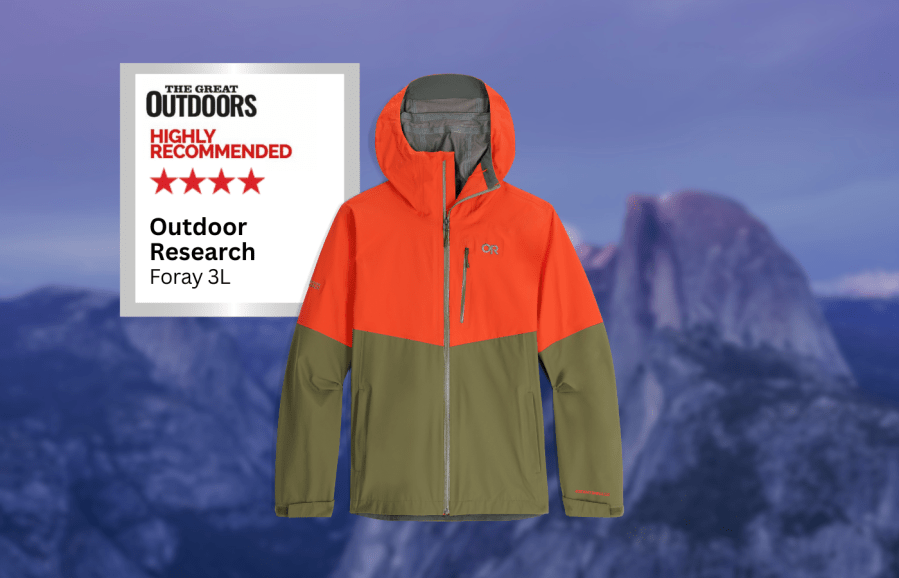
Chris Townsend Highly Recommends
The Foray 3L is comfortable to wear and excellent for three-season use. It’s good in winter weather too, if lacking a stiffer hood.- side vents
- breathability
- soft fabric
- recycled fabric
- front hood drawcords inside jacket
- hood peak could be stiffer
| Quick specs |
|---|
| Price: $336 / £260 (available from Outdoor Research) |
| Weight: 475g (L) |
| Materials: bluesign® Approved PFAS-free AscentShell Dry 3L 100% Recycled Nylon 40D with Nikwax DWR |
| Hood: front and rear adjustment, stiffened peak |
| Front Closure: YKK AquaGuard Zip, inner flap |
| Underarm/Side Zips: full-length two-way side |
| Pockets: 2 hand pockets, 1 chest |
| Hem: Drawcord adjustment |
| Cuffs: Velcro |
| Sizes: XS – XXXL |
| Women’s version: Yes, the Aspire 3L Jacket |
| outdoorresearch.com |
The latest version of the Foray jacket, new last year, is made from AscentShell Dry, which is exclusive to Outdoor Research and made by a complex electrospinning process. The fabric is soft, quiet, slightly stretchy and made from 100% recycled nylon with a Nikwax Direct.Dry DWR that’s also exclusive to Outdoor Research. Outdoor Research says it offers ‘superior breathability’. I’ve certainly found the breathability as good as most. The Foray 3L has an excellent feature that really enhances the comfort – zipped vents that stretch from the biceps to the hem. This allows far more ventilation than standard under arm zips and for dumping excess heat and moist air, venting always beats fabric breathability, so this makes a big difference to comfort. You can even open both sides and wear the jacket as a poncho.
The Foray 3L is comfortable to wear and excellent for three-season use. It’s good in winter weather too, although I’d prefer a stiffer hood peak then.
Read more: Chris’ full Outdoor Research Foray 3L review
Lightest in Test
Rab Phantom Mountain
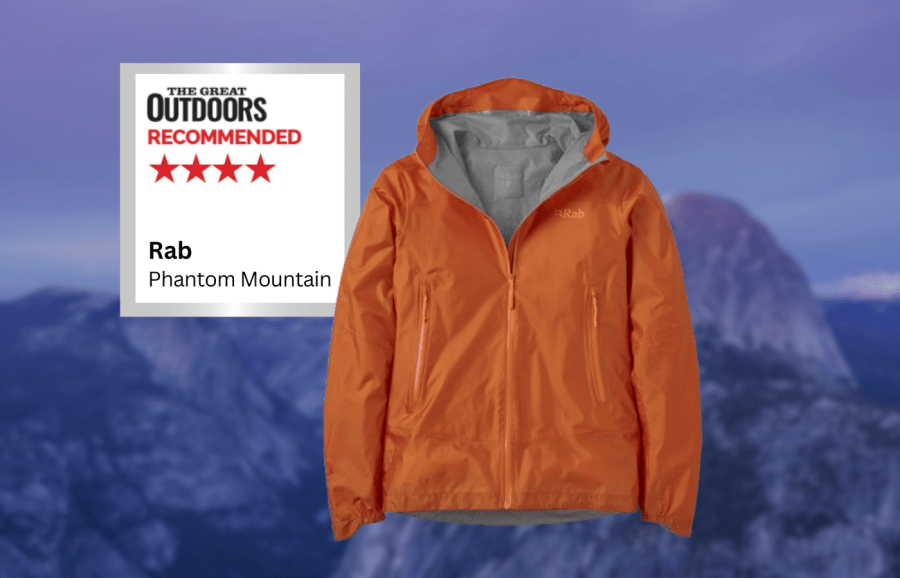
Lara Dunn recommends
It offers good value for money for what is a super-lightweight waterproof jacket with excellent breathability.- light and packable
- very breathable
- not suited to full-day wet weather walks
- very long sleeves
| Quick specs |
|---|
| Price: $225 / £160 (available from Rab) |
| Weight: 227g (size 14) |
| Materials: 2.5 layer Pertex Shield Diamond Fuse fabric 100% Polyamide. PFAS-free. |
| Hood: Volume adjuster and stiffened peak |
| Front Closure: Water resistant zip with small storm flap |
| Underarm/Side Zips: no |
| Pockets: 2 large high side pockets |
| Hem: Drawcord adjustment |
| Cuffs: half elasticated |
| Sizes: UK8 – 16 |
| Women’s version: Yes |
| rab.equipment |
For those situations where a waterproof jacket is most likely going to be dead weight in a backpack, this jacket from Rab is a cut above. It weighs about as much as a family sized bag of crisps and packs as small as a can of beans! Groceries aside, it’s an extremely competent jacket that delivers far above just a basic level of performance. The Pertex Shield fabric is a winning combination of windproof and highly breathable, yet offers a decent level of waterproofing too, keeping me dry for a couple of hours of utterly torrential rain without me overheating or getting sweaty, even on a warmer soggier day. It’s not really built to take on all day rain, particularly with a pack impacting on the fabric and increasing the chance of wetting out, but it performs well for long enough.
The hood is adjustable, has a low-key stiffened peak and also acts as an integral stuff sack for the jacket. The side pockets are very spacious and the overall fit is nicely contoured to avoid unnecessary extra fabric. At £160 it offers good value for money for what is a super-lightweight waterproof jacket with excellent breathability that you’ll always be hoping you’ll never actually need to use, but that gives confidence in its ability to offer decent protection when it IS needed.
Read more: Lara’s full Rab Phantom Mountain review
Patagonia Boulder Fork
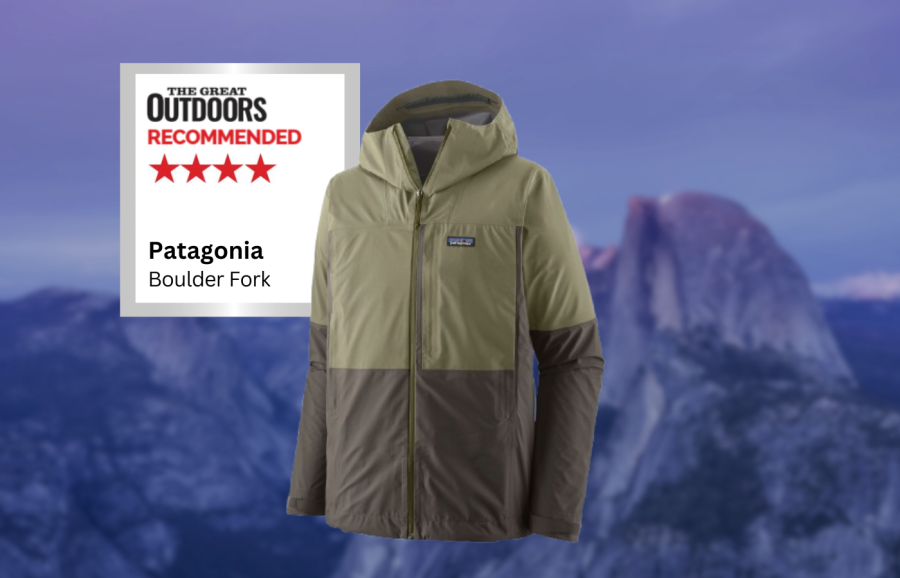
James Roddie’s lightest in test
This is a jacket I will often pack for slower paced days, or for times when I’m not expecting to have to wear it for long periods whilst moving.- lightweight
- excellent construction quality
- no underarm vents
| Quick specs |
|---|
| Price: $229 | £250 (available from Cotswold Outdoor) |
| Weight: 380g (Size S) |
| Materials: 30D 100% recycled polyester. |
| Hood: One-way volume adjustment. |
| Front Closure: Watertight zip with internal storm flap. |
| Underarm/Side Zips: No |
| Pockets: 3 |
| Hem: Internal drawcord adjustment |
| Cuffs: Velcro |
| Sizes: XS – XXL |
| Women’s version: Yes |
| patagonia.com |
The Patagonia Boulder Fork has quite a minimal design, but there is a lot to like here for those who aren’t looking for a feature-packed jacket. The H2No fabric does a great job of keeping out wet weather if you clean it regularly, and it has a nice amount of stretch. The internal fabric is soft to the touch and it feels pleasant to wear over just a t-shirt. The construction quality is excellent throughout, with fully taped seams. Patagonia are known for their environmental credentials, and this jacket is made from largely recycled polyester without any intentionally added PFAS ‘forever chemicals’. At 380g this is a lightweight jacket and packs down nice and small. There are three pockets which are generous in size, but I wish the openings were larger for storing a map. The positioning of the pockets is well-considered and are not obstructed whilst wearing a rucksack.
The main zip is watertight with a small storm flap beneath. This does a great job and I haven’t experienced any seepage in wet weather. I’d prefer the zip pullers to be more substantial as they can be fiddly to use whilst wearing gloves. The hood is low profile with a single adjustment point, which is simple but effective. I like how the hood naturally lies flat when it isn’t in use, as opposed to bunching up around your neck as can happen with some jackets. A deal breaker for some will be the lack of underarm vents. This definitely makes the Boulder Fork less well-suited to strenuous or prolonged activity. As such this is a jacket I will often pack for slower paced days, or for times when I’m not expecting to have to wear it for long periods whilst moving.
Read more: James’ full Patagonia Boulder Fork review
Arc’teryx Beta SV
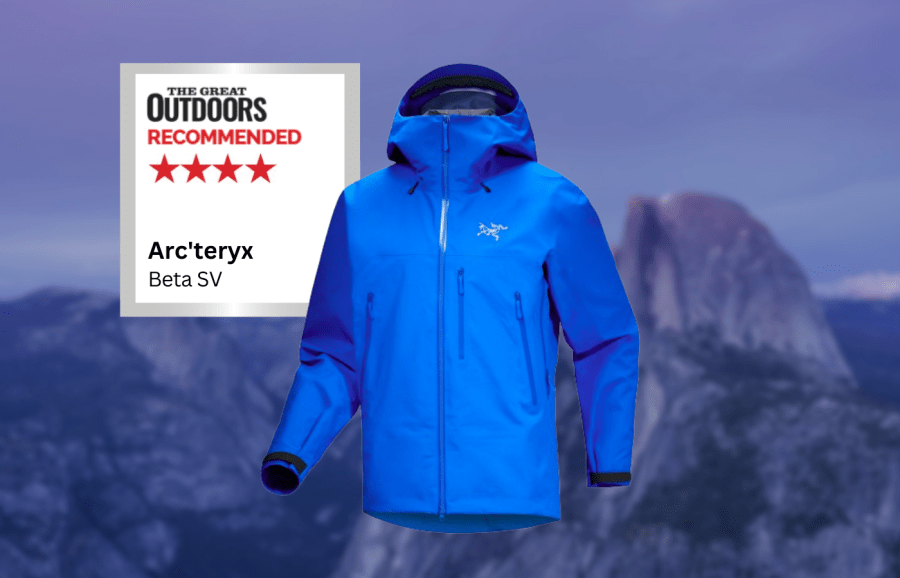
James Roddie recommends
It feels extremely tough without being stiff, and it is more durable than the shell material found in many other jackets of a comparable weight.- extremely durable
- high quality material
- versatile
- excellent hood adjustment
- expensive
| Quick specs |
|---|
| Price: £700 (available from Ellis Brigham) |
| Weight: 460g (Size S) |
| Materials: 100D Gore-tex Pro ePE. 100% Nylon. |
| Hood: Three-way volume adjustment. |
| Front Closure: Watertight 2 way zip with internal storm flap. |
| Underarm/Side Zips: Yes, with two way zips. |
| Pockets: 4 |
| Hem: Drawcord adjustment |
| Cuffs: Velcro |
| Sizes: XS – XXXL |
| Women’s version: Yes |
| arcteryx.com |
The Arc’teryx Beta SV is a very high performance hardshell, designed for prolonged use in harsh mountain conditions. The 100D Gore-Tex Pro shell material is highly abrasion resistant. It feels extremely tough without being stiff, and it is more durable than the shell material found in many other jackets of a comparable weight. A size Small only weighs 460g – a pleasingly low weight for such a rugged jacket. The durability allows the Beta SV to be well-suited to higher impact activities such as scrambling or long-term use for backpacking.
The waterproof membrane is highly effective against even prolonged heavy rain or wet snow. The storm hood does a great job in the wettest conditions as well. This is three way adjustable and is large enough to wear over a climbing helmet, but can be cinched in tight as well. A 2 way main zipper is a welcome feature. This is useful for accessing lower pockets in a mid-layer, and makes the jacket useable whilst wearing a climbing harness. All pockets are positioned thoughtfully and are not obstructed by rucksack straps or a hip belt. I like the internal mesh ‘dump pocket’, which I regularly use for quickly stashing gloves.
The two double zipped underarm vents are very generous. Combined with the breathability of the fabric, this level of ventilation allows this jacket to be comfortably used in summer conditions. When used as part of an effective layering system, I would happily recommend this jacket for full-on mountain winter conditions. Equally I have been more than satisfied using it on warm but wet scrambling days on the Cuillin ridge.
Read more: James’ full Arc’teryx Beta SV review
Sprayway Reaction
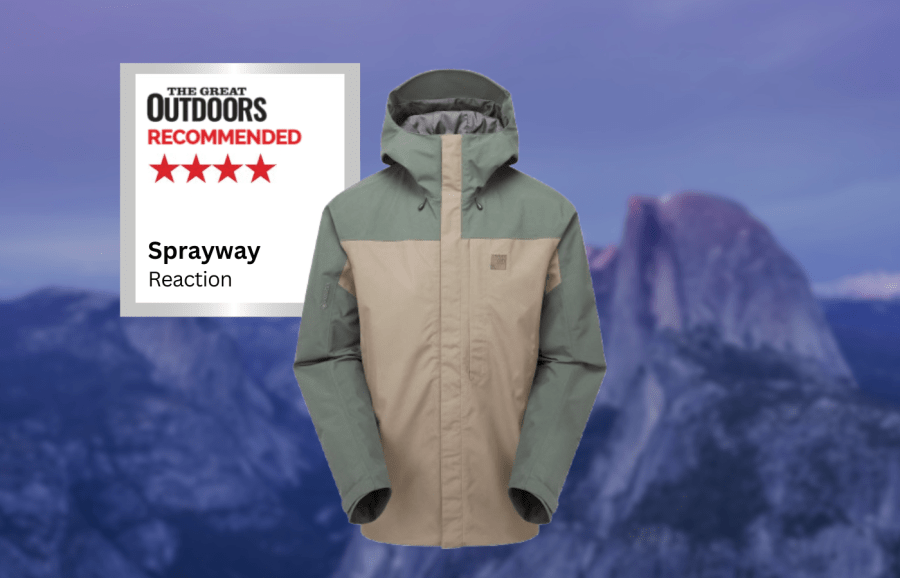
James Roddie recommends
The features and design make this a jacket best suited for use on chilly, bad weather days.- extremely durable
- generous pockets
- no underarm vents
- heavier
| Quick specs |
|---|
| Price: £250 (available from nevisport) |
| Weight: 700g (Size S) |
| Materials: 100% recycled polyester. |
| Hood: Wired peak. Two-way volume adjustment. |
| Front Closure: 2 way zip with double external storm flap and velcro. |
| Underarm/Side Zips: No |
| Pockets: 4 |
| Hem: Split hem drawcords. |
| Cuffs: Velcro |
| Sizes: S – XXL |
| Women’s version: Yes |
| sprayway.com |
The Sprayway Reaction is robust and built to last. The 150D face fabric is exceptionally hard-wearing – in fact, you would need to try pretty hard to damage it. It resists scrapes against rocks or tree branches really well, and it is a far cry from the paper-thin fabric found on ultralight jackets. At 700g (Size S) this is certainly not lightweight but it really should last for many years. The features and design make this a jacket best suited for use on chilly, bad weather days. The fit is roomy with long sleeves and a long cut. There’s plenty of room for other layers beneath. The hood is quite spacious with a wired peak and a Velcro tab to roll it away.
I like that the main zip is 2-way, and that it is covered by a double storm flap for extra protection against rain. I wish there were underarm vents. Their lack means that in mild conditions I find myself overheating quite rapidly. All the pockets are generous in size and you can easily fit a map in all but the internal pocket. The internal pocket material feels warm to the touch, and this is welcome on days when you want to keep your hands warm and dry but not wear gloves. £250 feels like a very reasonable price for such a durable jacket with plenty of features. This is partially due to the two-layer Gore-Tex construction, which is heavier but more affordable than a three layer construction would allow.
Read more: James’ Sprayway Reaction review
Didriksons Varja
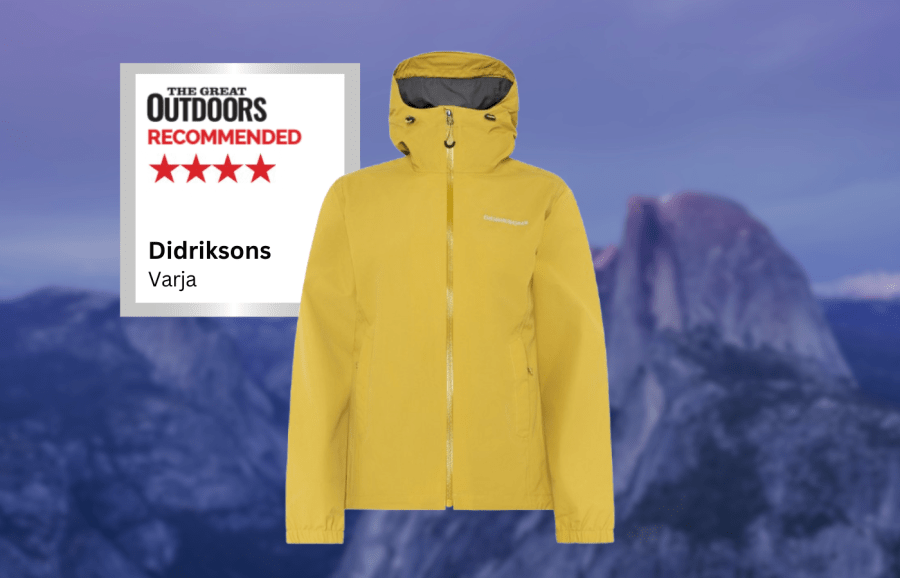
Lara Dunn recommends
The outer shell is extremely protective and the lining gives good breathable comfort.- comfortable casual fit
- inexpensive
- Full lining and lack of pit zips mean it’s best suited to less intense hikes
| Quick specs |
|---|
| Price: £110 (available from Didriksons) |
| Weight: 512g (size EU44) |
| Materials: 100% Polyester shell, 100% Polyester lining |
| Hood: Velcro and drawstring volume adjusters and stiffened peak |
| Front Closure: Water resistant zip with storm flap and button for ventilation |
| Underarm/Side Zips: no |
| Pockets: 2 large side pockets |
| Hem: Drawcord adjustment |
| Cuffs: elasticated |
| Sizes: 34-48 |
| Women’s version: Yes, the Dario |
| www.didriksons.com |
With a decidedly manageable price tag, the Didriksons Varja jacket offers good levels of performance for its price and is the sort of jacket you could get good use out of on or off the hill. It’s a relaxed fit with space for layering underneath and given that the jacket is fully lined rather than being just a shell, it’s ideal being able to add a bit extra under it. The lining – whilst breathable – does mean that it’s on the warm side for energetic spring and summer use, but it’s ideal for chillier persistently wet weather and less vigorous walks.
Didriksons are an outdoor lifestyle brand, rather than focussing only on high performance specialist hiking and mountaineering kit, and this jacket show that background, yet also delivers genuine outdoor functionality. It’s far from the heaviest jacket and nor is it particularly bulky but it’s sufficiently burly that it’s better suited to being an all-day wet-weather layer rather than being carried. The outer shell is extremely protective and the lining gives good breathable comfort but it does run quite warm. A press stud on the front can be used to keep the worst of the weather out while still ventilating with the front zip open. There’s a generous protective hood that’s fully adjustable with both a Velcro tab at the back and a drawstring and a soft chin guard on the flexible collar. It’s got an interior pocket as well as the two exterior side pockets.
Read more: Lara’s full Didriksons Varja review
Sprayway Corbitt
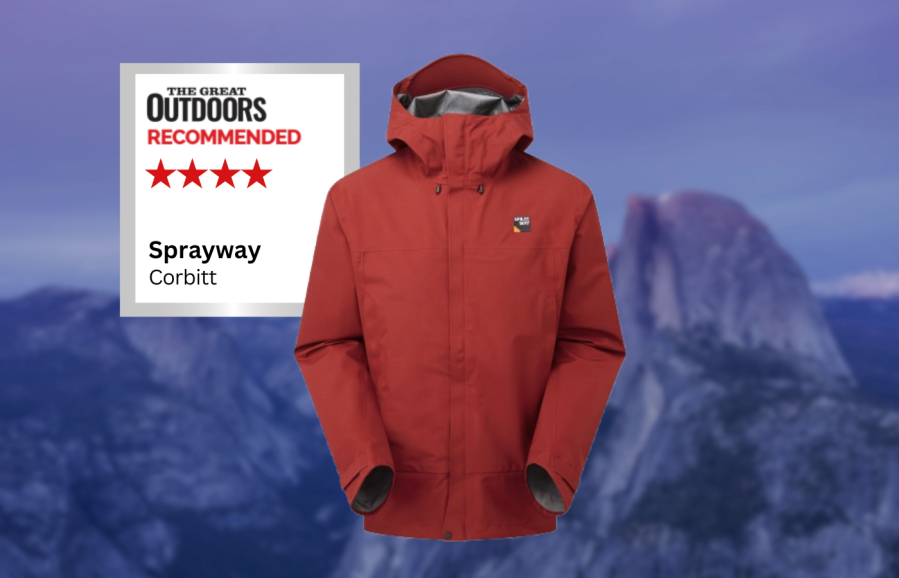
Kirsty Pallas recommends
The simple design hits the key points to make this jacket a good all-rounder for typically British weather.- hood
- cuffs
- non waterproof zip
- inside pocket placement
| Quick specs |
|---|
| Price: $426 / £330 (available from Outdoor Action) |
| Weight: 450g (size 10) |
| Materials: 100% polyester recycled with Goretex 75D |
| Hood: Wired peak with volume adjusters at back and sides |
| Front Closure: 2 way zip with internal and external storm flap and stud |
| Underarm/Side Zips: No |
| Pockets: 2 large hand pockets, and 1 internal |
| Hem: Drawcord adjustment |
| Cuffs: Velcro |
| Sizes: 8 – 18 |
| Men’s version: Yes |
| sprayway.com |
Sprayway are back to designing great hill gear, and this Corbitt jacket is an example of that. It’s a sleek and simple design, but hits the key points to make it a good all-rounder for typically British weather. The Gore-Tex membrane feels tough but combined with a well cut fit, it doesn’t feel too crinkly or stiff. I really like the hood and cuffs on this jacket, they’re well designed for use and ease of use too.
I’m impressed with the Corbitt and it really does feel like Sprayway have stepped up their gear to properly deal with all mountain weather. It’s a jacket I will use through winter, especially on those particularly manky days when it feels like you’re not sure why you’re even going out!
Read more: Kirsty’s full Spraway Corbitt review
Salewa Ortles 3L GTX
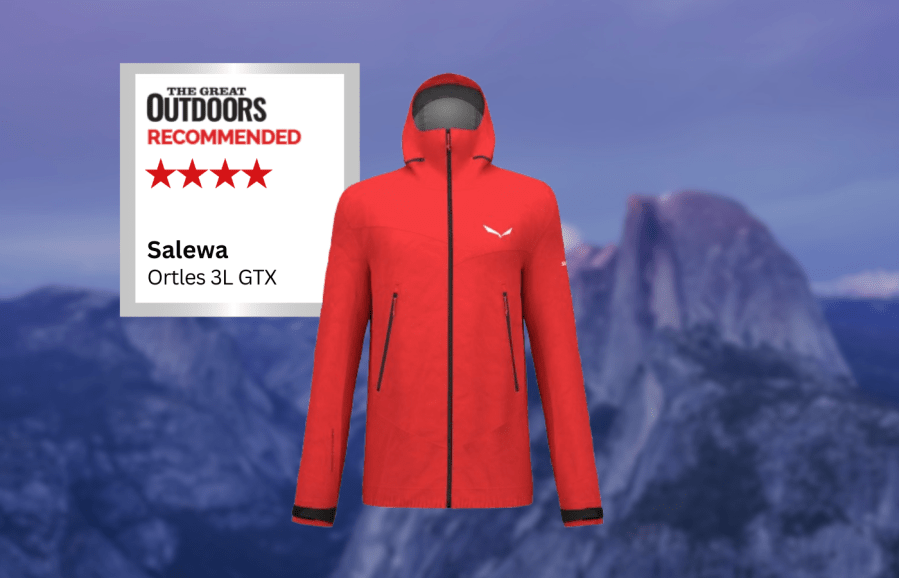
Chris Townsend recommends
The Ortles is the most expensive jacket tested. It is middling in weight and suitable for year-round use.- breathability
- pockets
- hood gusset
- cost
| Quick specs |
|---|
| Price: $470 / £365 (available from Salewa) |
| Weight: 500g (L) |
| Materials: Gore-Tex 2L Paclite Plus/ recycled polyester, Gore-Tex 3L recycled polyester |
| Hood: rear adjustment, zipped gusset for helmet compatibility, stiffened peak |
| Front Closure: YKK waterproof zip, inner flap |
| Underarm/Side Zips: zipped with flap on the back of the upper arms |
| Pockets: 2 mid hand, 2 stretch inner |
| Hem: Drawcord adjustment |
| Cuffs: Velcro |
| Sizes: XS – XXL |
| Women’s version: yes |
| salewa.com |
Unusually, the Ortles jacket is made from two different Gore-Tex fabrics, a durable 3-layer one on the front and upper arms and Paclite on the back, hood, and lower arms for reduced weight and increased packability. The fabrics are quite noisy and a little stiffer than on the other jackets reviewed in this test.
The jacket has a hydrostatic head of 28,000mm and a RET of <9. The last means breathability should be good and it is. I have to work quite hard to produce much condensation inside. When overheating does occur, there are zipped vents on the back of the upper arms. These aren’t as effective as underarm zips but are easier to use as they don’t run under pack shoulder straps.
The Ortles is the most expensive jacket tested. It’s mid-range in weight and suitable for year-round use.
Read more: Chris’ full Salewa Ortles 3L GTX review
Best value (men's)
Highlander Munro V2
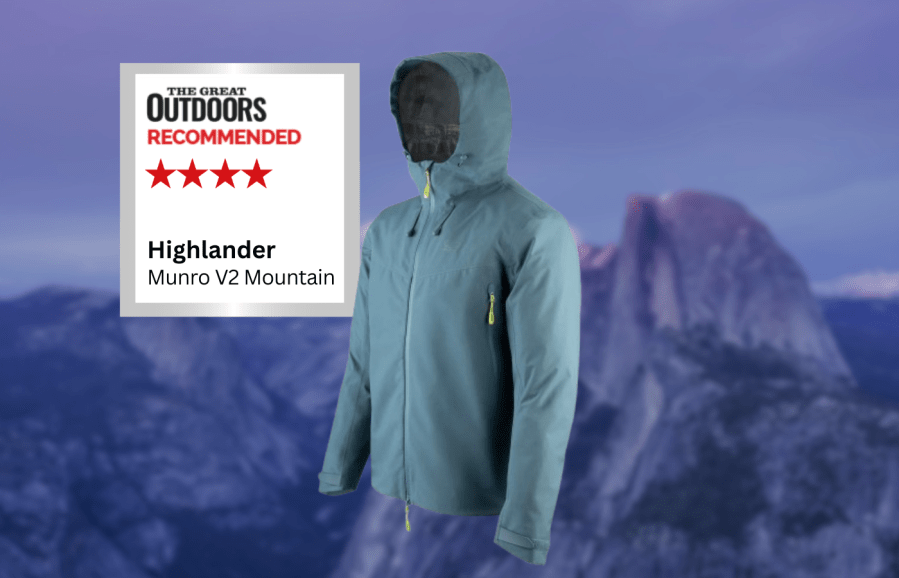
Chris Townsend’s Best Value
The Munro Jacket is comfortable and I’ve been happy wearing it in storms. It may be inexpensive but it doesn’t feel like a budget garment.- hood
- cost
- quite heavy
- no women’s version
| Quick specs |
|---|
| Price: $232 / £180 (available from Highlander) |
| Weight: 580g (L) |
| Materials: 3 – layer PROT3X PFC Free polyester |
| Hood: front and rear adjustment, wired stiffened peak |
| Front Closure: YKK waterproof zip, inner flap |
| Underarm/Side Zips: two-way YKK zips |
| Pockets: two harness/hipbelt compatible, 1 inner |
| Hem: Drawcord adjustment |
| Cuffs: cuffs |
| Sizes: S – 2XL |
| Women’s version: no |
| highlander-outdoor.com |
The Highlander Munro V2 Mountain Jacket is a fully specified jacket suitable for year-round use at a low cost, making it superb value for money. The hydrostatic head rating of 20,000mm (the height of a column of water that can stand on the fabric before it leaks) compares well with that of many far more expensive jackets. In heavy rain it has proved fully waterproof. Breathability however is on the low side at 15,000 MVTR (Moisture Vapour Transmission Rate). Top end jackets are usually at least 20,000. In practice I have found condensation appearing inside a bit sooner than with the other jackets tested but it’s not been a problem. A main reason for this is that the Munro has long underarm zips so damp air can be easily expelled. This is an excellent feature, especially given the price.
The Munro Jacket is comfortable and I’ve been happy wearing it in storms. It may be inexpensive but it doesn’t feel like a budget garment. It is quite heavy, the heaviest jacket tested, and maybe overkill for summer backpacking, but at the same time it’s adequate for winter mountain use.
Read more: Chris’ full Highlander Munro V2 review
Berghaus Ridge Seeker
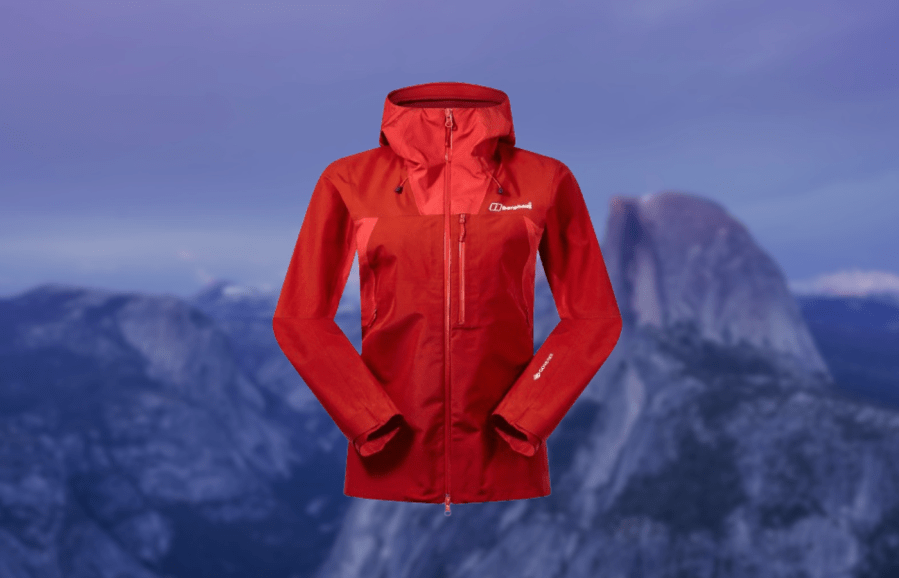
Kirsty Pallas’ verdict
Overall, it’s a solid jacket with good features that are almost ideal but just need a little tweak to make it a great jacket.- durability
- roomy fit
- pocket placement
| Quick specs |
|---|
| Price: $452 / £350 |
| Weight: 440g (size 10) |
| Materials: Goretex 3L 100% polyester with ePE membrane |
| Hood: Wired peak with volume adjusters at back and sides |
| Front Closure: 2 way waterproof zip with internal storm flap |
| Underarm/Side Zips: 2 way pit zips |
| Pockets: 2 hand pockets, 1 external chest and 1 internal chest |
| Hem: Drawcord adjustment |
| Cuffs: Velcro |
| Sizes: 8 – 20 |
| Men’s version: Yes |
| berghaus.com |
This jacket from Berghaus is about as classic a jacket you can get. The Gore-Tex 3L fabric feels tough and durable, meaning the Berghaus Ridge Seeker feels ready to take a bit of a battering in winter. There’s a good selection of pockets with the hand pockets just big enough to fit a map, and both the internal and external chest pockets a good option for a phone. The hand pockets do sit lower than I’d like, and so get in the way of a rucksack or harness waist belt, which limits what I put in them.
Overall, it’s a solid jacket, with good features that are almost ideal but just need a little tweak to make it a great jacket.
Read more: Kirsty’s full Berghaus Ridge Seeker review
How we tested
Chris tested his jackets on day walks and multi day trips in the Scottish Highlands from spring 2024 through to early 2025. He is short and mostly wears a size large. Conditions included heavy rain, soaking drizzle, blizzards, and ferocious winds.
Kirsty tested these jackets through Autumn and early winter in Scotland while hillwalking, biking and mountaineering in a mix of rain, snow and even some sunshine. Kirsty is a short size 8-10 and was aiming to get several layers under each jacket.
Lara tested these waterproof jackets from February to June in a variety of wet conditions varying from around freezing temperatures to mid-twenties, on day hikes of varying lengths in the Malvern Hills, Brecon Beacons and Black Mountains. Lara is 165cm tall and wears size 14/14-16 (Large/XL), brand dependent. Weights are from her own digital scales.
James tested these waterproof jackets in the Scottish Highlands, with weather ranging from heavy snow and prolonged rain to mild, showery days with temperatures up to 16C. James is 180cm tall with quite long arms and usually wears size small jackets. Weights are from his own scales.
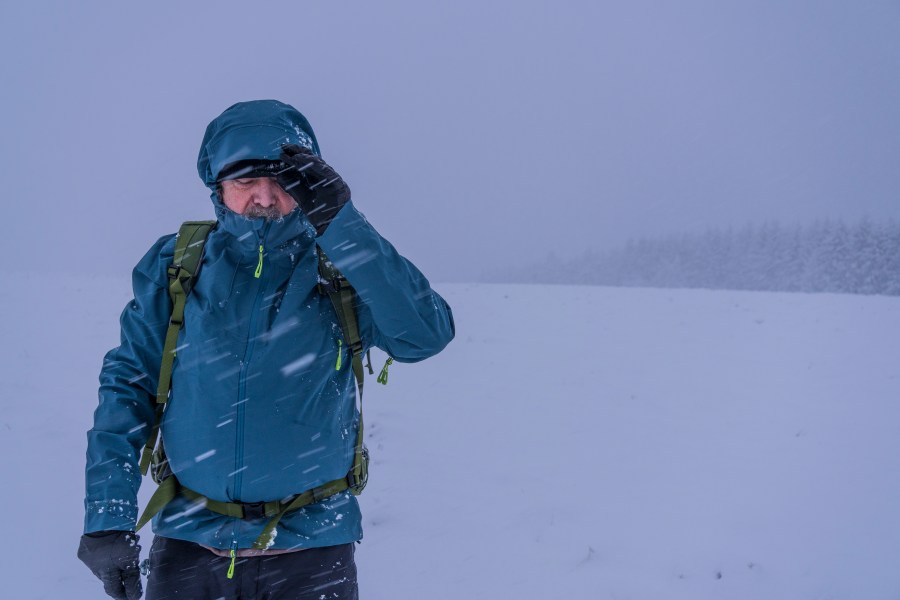
How to choose the best waterproof jacket for you
Finding the right waterproof jacket can greatly enhance your comfort and performance in adverse weather conditions. It’s also absolutely crucial from a safety perspective. First and foremost, the main things to assess when choosing a rain jacket are the levels of waterproofness and breathability as these determine its ability to keep you dry while allowing moisture to escape. Additionally, consider the hardshell jacket’s durability, weight, and packability to match your intended activities and environment. If you like to move fast and light, for instance, then a lightweight 2.5-layer shell that’s light on features will be best for you. Conversely, if you’re into your winter mountaineering then you’ll want a more durable shell – 3-layer perhaps – with pockets and lots of adjustment.
Pay attention to features like hood design: is there adjustment so that it will hold in high winds? And pocket placement: will they be accessible when you’re wearing a baclpack with a hipbelt? You’ll also want to take into account the jacket’s fit and sizing to ensure optimal comfort and freedom of movement – many of our full individual jacket reviews will specify whether a jacket is true to size or not. If we don’t specify in the review, please feel free to get in touch with us directly to ask.
Finally there’s the sustainability side of things. If you’re conscious of the environmental impact of products, check whether any recycled materials are present and also whether the materials can go on to be recycled when the jacket comes to the end of its life. Some jackets these days still come with PFCs. These are water resistant chemicals that often escape through our washing machines and into the world’s water supplies where they stay for a very long time. Studies have found these in the world’s deepest oceans and even on the summit of Everest!
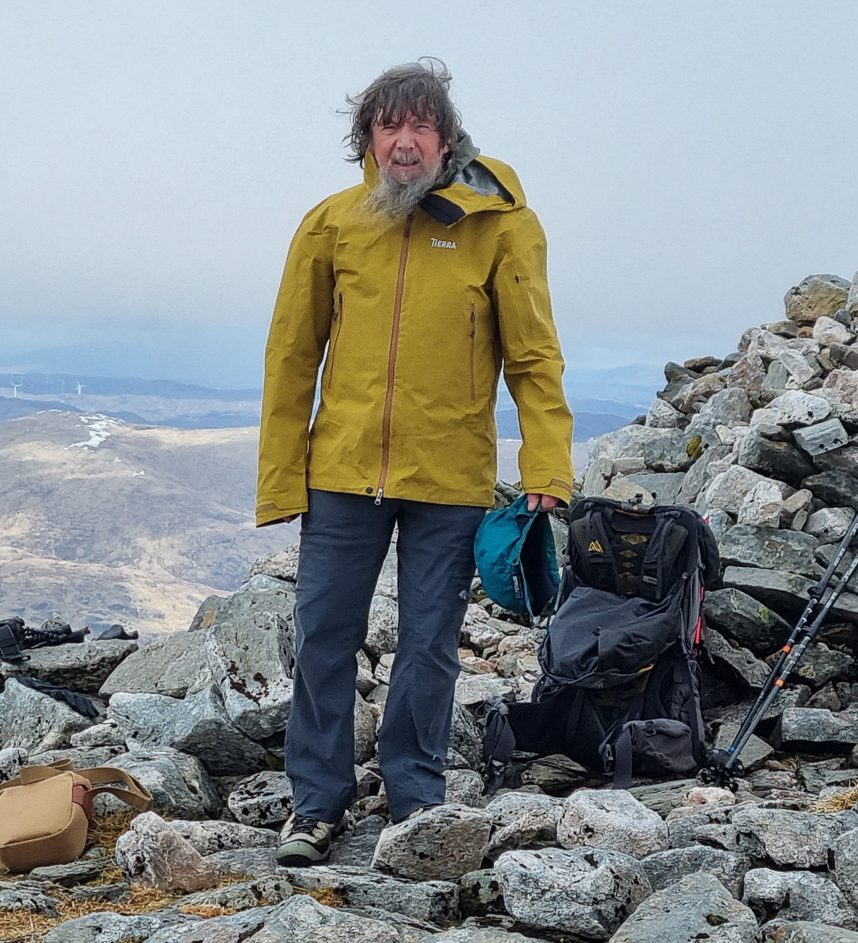
Fabric
The fabric determines how ‘breathable’ a garment will be. All waterproof fabrics are fully waterproof regardless of cost. Thicker fabrics give better protection in winter weather.
Construction
Waterproof fabrics are made up of layers of material. The most durable construction is three-layer in which the waterproof layer is sandwiched between the face fabric and an inner layer.
Hood
Hoods should be easily adjusted and move with your head. A wired or stiffened peak is useful in wind driven rain and snow. Helmet-compatible hoods should have volume adjusters so they can be reduced in size without affecting your vision for non-helmet wear.
Front Closure
Water-resistant zips are now standard. These are not fully waterproof in driving rain and should have an inner flap to repel any rain that gets through.
Ventilation
Underarm/side zips can be awkward to use but do allow good ventilation. They can often be used when the front zip has to be closed due to rain or snow. Zips that curve under the armpits are effective but the most difficult to adjust. Side zips that run from the armpit down the jacket are much easier to use.
Cuffs
Cuffs that can be opened wide are good for ventilation in the arms. Elasticised and narrow cuffs can lead to sweaty wrists.
Pockets
Whilst not essential pockets that are accessible when wearing a rucksack hipbelt are useful for items like compass, phone, snacks, map, hat and gloves.
DWR
The durable water repellency treatment (DWR) makes water bead and run off fabrics. In time this degrades and needs to be restored with a wash-in or spray-on product. The DWR does not affect the waterproofness of a garment but does reduce the breathability when it wears off gets dirty so you get more condensation inside. The DWR treatment used for many decades is being phased out as it contains environmentally damaging PFCs. Unfortunately, PFC-free DWRs do not last as long so garments need washing and reproofing more often.
Fit
For the most efficient breathability, the best waterproof jackets should fit fairly closely. At the same time, they shouldn’t be so tight that they restrict movement. And a rain jacket should fit comfortably over all the layers you might need to wear underneath it. Size labels should be taken as a guide only – they’re not consistent between makes.
Waterpoofing, breathability, adjustment, fit, features, sustainability and of course price. There’s a lot to consider, but by carefully weighing these up you can make a well-informed choice and invest in a waterproof shell that could serve you well and for a long, long time.
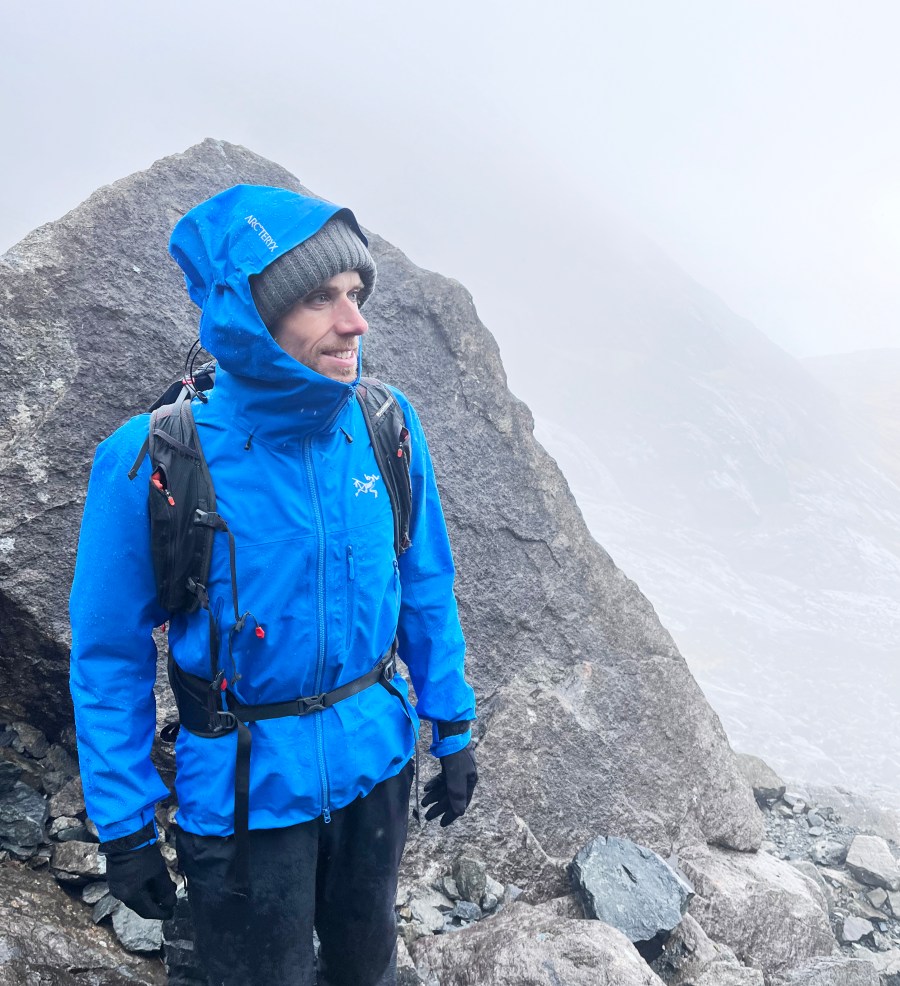
Measuring waterproofness and breathability
If you want to know how to stay dry when hiking in the rain, it’s important to consider a rain jacket’s waterproofness and breathability. If the weather is wet and warm, the fabric needs to have the capacity to let the moisture created by sweat to escape, otherwise you will end up damp inside the rain jacket. These days there are excellent waterproof and breathable membranes (which are also windproof). Most jackets also have a durable waterproof repellency (DWR) treatment added to the outer layer of fabric.
The waterproofness of a rain jacket is measured by determining the height of a column of water that the fabric can withstand before it starts to leak through. The resulting figure is known as the hydrostatic head (HH) and this is expressed in millimetres – the higher the number, the more waterproof the jacket is considered to be.
The breathability of waterproof garments is determined by the “Moisture Vapor Transmission Rate” (MVTR). This test measures the amount of water vapor that can pass through the jacket’s fabric over a given period of time. The unit of measurement used is typically grams per square meter per 24 hours (g/m²/24h). The higher the MVTR rating, the more breathable the jacket is considered to be.
Finally, colour choice may seem less important but a brighter shade will allow you to be more easily seen should you get into difficulty. Black, dark blues and greens blend in rather than stand out. Also, very light shades will show the dirt quickly.
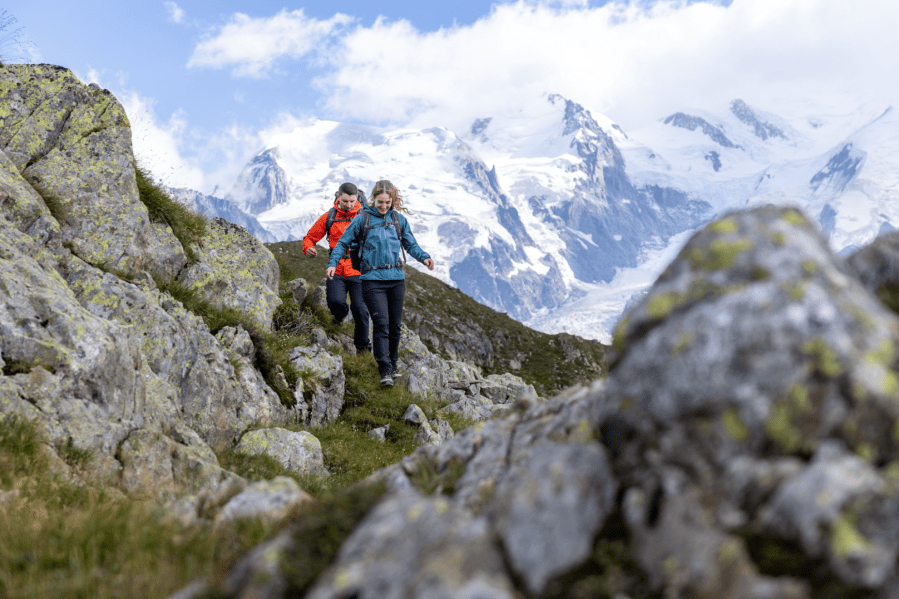
Waterproof fabrics and their ratings
- Hydroshell (Berghaus) – HH: 15,000 mm | MVTR: 20,000 g/m²/24h (official)
- Dermizax EV – HH: 25,000 mm | MVTR: 20,000 g/m²/24h (official)
- Unbranded (Alpkit Balance) – HH: 20,000 mm | MVTR: 20,000 g/m²/24h (official)
- Polartec Power Shield – HH: 20,000 mm | MVTR: 20,000 g/m²/24h (official)
- Futurelight (The North Face) – HH: Unknown | MVTR: 75,000 g/m²/24h (official)
- Pertex Shield – HH: 20,000 mm | MVTR: 20,000 g/m²/24h (estimated)
- H2No (Patagonia) – HH: 10,000mm to 20,000 mm | MVTR: 12,000 – 15,000 g/m²/24h (estimated)
- Omni-Tech (Columbia) – HH: 10,000 mm | MVTR: 10,000 g/m²/24h (estimated)
- eVent – HH: 30,000 | MVTR: 15,000 to 25,000 g/m²/24h (estimated)
- Gore-tex – HH: 28,000 mm | MVTR: 17,000 g/m²/24h (estimated)
- Gore-tec Paclite – HH: 28,000 mm | MVTR:15,000 g/m²/24h (estimated)
- Gore-tex Pro – HH 28,000 mm | MVTR: 25,000 g/m²/24h (estimated)
How to look after your waterproof jacket
Looking after waterproof jackets can be trickier than a normal piece of clothing; they require a certain amount of upkeep if they are to continue to keep you dry and perform well for a long time. Dirty rain jackets don’t let body moisture through very well, so you get damp from condensation building up inside the rain jacket as you sweat quicker. The Durable Water Repellency (DWR) treatment on the outside of hardshell jackets that causes rain to bead and run off rather than soak in can also wear off and need replacing over time. This also leads to condensation as the garment is then less breathable.
There are two main elements to waterproof jacket care: washing, and restoring the jacket’s DWR treatment. Our guide on how to look after your waterproof jacket will further help you to understand common problems with hardshells, rain jackets and how to manage them.
How to repair your waterproof
To repair a small hole or tear you will need:
- Duct tape
- Seam sealant
How to do it: Patch over with tape (do this on both sides if possible). Reinforce edges with seam sealant. You could also use a Gore-Tex repair kit. You can use duct tape on clothing and sleeping bags. I have down jackets and bags with duct tape patches that have been there for years). I’ve never had to repair a softshell jacket but if there was a big hole or rip I’d just stick duct tape on it. Of course, a hole in softshell or fleece is more significant compared to one in a waterproof.
Learn more about how to repair your waterproof jacket.