
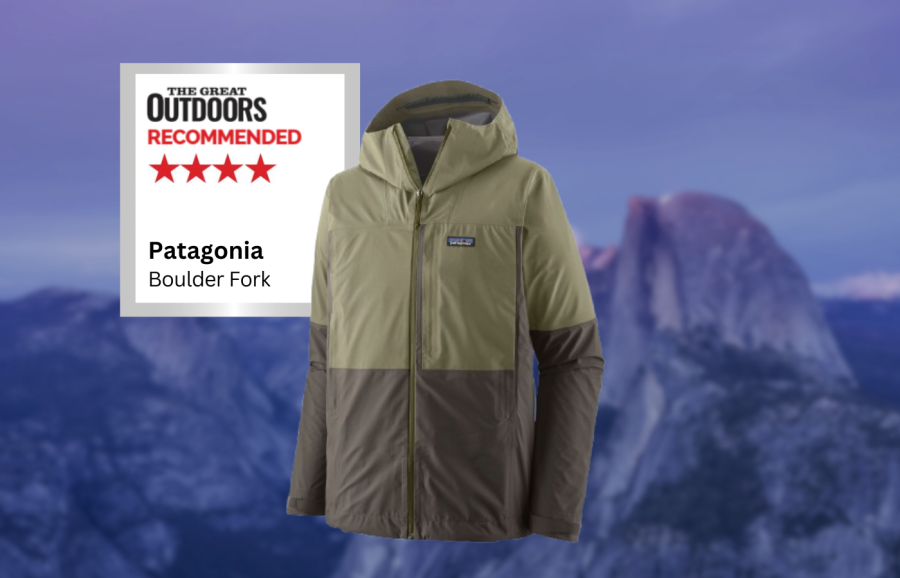
James Roddie rates the lightest jacket he tested in 2026, the Patagonia Boulder Fork.
The Patagonia Boulder Fork has quite a minimal design, but there is a lot to like here for those who aren’t looking for a feature-packed jacket.
James Roddie’s lightest in test
This is a jacket I will often pack for slower paced days, or for times when I’m not expecting to have to wear it for long periods whilst moving.- lightweight
- excellent construction quality
- no underarm vents
| Quick specs |
|---|
| Price: $229 | £250 (available from Cotswold Outdoor) |
| Weight: 380g (Size S) |
| Materials: 30D 100% recycled polyester. |
| Hood: One-way volume adjustment. |
| Front Closure: Watertight zip with internal storm flap. |
| Underarm/Side Zips: No |
| Pockets: 3 |
| Hem: Internal drawcord adjustment |
| Cuffs: Velcro |
| Sizes: XS – XXL |
| Women’s version: Yes |
| patagonia.com |
The H2No fabric does a great job of keeping out wet weather if you clean it regularly, and it has a nice amount of stretch. The internal fabric is soft to the touch and it feels pleasant to wear over just a t-shirt. The construction quality is excellent throughout, with fully taped seams. Patagonia are known for their environmental credentials, and this jacket is made from largely recycled polyester without any intentionally added PFAS ‘forever chemicals’. At 380g this is a lightweight jacket and packs down nice and small. There are three pockets which are generous in size, but I wish the openings were larger for storing a map. The positioning of the pockets is well-considered and are not obstructed whilst wearing a rucksack.
The main zip is watertight with a small storm flap beneath. This does a great job and I haven’t experienced any seepage in wet weather. I’d prefer the zip pullers to be more substantial as they can be fiddly to use whilst wearing gloves. The hood is low profile with a single adjustment point, which is simple but effective. I like how the hood naturally lies flat when it isn’t in use, as opposed to bunching up around your neck as can happen with some jackets. A deal breaker for some will be the lack of underarm vents. This definitely makes the Boulder Fork less well-suited to strenuous or prolonged activity. As such this is a jacket I will often pack for slower paced days, or for times when I’m not expecting to have to wear it for long periods whilst moving.
How James tested
James tested these waterproof jackets in the Scottish Highlands, with weather ranging from heavy snow and prolonged rain to mild, showery days with temperatures up to 16C. James is 180cm tall with quite long arms and usually wears size small jackets. Weights are from his own scales.This review was published in the September 2026 issue of The Great Outdoors. Compare it with others in our guide to the best waterproof jackets.