
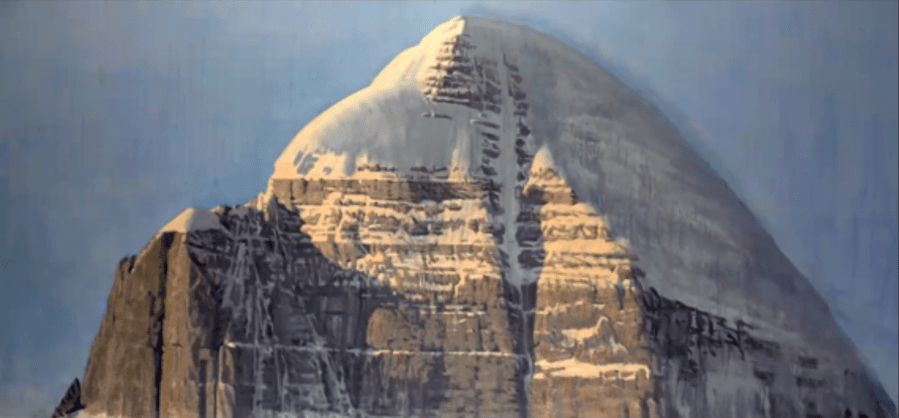
Sometimes, for an artist, there’s a single work that culminates a lifetime. Michelangelo’s Sistine Chapel, Rodin’s ‘Gates of Hell’, Bach’s great Mass in B Minor. For mountain painter Julian Cooper (though Julian himself probably wouldn’t go along with this) it’s ‘Earthly Powers’, his set of four large oil-paintings of Kailash, the sacred mountain in western Tibet, roughly midway between K2 and Everest.
Main image: Kailash South Face © Julian Cooper, 2007
It’s the work that his previous 40 years of mountain painting have been leading up to. And before that, even, the previous 120 years… Cooper’s grandfather, Alfred Heaton Cooper, was a landscape painter and guidebook illustrator working in the Lake District and northern England at the start of the 20th Century. His father, generally just ‘Heaton Cooper’, is the Lakeland painter celebrated at the gallery in the centre of Grasmere – Heaton’s work infused with the love of Lakeland that so many of us share.
Compared to his ancestors, Julian Cooper’s work looks closer and deeper. Seen close up (many of his paintings are 2m wide or more) some could be read as austere abstracts: blocks of brownish, reddish, grey, broad brushstrokes, even dribbles of paint. But they’re not abstract: what we’re looking at is an actual mountain.
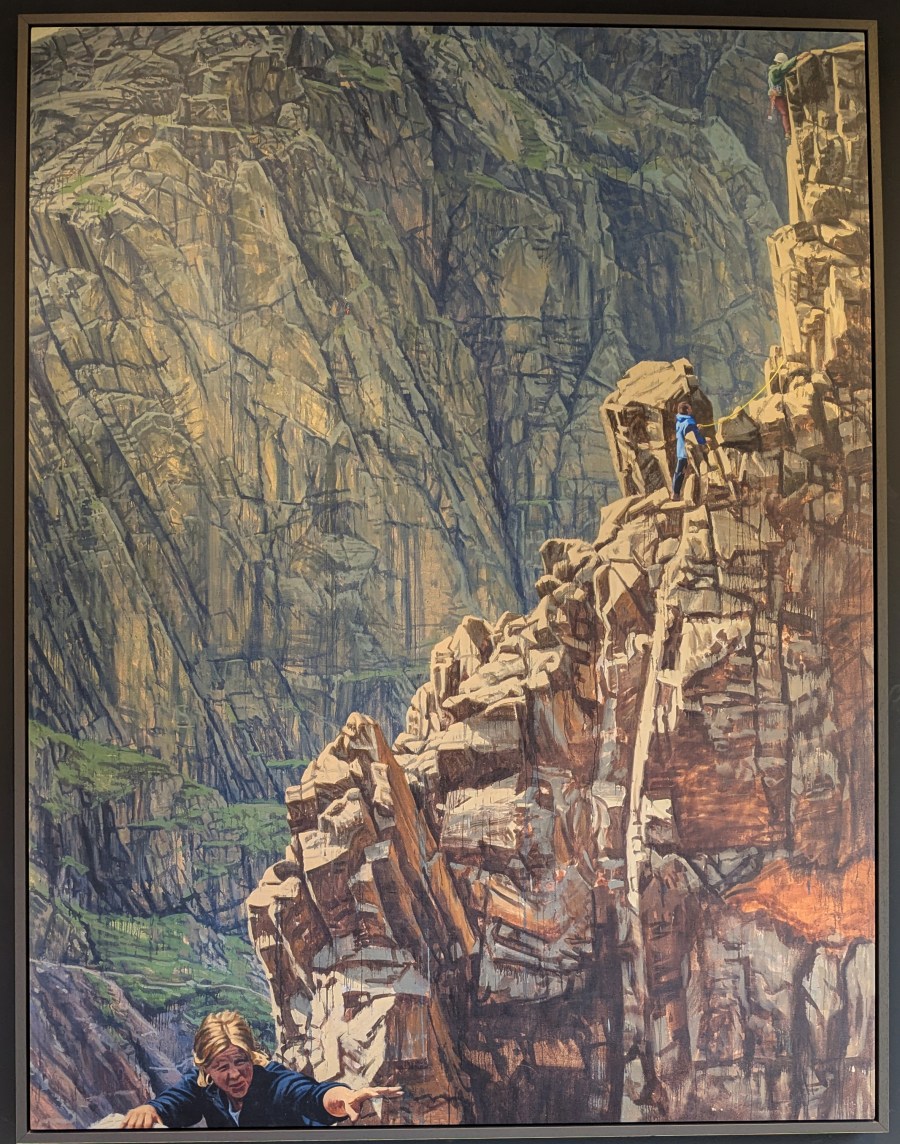
Paintings of the 1990s were usually with the sky and surroundings excluded – lower slopes of the Matterhorn, the north face of Kanchenjunga – deliberately chosen as being inaccessible. Then in year 2000 came a commission from the Mountain Heritage Trust for the then-new Rheged Centre: the coffee and shopping stop on the A66 just off the motorway. They wanted a large painting to hang in the shadows above the ticket counter. This 4m-tall crag study was to involve populated rocks: the foreground filled with Crenation Ridge (Diff), one of the classic routes on Pikes Crag, with the great crag of Scafell filling the rest of the frame. This painting hung in the Heaton Cooper Gallery’s café until last autumn, but has now been sold to some unknown buyer with a big wall.
Scafell Crag led him to consider how a crag changes when inhabited: with studies of the Eiger’s north face where every ledge and gully has a name and history; and of the quarried face of Honister Crag at the head of Buttermere.
And then, in 2002, came a place on a climbing expedition to the Himalaya; and a chance for the pilgrim circuit of Kailash. It’s a mountain which is sacred, apparently, to no fewer than four different religions. In a trip of just five days, and having lost his still camera, he looked up at all four faces of the mountain; sketching in oils and memorising with fierce concentration. The east face was clouded; the large paintings that resulted include one each of the South and Wet Faces, and two of the North, with opposing sunlight at daybreak and evening.
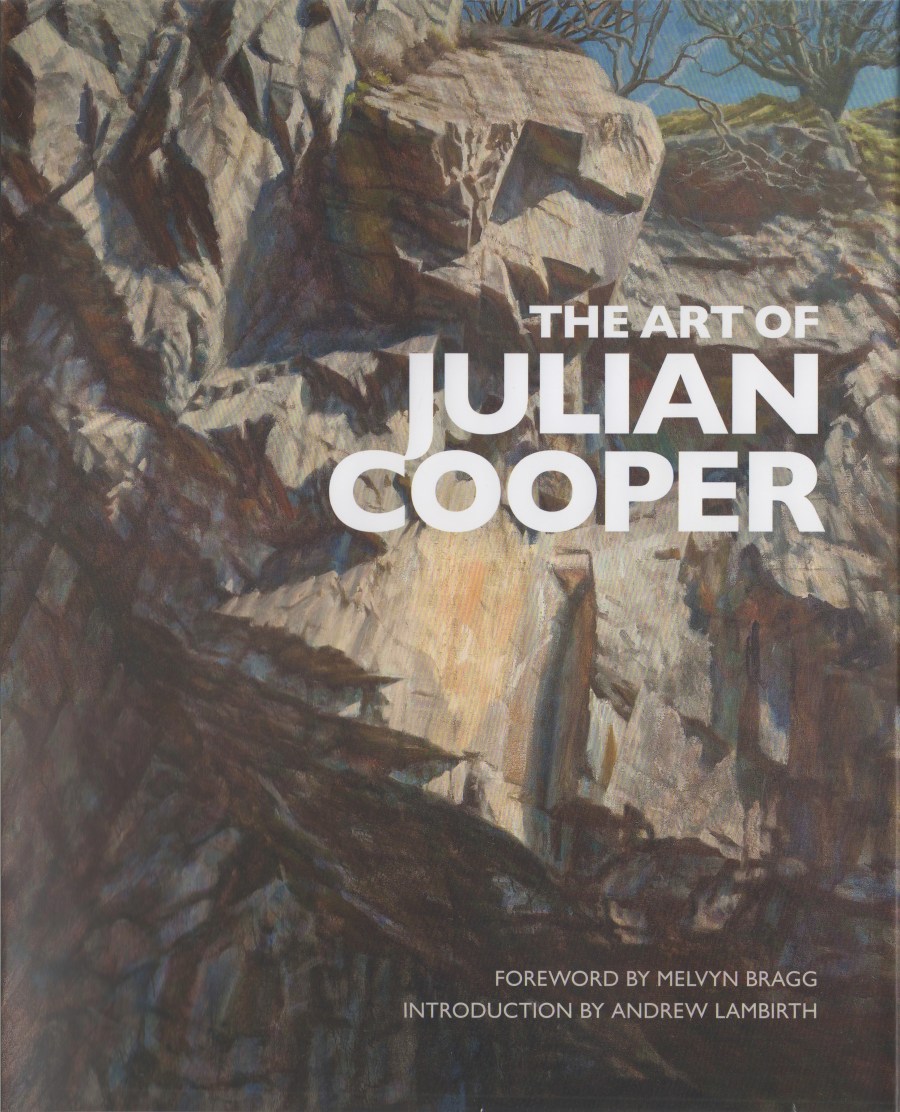
Given their size, you’re unlikely to have a Julian Cooper to hang in your house. But now, in his late 70s, his lifetime work’s been gathered in The Art of Julian Cooper. It’s a massive work – literally – at 24 x 30 cm, with some pullout pages doubling that, and weighing in at a solid 2.3kg. About half is placed in the Lake District – but the Lake District as those of us who aren’t Cooper have never really noticed it: iron-stained quarry walls, rock detail, a gill gully abstracted from a greater slope. And the rest is the rest of the world: Himalayas, mainly.
The Art of Julian Cooper is published by Unicorn, on 3rd March, at £40. An associated exhibition at the Circle Gallery, Theatre by the Lake in Keswick runs from March 9–April 18.
When contributors to The Great Outdoors aren’t out walking, some like to relax with a good book. Read their outdoor book reviews and discover your next adventurous tale.