
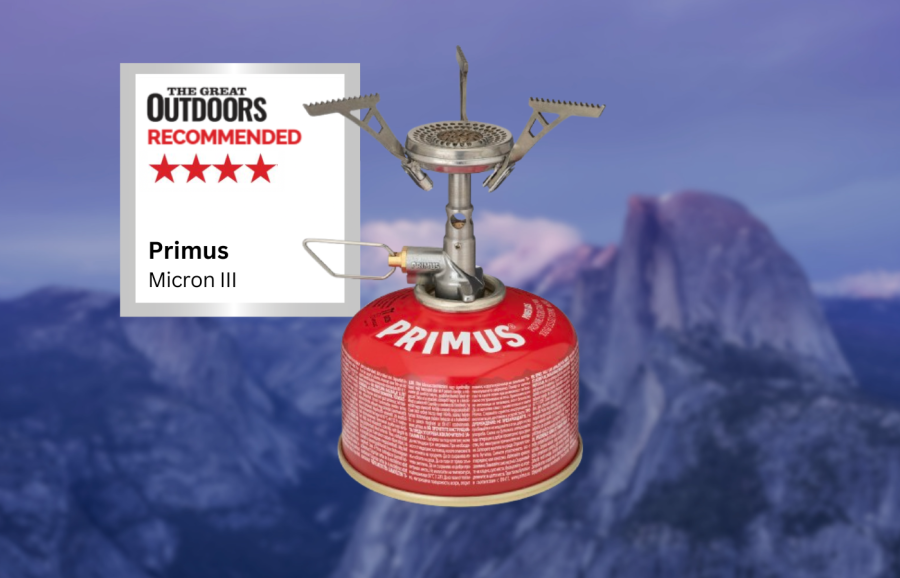
Chris Townsend recommends the Primus Micron III for those looking for a powerful, lightweight stove for three seasons.
The latest version of Primus’s Micron stove, which has been around in different models for over twenty years, is the lightest, just 58g, and most compact yet. While the Primus Micron III is tiny folded up, it has wide pot supports and a long control handle that’s easy to use with gloves and prevents burnt fingers.
Chris Townsend recommends
A powerful, ultralight three-season stove with good flame control.- good flame control
- fuel efficient
- compact
- ultralight
- powerful
- not regulated
- poor wind-resistance
| Quick Specs |
|---|
| Price: $69.99 | £60 Weight: 58g Fuels: gas canister Dimensions: 80 x 110mm open, 62 x 41mm folded Burner Diameter: 38mm Power: 2600 watts/ 8900 BTU Boil time: average 2 min 45 sec for 500ml water Fuel used: 6 – 7g www.primusequipment.co.uk |
The pot supports have serrated edges to hold pots securely and click into place when unfolded. The burner has a narrow flame and a mesh centre that glows red. Flame control is good so food can be simmered.
The burner isn’t regulated to maintain a constant fuel flow as the pressure in the canister drops due to cold weather or as it empties, and the power does fall off when a canister is almost empty. In sub-zero temperatures this would probably be a problem, making this a three-season stove.
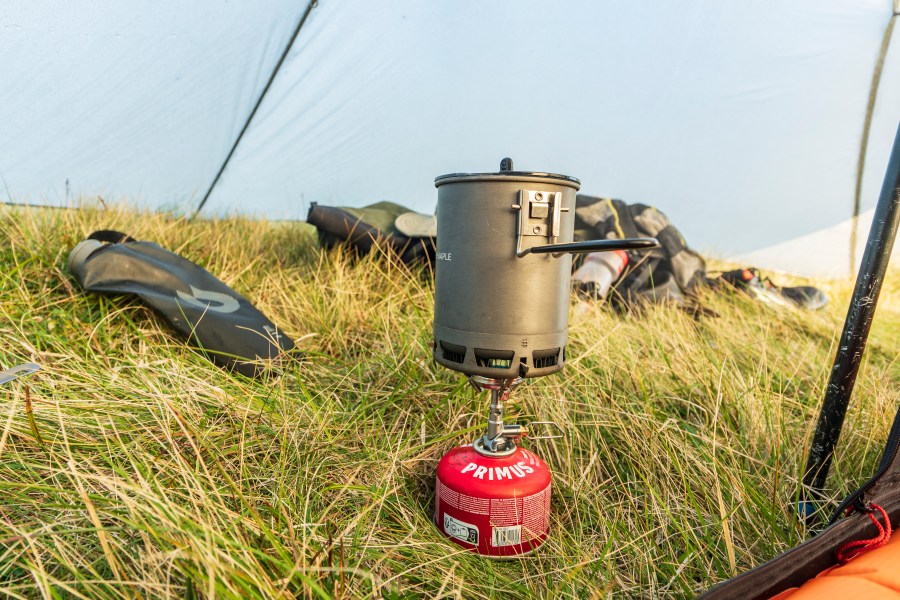
There’s no Piezo igniter, though a separate one is available. I don’t miss this as they are prone to failure. I always carry a fire steel and a lighter anyway. In calm controlled conditions the Micron took 3 minutes to boil 500ml of water in an MSR Titan 900ml titanium pot and 1 minute 45 seconds in a Fire Maple Petrel G2 aluminium heat exchanger pot, using 7 and 6 grams of fuel respectively. In real world use a Primus Power Gas 100g canister lasted 4 days with the stove, boiling around 4.5 litres in a heat exchanger pot before it was empty.
The power did fade as the canister emptied though water still boiled, it just took longer. The fuel consumption was higher than in the controlled tests, mainly due to the effect of wind. In the strongest winds I used a foil windscreen. Without it fuel consumption doubled though the wind was never strong enough to prevent boiling.