
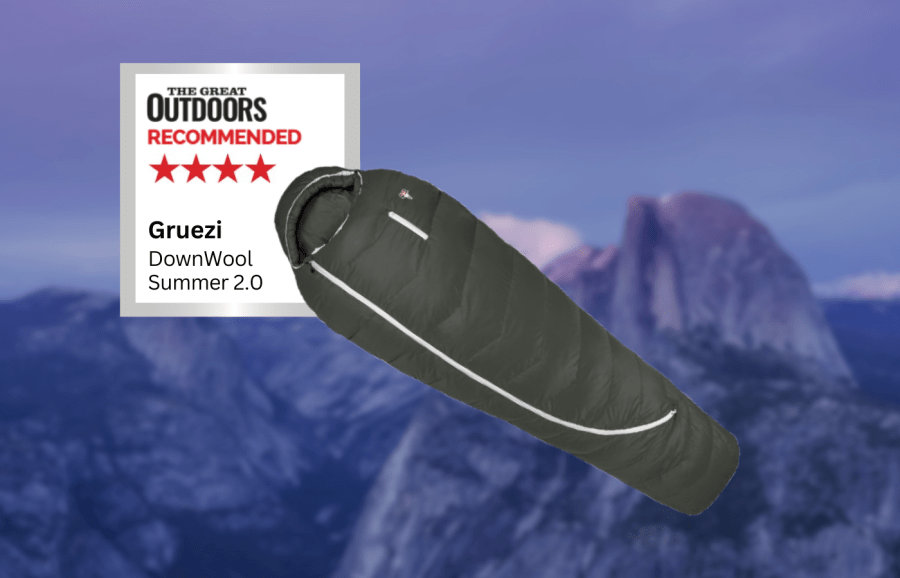
The Gruezi DownWool Summer 2.0 sleeping bag is a great choice for the damp British climate, says Steph Wetherell.
If eco-credentials are high up your list, or you want a down bag that is more resilient in a wet environment, the Gruezi DownWool Summer 2.0 sleeping bag offers an innovative solution to camping in a damp climate.
Steph Wetherell’s Greener Choice
A great choice for the damp British climate, and the eco-credentials are a real bonus on top of a well-designed and bag that performs across a range of temperatures.- Good in humid and damp environments
- A little heavier than some competitors
| Quick specs |
|---|
| Price: €300 / £305 (available from ultralightoutdoorgear.co.uk) Weight: Long: 998g including stuff sack (82g) Fill: Downwool 2.0. 70% 379g (long) 700FP RDS down, 30% Alpine wool Shell: Ultra-light 20 denier 380T nylon Construction: V shaped H box chambers Zip: 2-way curved full length autolock anti-snag zipper (right hand side) Length: 175cm (regular), 185cm (long), 200cm (extra long) Rating: 2 C (comfort), -3 C (limit) Sizes: Regular, long, extra long Women/Mens version: Unisex en.gz-bag.de |
The innovation at the heart of this bag is the Downwool, which as you might expect from the name, is made from 70% 700+ fill power down and 30% Alpine wool. Their newly updated Downwool 2.0 has provided further optimisation, giving the wool a down-like structure and loft. This means that their new bags provide a warmer sleep than previous models without adding additional weight.
One of the main advantages of the wool is that it absorbs moisture in the insulation, meaning the down itself doesn’t need to be treated with a DWR impregnation (which can be environmentally impactful) to provide water repellence. As someone who sleeps under a wool duvet at home, I liked the feel of the down wool bag – it feels less light and fluffy than a fully down bag, but not necessarily in a bad way.
Sustainable materials are at the heart of the construction with non-toxic dyes used, and a water-repellent treatment – BeSoDRY-ECO – which is a sustainable PFC finish on the shell. In addition the textiles have been tested to be free of over 1000 harmful substances according to the OEKO-TEX Standard 100. The fabric is maybe not quite as soft as some other sleeping bags, but it was still comfortable enough to sleep in, and feels robust and like it won’t easily snag.
The bag features a curved zip that is located along the side of the top of the bag, which I found made the bag easy to get in and out of. It crosses on top above your feet, and I found the two way zip made for easier foot venting than a zip at the side – I found that opening the zip provided a nice amount of ventilation and helped regulate my temperature.
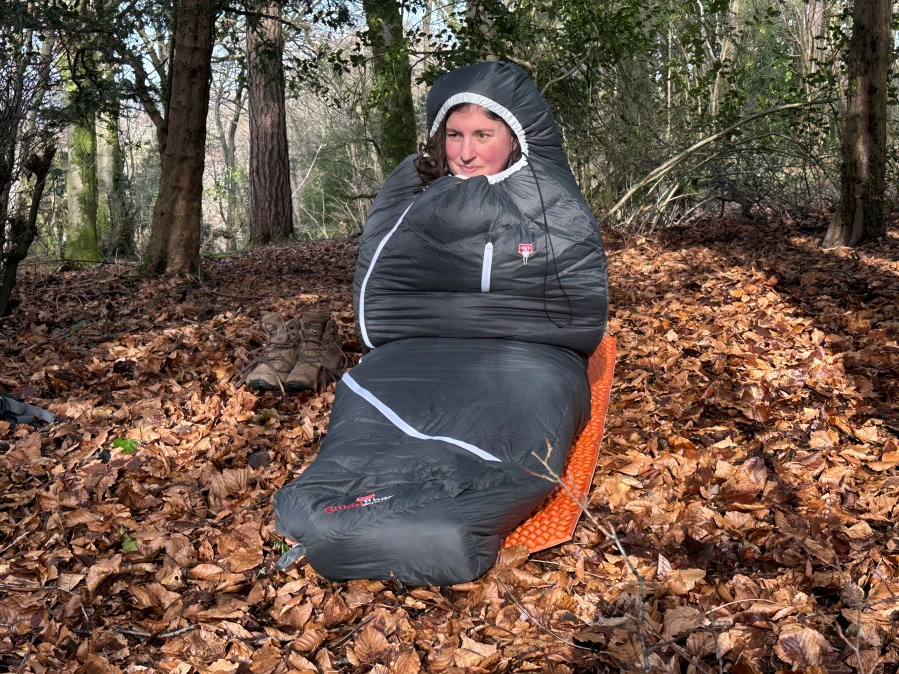
I tested the long length and found I had enough room as a size 20 person – I could turn over easily inside without feeling it was too tight. I tested the bag close to the comfort limit, and in some rather damp weather to boot and stayed warm throughout the night despite being a cold sleeper, but would probably opt for one of their warmer bags in colder temperatures. I also found that I didn’t overheat as much as I sometimes do in a pure down bag and my temperature regulated easily with some minor zip tweaks.
Another nice detail is the pillow pocket, a thin pouch in the hood that holds your pillow (or folded clothing) in place securely. There are also two pockets for valuables – a zipped one on the outside and a small velcro fastened internal pocket, which can be useful for keeping electronic devices from getting too cold. The one drawback for me was the stuff sack – it has two crossing straps to compress a bag rather than a hood closure, and I felt it could have compressed a bit smaller. However this is a simple upgrade you could make yourself if you felt this was worthwhile.
Overall this isn’t the lightest or smallest on the market but is a great choice for the damp British climate, and the eco-credentials are a real bonus on top of a well-designed and bag that performs across a range of temperatures.
How we tested
Steph tested these sleeping bags in South Wales during the autumn and spring months. She is a size 20 and 5’10 tall so favours a spacious bag, and is also a cold sleeper. She’s put together a guide to the best plus-size gear – and you can compare this model with other bag in our guide to the best sleeping bags.