
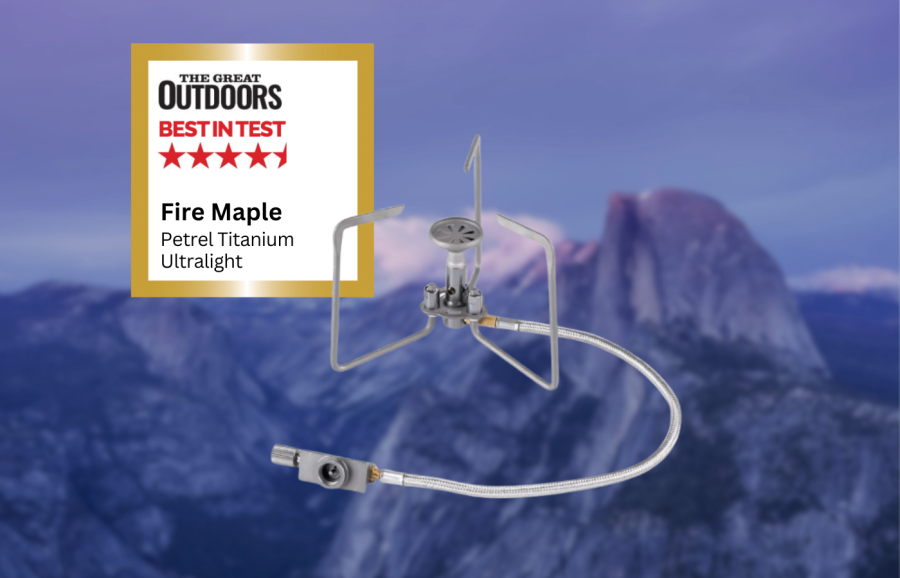
The Fire Maple Petrel Titanium Ultralight stove is awarded Best in Test by backpacking veteran, Chris Townsend. Find out why.
The Fire Maple Petrel is a very light remote canister stove – the only one I know of weighing under 100 grams.
Chris Townsend’s Best in Test
Overall, this is a lovely little stove that has quickly become a favourite.- ultralight
- low profile
- compact
- stable
- cost
- no pre-heat tube
| Quick Specs |
|---|
| Price: $31.96 | £43.34 (available from Fire Maple) Weight: 96g, 116g with windscreen Fuels: butane/propane Dimensions: packed 30mm x 100mm Burner Diameter: 25mm Power: 2.7KW, 9213 BTU Boil time: titanium pot 7min 10 sec, HX pot 5 min 10 sec Fuel used: titanium pot 11g, HX pot 6g firemaplegear.com |
It has a long hose to attach to the canister, which makes for a low profile and good stability. The burner can also be completely surrounded by a windshield (but note that the supplied one only wraps about two-thirds of the way). The low profile is good for cooking in small tent porches as well as being more stable than a canister top stove, especially with wider pots. It’s a neat little stove with combined legs/pot supports that fold flat and compact when not in use. The hose swivels under the burner so the canister can be moved with the stove lit. The flame control is on the canister not the stove so there’s no danger of burning your fingers when adjusting the flame. The burner is powerful and boils water fast. It simmers well too, though as with all remote stoves there’s a slight lag between turning the control and the flame changing.
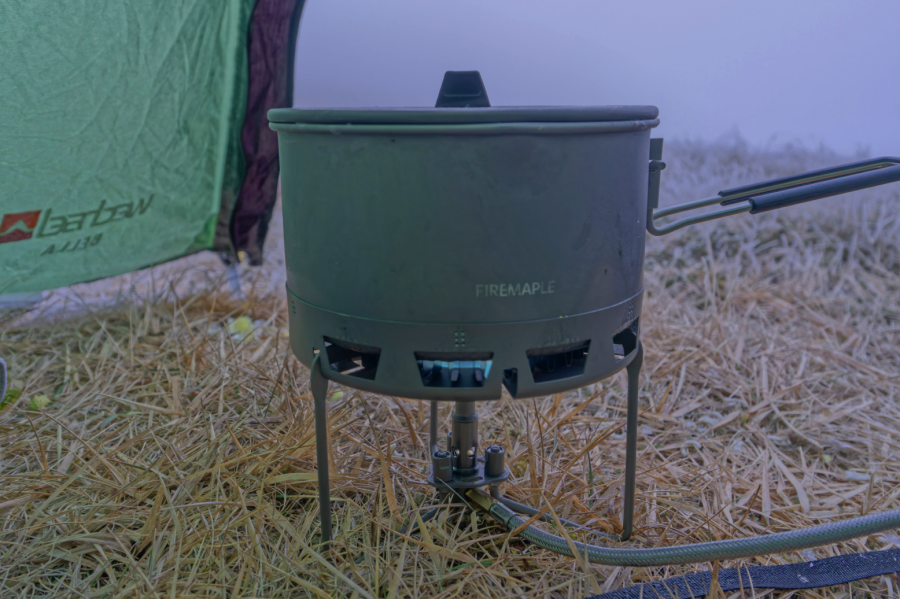
There’s no Piezo igniter so pack a lighter or fire steel. Sadly, there is no pre-heat tube, which makes the Petrel a three-season rather than four-season stove. However, I have used it in temperatures just below freezing and it worked okay with a heat exchanger pot. As the burner isn’t regulated, I did find that the power declined with a near-empty canister, although it still boiled water.
Overall, this is a lovely little stove that has quickly become a favourite.
How Chris tested
In the field, the stoves were used during the autumn and winter 2025-2026 on wild camps in the Scottish Highlands in temperatures ranging from 10c to below freezing. In controlled conditions, I boiled 500ml in the three canister stoves and 400ml in the meths/alcohol stove, in still air with a temperature of 2°C and with water at 7°C. With the two remote canister stoves, I compared a titanium MSR Titan Kettle and an aluminium Fire Maple Petrel G2 pot which has a heat exchanger (HX). The other two stoves tested at this time came with their own pots. Quoted boiling times indicate the power of the stove. I also measured how much fuel was used, perhaps more significant than boiling time, especially on multi-day walks. The results show that HX pots are more fuel efficient and reduce boil times.
THis review was first published in the May 2026 issue of The Great Outdoors. Compare it with others in our guide to the best stoves.